Bronchiolitis and respiratory syncytial virus (RSV): Nursing process (ADPIE)
Charlie Santos is a 2-month-old male who is brought to urgent care by his mother. She says that he has had a runny nose and an axillary temperature of 100.4 F, or 38 C, for the past two days.
This morning she noticed that he seemed to need to work harder to breathe, and she tells you he has been fussy and not feeding well. She also mentions that he attends daycare, and recently many of the children have been sick with similar symptoms.
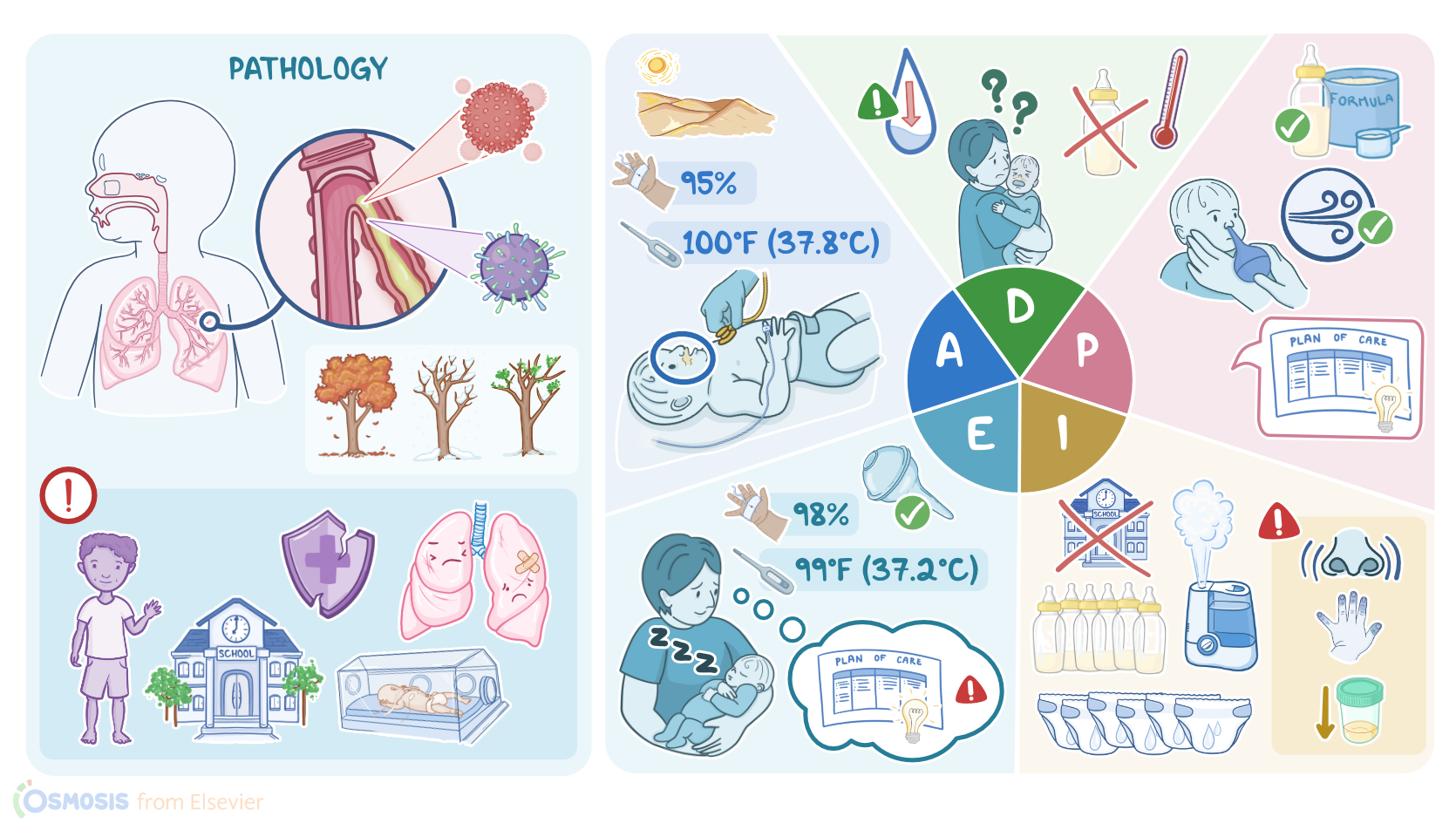
Based on Charlie’s clinical presentation and history, an infection with respiratory syncytial virus, or RSV, is suspected. The respiratory tract is divided into two parts; the upper airway, which consists of the nasal cavity, paranasal sinuses, pharynx, and larynx; and the lower airway, which consists of the trachea, bronchi, bronchioles, alveoli, and lungs.
Inflammation of the bronchioles, which are the smallest airways of the lungs, is known as bronchiolitis. It commonly occurs during the colder months, so fall, winter, and early spring, and it’s most often caused by the respiratory syncytial virus, or RSV for short.
Other causes include viruses like adenovirus, parainfluenza virus, or rarely from bacteria like Mycoplasma pneumoniae. Now, the most important risk factor for bronchiolitis is young age, since it mostly affects children under 2 years of age, with infants less than 3 months being at the highest risk.
Other risk factors include premature birth, attending crowded places like daycare, or having older siblings who can catch it in school. Finally, some underlying conditions may increase the risk of bronchiolitis, including chronic lung disease, congenital heart disease, or being immunocompromised.
Transmission of RSV typically occurs from direct contact with respiratory droplets when an infected person talks, sneezes, or coughs. These droplets can then land in the mouths or noses of people nearby, or be inhaled into their lungs.
| BRONCHIOLITIS AND RESPIRATORY SYNCTIAL VIRUS (RSV) | ||
| KEY POINTS | NOTES | |
| PATIENT REPORT |
| |
| PATHOPHYSIOLOGY |
| |
| DIAGNOSIS AND TREATMENT |
| |
| ASSESSMENT |
| |
| NURSING DIAGNOSES |
| |
| PLANNING |
| |
| IMPLEMENTATION |
| |
| EVALUATION |
| |
- "Ackley and Ladwig’s Nursing Diagnosis Handbook: An Evidence-Based Guide to Planning Care, 13th edition" Mosby (2022)
- "Rhinovirus Type in Severe Bronchiolitis and the Development of Asthma" J Allergy Clin Immunol Pract (2020)
- "Effectiveness of Targeted Interventions on Treatment of Infants with Bronchiolitis: A Randomized Clinical Trial" JAMA Pediatr (2021)
- "Bronchiolitis therapies and misadventures" Paediatr Respir Rev (2023)
- "Harrison’s Principles of Internal Medicine, 21st edition" McGraw Hill / Medical (2022)
- "Bronchiolitis" CMAJ (2022)
- "Recent advances in the understanding of bronchiolitis in adults" F1000Res (2020)
- "Critical Care Nursing: Diagnosis and Management, 9th edition" Elsevier (2021)
Aún no hay notas para este video
Intenta agregar una nota a continuación