Case study - Dementia: Nursing
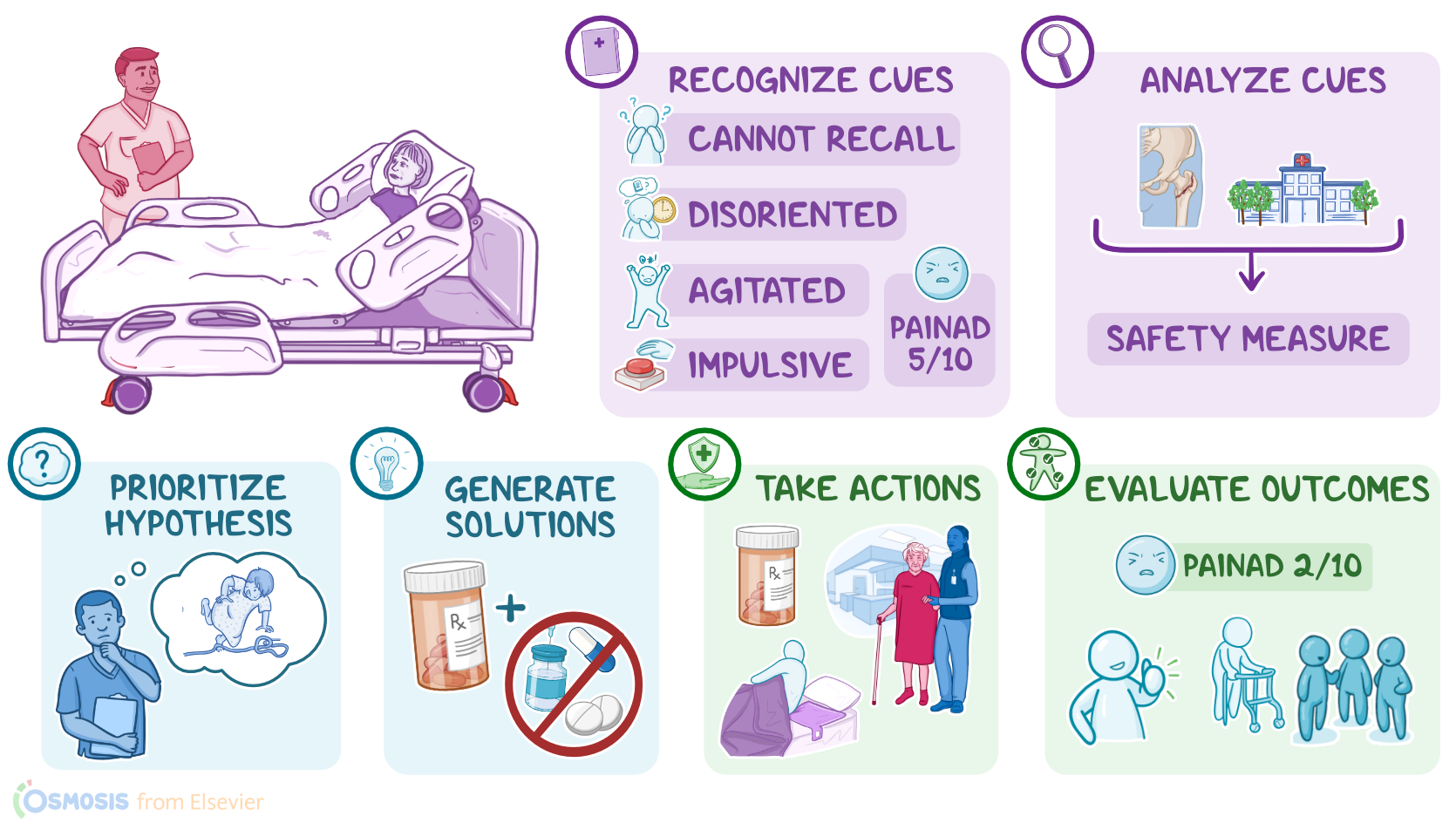
Nurse Darian works on an inpatient orthopedic floor and is caring for Rosemary, an 84-year-old female with a history of Alzheimer disease who was admitted for a hip fracture. After settling Rosemary in her room, Nurse Darian goes through the steps of the Clinical Judgment Measurement Model to make clinical decisions about Rosemary’s care by recognizing and analyzing cues, prioritizing hypotheses, generating solutions, taking action, and evaluating outcomes.
First, Nurse Darian recognizes important cues, including Rosemary’s inability to recall her daughter’s name, and disorientation to date and time. He also notices that Rosemary becomes agitated when asked several questions in a row; and as the evening progresses, she becomes more impulsive, and tries to get out of bed on her own.
Next, Nurse Darian analyzes these cues. He recalls that Rosemary’s dementia can be exacerbated by illness, such as her hip fracture, and changes to her familiar environment, and he realizes Rosemary needs effective safety management. After reviewing her electronic health record, or EHR, he enters Rosemary’s room.
Nurse Darian: Hi Rosemary, my name is Nurse Darian. I was your nurse yesterday and I'll be your nurse again today.
Rosemary: I've never met you.
Nurse Darian: That’s okay, Rosemary. Are you having any pain right now?
Rosemary: Why does everyone have so many questions all the time?
Nurse Darian notes that Rosemary begins to sit up in bed and tries to swing her legs to the side of the bed to stand up. The two siderails by Rosemary’s head are up, as well as one siderail by her feet. She then moves towards the open space in the bed to exit, so Nurse Darian moves to prevent her from getting up on her own.
Nurse Darian: Careful there. Let’s get you comfortable and back in bed safely Rosemary. We can put your favorite show on the television.
Rosemary: Okay.
| CASE STUDY - DEMENTIA | ||
| KEY POINTS | NOTES | |
| INTRODUCTION |
| |
| RECOGNIZING AND ANALYZING CUES |
| |
| PRIORITIZING HYPOTHESES, GENERATING SOLUTIONS, AND TAKING ACTIONS |
| |
| EVALUATING OUTCOMES |
| |
- "Lewis's medical-surgical nursing: Assessment and management of clinical problems. (12th ed.)" Elsevier (2022)
- "Medical-surgical nursing: Concepts for interprofessional and collaborative care. (10th ed.)" Elsevier (2021)
- "Lewis’s medical-surgical nursing in Canada: Assessment and management of clinical problems. (5th ed.)" Elsevier (2023)
Aún no hay notas para este video
Intenta agregar una nota a continuación