Case study - Healthcare-associated infection (HAI): Nursing
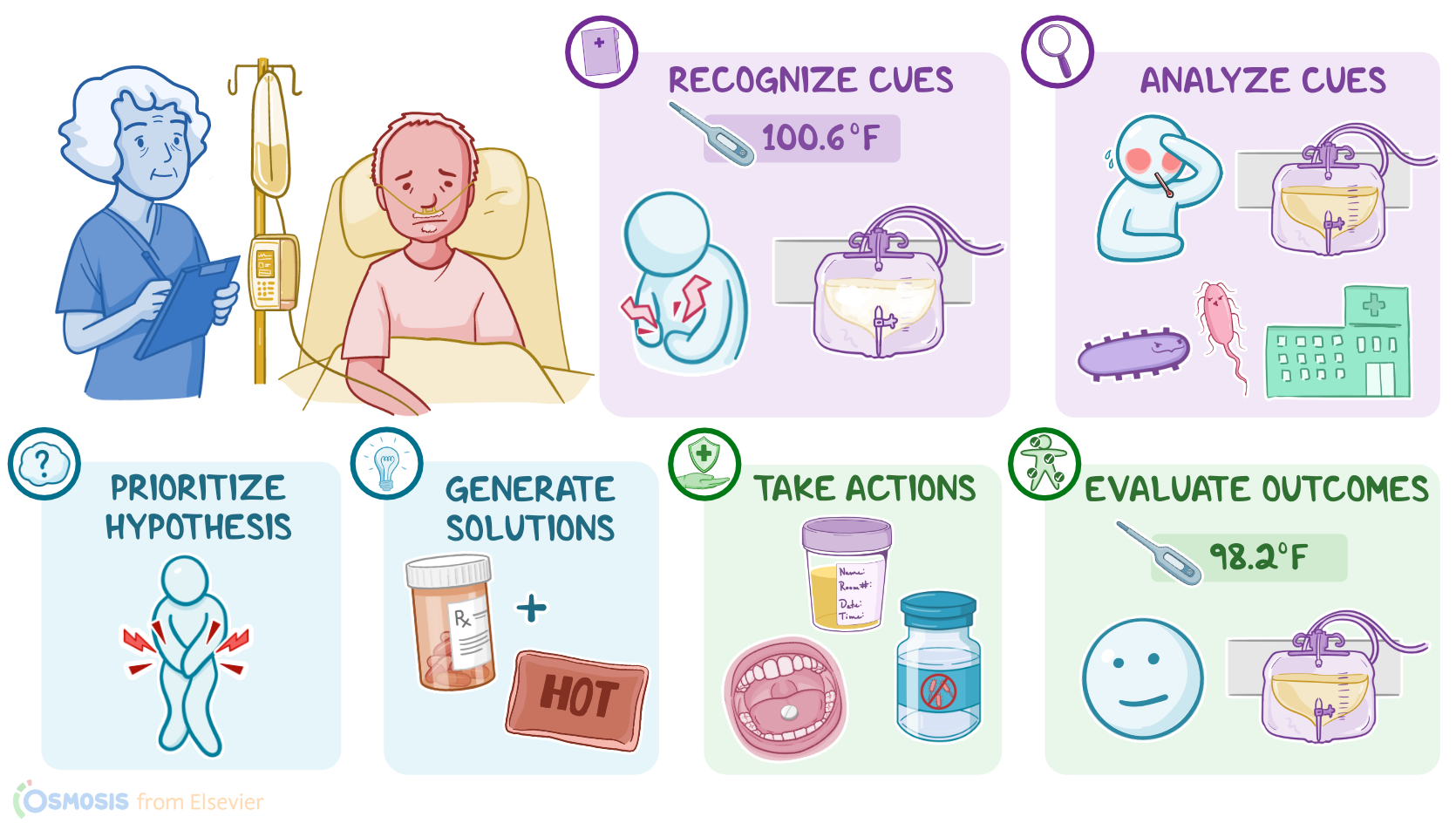
Nurse Monique begins her shift on a medical-surgical unit caring for Sam, a 78-year-old male who was admitted two days ago for chronic heart failure. After introducing herself, Nurse Monique begins her shift assessment and goes through the steps of the Clinical Judgment Measurement Model to make clinical decisions about Sam's care by recognizing and analyzing cues, prioritizing hypotheses, generating solutions, taking action, and evaluating outcomes.
First, Nurse Monique recognizes important cues. First, she notices Sam has an indwelling urinary catheter, which is draining cloudy urine. Then, she takes his vital signs and notes his temperature is 100.6 F, or 38.1 C. She palpates Sam’s abdomen, which elicits suprapubic pain that Sam rates as a 4 out of 10. He also reports that he didn’t have this type of pain until this morning.
Next, Nurse Monique analyzes these cues. She reviews the electronic health record, or EHR, which shows Sam’s vital signs during the previous shift were within normal limits and his urine was clear. Nurse Monique knows that due to Sam’s increased age and presence of an indwelling catheter, he's at high risk for a health care-associated infection, or HAI, which is an infection that develops from exposure to microorganisms in a health care setting.
Nurse Monique considers these risk factors along with Sam’s new onset of fever, pain, and cloudy urine. She suspects that Sam is experiencing a type of HAI known as a catheter-associated urinary tract infection, or CAUTI.
Now, using the information Nurse Monique has gathered, she chooses a priority hypothesis of impaired urinary elimination.
Then, she generates solutions to address this hypothesis that will include pharmacologic and nonpharmacologic interventions. She also establishes the expected outcome, that after intervention, Sam’s temperature will be within normal range, and his symptoms of CAUTI will improve.
Next, Nurse Monique takes action to implement these solutions. She calls the health care provider to report her assessment findings. The health care provider orders a urinalysis, a urine culture, and prescribes 650 milligrams of acetaminophen by mouth every four hours as needed for pain and fever. While waiting for the pharmacy to approve the new medication, she gathers supplies needed to obtain the urine specimens and enters Sam’s room.
Nurse Monique: The symptoms you’re having might be due to a urinary tract infection, so your health care provider has ordered some urine tests, and some acetaminophen for the pain and fever. I also brought a heat pack for your abdomen, which can help you feel more comfortable.
Sam: How did I get a urinary tract infection?
Nurse Monique: Well, when a patient has a urinary catheter, it gives bacteria a pathway to bypass the body’s normal defenses and cause an infection. Your health care provider will order an antibiotic to help get rid of the infection, so let's get those samples sent to the lab.
Sam nods in agreement.
| CASE STUDY - HEALTHCARE-ASSOCIATED INFECTION (HAI) | ||
| KEY POINTS | NOTES | |
| INTRODUCTION |
| |
| RECOGNIZING AND ANALYZING CUES |
| |
| PRIORITIZING HYPOTHESES, GENERATING SOLUTIONS, AND TAKING ACTIONS |
| |
| EVALUATING OUTCOMES |
| |
- "Lewis's medical-surgical nursing: Assessment and management of clinical problems (12th ed.)" Elsevier (2022)
- "Medical-surgical nursing: Concepts for interprofessional and collaborative care (10th ed.)" Elsevier (2021)
Aún no hay notas para este video
Intenta agregar una nota a continuación