Case study - Personality disorder: Nursing
Revisores de contenido
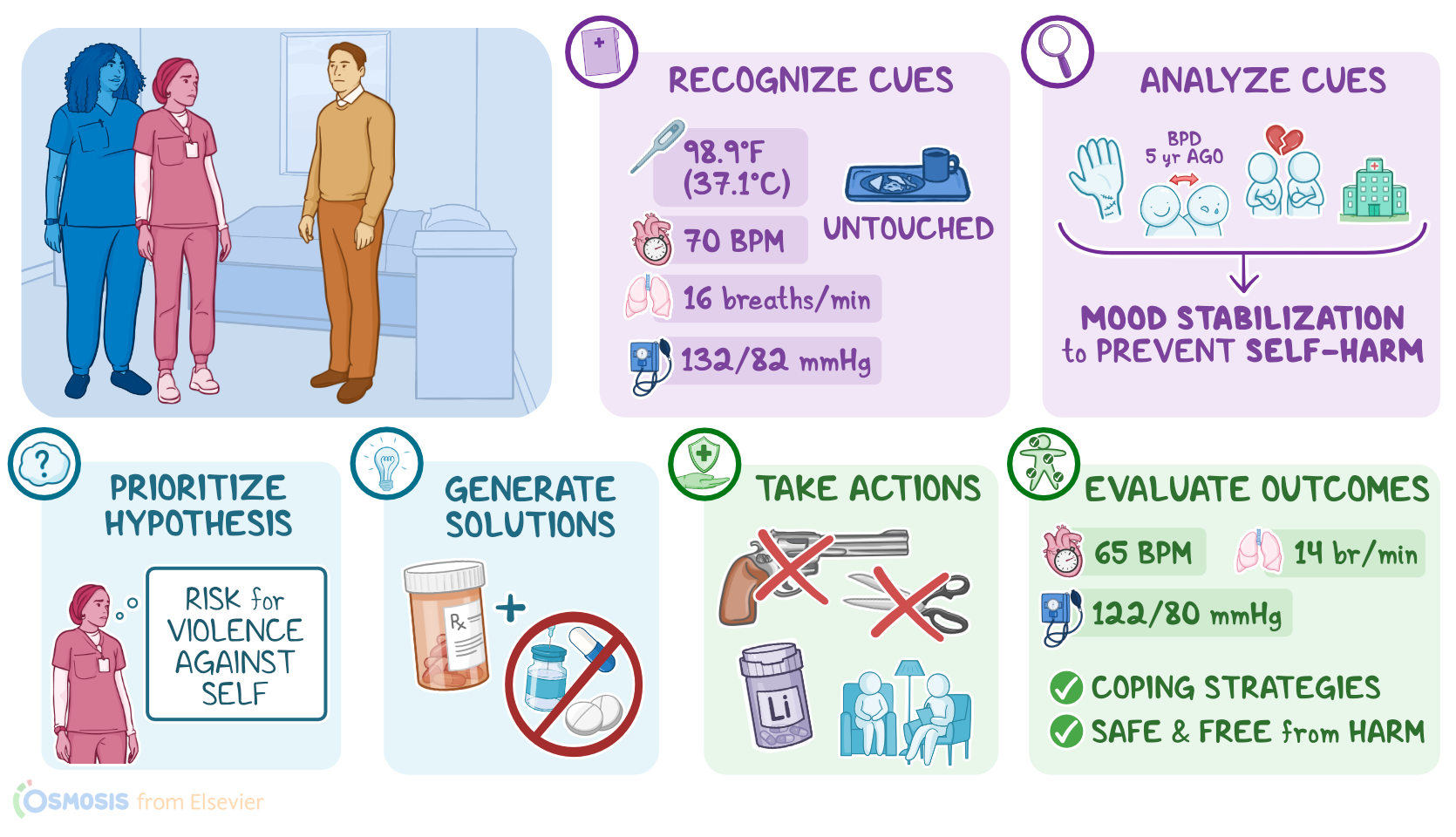
Nurse Amirah works on an inpatient psychiatric unit and is caring for Yang, a 42-year-old with a history of borderline personality disorder, who was admitted a week ago for self-harm ideation following a breakup with his partner. In collaboration with the registered nurse, RN Francie, Nurse Amirah goes through the steps of the Clinical Judgment Measurement Model to make clinical decisions about Yang’s care by recognizing and analyzing cues, prioritizing hypotheses, generating solutions, taking action, and evaluating outcomes.
First, Nurse Amirah recognizes important cues, including Yang’s vital signs, which are temperature 98.9 F or 37.1 C, heart rate 70 beats per minute, respirations 16 breaths per minute, and blood pressure 132/82 mmHg. She notes that Yang’s breakfast tray is untouched on the bedside table.
Nurse Amirah: Hi Yang, I noticed you haven’t eaten your breakfast. How are you doing today?
Yang: Sorry, no offense, but that food is disgusting. I’m good, actually, and I’m happy I don’t have a sitter anymore. I’m ready to pack up my stuff and go home.
Nurse Amirah: I’m glad you feel ready for discharge. To make sure you’re safe to leave, Nurse Francie and I need to gather some information and give you your medicine.
Yang: I know, I know. I’m still sad my boyfriend broke up with me, but I’m able to talk about it now. I have other people in my life that care about me, so I feel less alone.
Nurse Amirah: That’s good to hear.
Next, Nurse Amirah analyzes these cues. She reviews the electronic health record, or EHR, and notes Yang was diagnosed with borderline personality disorder, or BPD, five years ago, and has been hospitalized for self-harm ideation in the past.
Nurse Amirah reviews the progress notes and sees that following the breakup between Yang and his partner, Yang called his sister and told her he wanted to commit suicide. His sister then called the emergency services, and he was taken to the hospital.
Nuse Amirah recognizes that BPD is a condition where individuals have unstable moods and relationships. Those with BPD may also experience fear of abandonment, which leads to threats of self-harm to keep someone from leaving them. Nurse Amirah recognizes that Yang needs continued mood stabilization to prevent self-harm.
Now, using the information she's gathered, along with Yang’s medical history, Nurse Amirah reports her findings to RN Francie, and together they choose a priority hypothesis of risk for violence against self.
Then, Nurse Amirah collaborates with RN Francie to generate solutions to address Yang’s altered safety that will include pharmacologic and nonpharmacologic interventions; and they establish the expected outcome that after intervening, Yang will continue to use coping strategies to remain safe and free from injury.
Nurse Amirah then takes action to implement these solutions. First, she confirms Yang’s room remains free from items that he could use to harm himself. She also notes that Yang is scheduled for his prescribed mood stabilizer. She gathers the supplies and enters Yang’s room.
| CASE STUDY - PERSONALITY DISORDER | ||
| KEY POINTS | MY NOTES | |
| INTRODUCTION |
| |
| RECOGNIZING AND ANALYZING CUES |
| |
| PRIORITIZING HYPOTHESES, GENERATING SOLUTIONS, AND TAKING ACTION |
| |
| EVALUATING OUTCOMES |
| |
- "Foundations of mental health care. (8th ed.)" Elsevier (2023)
Aún no hay notas para este video
Intenta agregar una nota a continuación