Diabetes mellitus (DM): Nursing process (ADPIE)
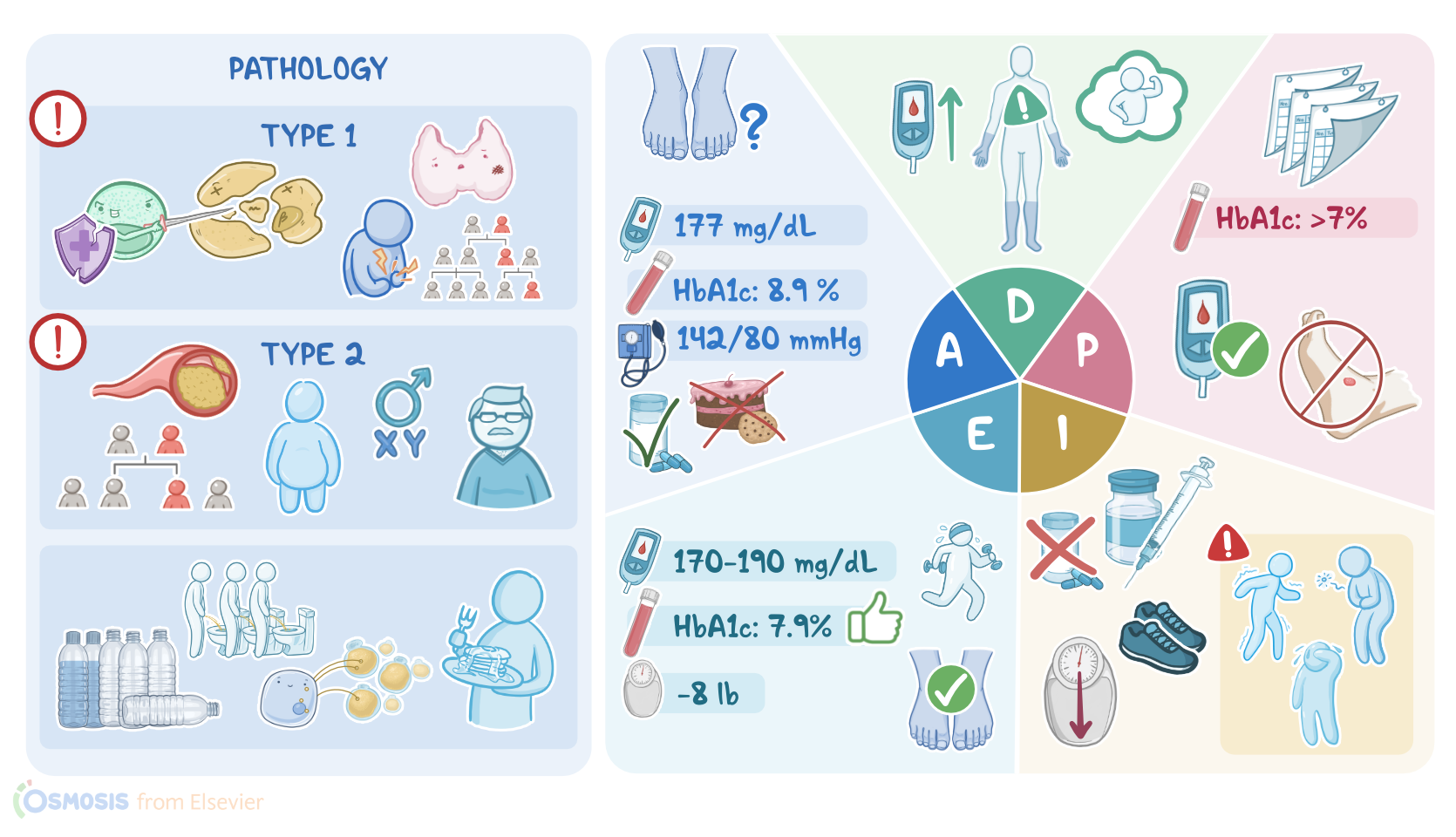
Harold Owl is a 63-year-old male client with a history of type 2 diabetes who is referred to the endocrinology clinic by his primary care provider for evaluation.
Mr. Owl takes the biguanide metformin and sulfonylurea glyburide to manage his diabetes, but his latest hemoglobin A1c, or HbA1c test, was 8.9% and he has recently developed numbness in his feet.
In diabetes mellitus, commonly just called diabetes, the body has trouble moving glucose from the blood into the tissue cells.
As a result, cells starve for energy despite having high blood glucose levels, which is called hyperglycemia.
Normally, high blood glucose stimulates the pancreatic beta cells to produce and secrete the hormone insulin, which in turn reduces blood glucose by stimulating the uptake of glucose into the cells. In diabetes, the blood glucose stays high because insulin’s function is impaired.
There are two main types of diabetes. In type 1 diabetes, there’s autoimmune destruction of the pancreatic beta cells, so they can’t produce and secrete insulin.
The exact cause of type 1 diabetes is unknown, but it’s thought to have a genetic and environmental component, and risk factors include personal or family history of type 1 diabetes, as well as celiac disease, and thyroid disease.
The onset is usually abrupt, generally appears before the age of 30, and is most often diagnosed during childhood or puberty.
On the other hand, in type 2 diabetes, the pancreas is able to produce and secrete insulin, but the tissue cells tend to be insulin resistant, meaning they are unable to respond well to insulin stimulation.
Type 2 diabetes is associated with risk factors, like male sex, increasing age, or having a first degree relative with type 2 diabetes, a body mass index or BMI over 25, a sedentary lifestyle, or a cardiovascular disease like hypertension.
With type 2 diabetes, the symptoms usually begin after the age of 45, and gradually worsen over a few months.
Classic symptoms of both type 1 and type 2 diabetes include polyuria, which means that individuals urinate frequently, which is associated with polydipsia, which means they are constantly thirsty and drink a lot of water.
| DIABETES MELLITUS | ||
| KEY POINTS | NOTES | |
| PATIENT REPORT |
| |
| PATHOPHYSIOLOGY |
| |
| DIAGNOSIS AND TREATMENT |
| |
| ASSESSMENT |
| |
| NURSING DIAGNOSES |
| |
| PLANNING |
| |
| IMPLEMENTATION |
| |
| EVALUATION |
| |
- "Ackley and Ladwig’s Nursing Diagnosis Handbook: An Evidence-Based Guide to Planning Care, 13th edition" Mosby (2022)
- "Genetics of diabetes mellitus and diabetes complications" Nat Rev Nephrol (2020)
- "Harrison’s Principles of Internal Medicine, 21st edition" McGraw Hill / Medical (2022)
- "Definition, Classification and Diagnosis of Diabetes Mellitus" Exp Clin Endocrinol Diabetes (2019)
- "Diabetes, cardiovascular disease and the microcirculation" Cardiovasc Diabetol (2021)
- "Critical Care Nursing: Diagnosis and Management, 9th edition" Elsevier (2021)
Aún no hay notas para este video
Intenta agregar una nota a continuación