Venous thromboembolism (VTE): Nursing process (ADPIE)
Video summary
Venous thromboembolism (VTE) is a condition where blood clots form in the veins, typically in the legs or pelvis, and can travel to the lungs, causing a pulmonary embolism (PE).
There are three main factors that lead to abnormal formation of clots, which are known as the Virchow's triad. They include venous stasis; a state of hypercoagulation; and damage to the endothelial cell lining. Venous stasis is said when blood doesn't flow appropriately in the veins due to prolonged periods of physical inactivity. Endothelial injury can occur when there is an injury or trauma to a blood vessel such as in trauma or surgery; and finally, hypercoagulable states can be seen in certain conditions like cancer and pregnancy.
Symptoms of VTE can include pain, swelling, warmth, and redness in the affected area, as well as shortness of breath, chest pain, and coughing up blood in the case of PE. The treatment involves thrombolytics to help break down the clot, or a thrombectomy, which is an intervention that aims to surgically remove the clot. Long-term treatment to prevent future thrombi from forming can include staying physically active, wearing compression stockings, and anticoagulant medications like warfarin or heparin.
Revisores de contenido
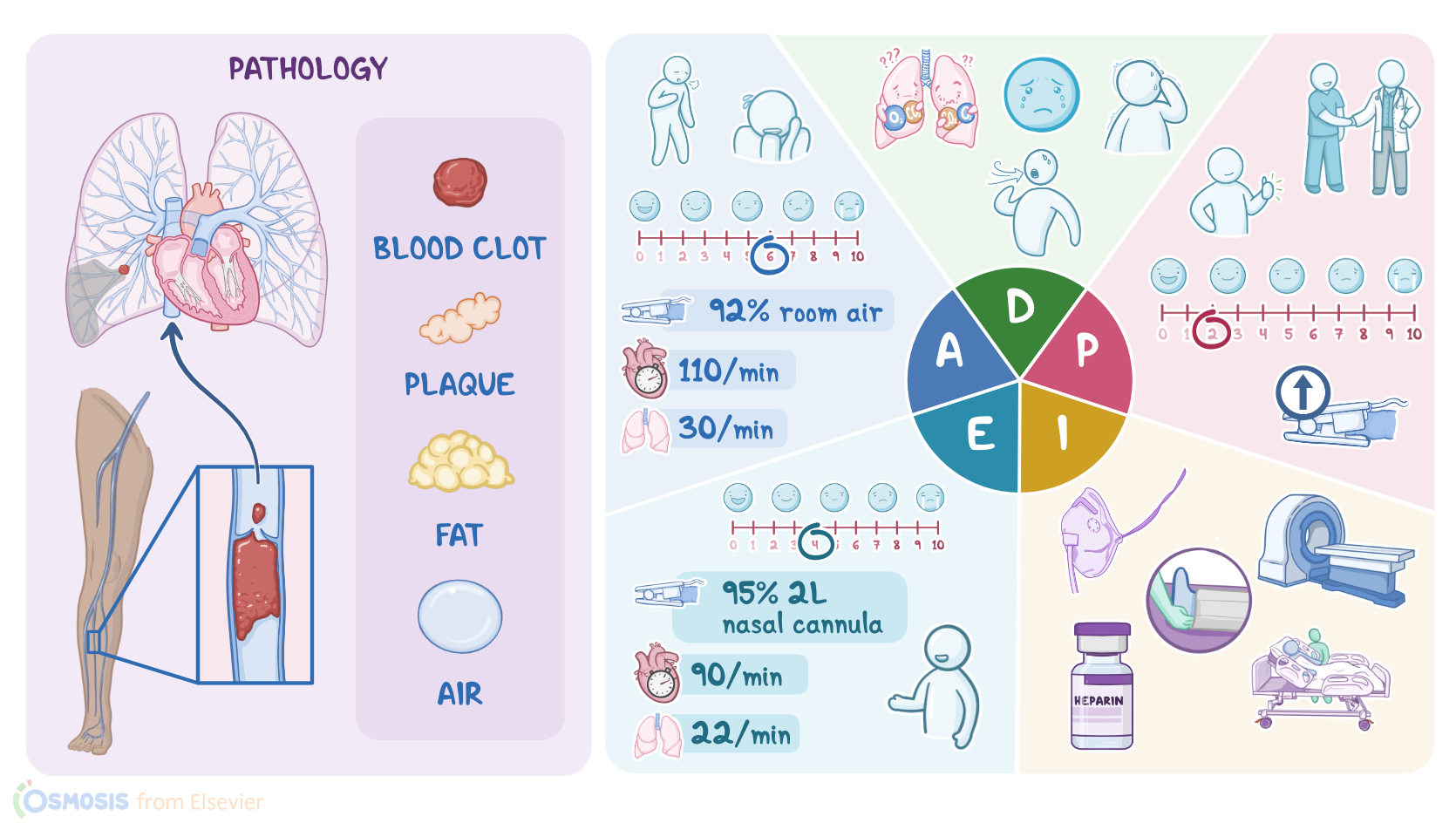
Renata Gutierrez is a 34-year-old woman who came to the Emergency Department, or ED, with her partner, because of shortness of breath, chest pain, and coughing up blood-tinged sputum. The triage nurse informs you that Ms. Gutierrez delivered a healthy full-term baby by cesarean section one week ago. She has no other significant past medical history.
Venous thromboembolism, or VTE, refers to a clot that starts in a vein.
Specifically, a pulmonary embolism, or PE, occurs when an embolus, which is a small mass that could be a blood clot, fat, or even an air bubble, becomes lodged in the pulmonary artery and obstructs the pulmonary circulation. Most often the embolus is a blood clot associated with deep vein thrombosis, or DVT, which is when a clot forms in a large vein, usually in the leg or pelvis. The clot can break off and travel up the inferior vena cava to the right atrium, into the right ventricle, and finally into the pulmonary artery. This causes decreased blood flow to the lung tissue and impaired oxygenation.
Factors that increase the risk of a pulmonary embolism are summarized in Virchow triad, which include slowed blood flow, or venous stasis, hypercoagulation, meaning the blood is more likely to form clots, and damage to the endothelial lining of a blood vessel. Venous stasis can occur because of prolonged immobility like during a severe illness or after surgery, when an enlarged uterus compresses the nearby veins during pregnancy, or due to long-haul travel. Hypercoagulability can be caused by clotting disorders, use of oral contraceptives, smoking, and it occurs normally during pregnancy. And lastly, damage to the endothelial cell lining of a blood vessel can be the result of trauma or surgery.
| VENOUS THROMBOEMBOLISM (VTE) | ||
| KEY POINTS | NOTES | |
| PATIENT REPORT |
| |
| PATHOPHYSIOLOGY |
| |
| DIAGNOSIS AND TREATMENT |
| |
| ASSESSMENT |
| |
| NURSING DIAGNOSES |
| |
| PLANNING |
| |
| IMPLEMENTATION |
| |
| EVALUATION |
| |
- "Inflammation, Infection and Venous Thromboembolism. 128(12):2017-2036. " Circ Res. (2021)
- "Management of venous thromboembolism in pregnancy. 211:106-113. " Thromb Res (2022)
- "Long-term treatment of venous thromboembolism. 135(5):317-325. " Blood (2020)
- "Harrison’s Principles of Internal Medicine. 21st edition. ISBN: 978-1-264-26850-4 " McGraw Hill / Medical (2022)
- "Epidemiology and prevention of venous thromboembolism. 20(4):248-262. " Nat Rev Cardiol. (2023)
- "American Society of Hematology 2021 guidelines for management of venous thromboembolism: prevention and treatment in patients with cancer. 5(4):927-974. " Blood Advances. (2021)
- "Robbins & Kumar Basic Pathology. 11th edition. ISBN: 978-0-323-79018-5 " Elsevier (2022.)
Aún no hay notas para este video
Intenta agregar una nota a continuación