Vital signs - Pediatric pain: Nursing skills
Pain is a feeling of discomfort and an emotional experience that is a common occurrence in children of all ages. To provide optimal pain management, the nurse must perform age-appropriate pain assessments and interventions.
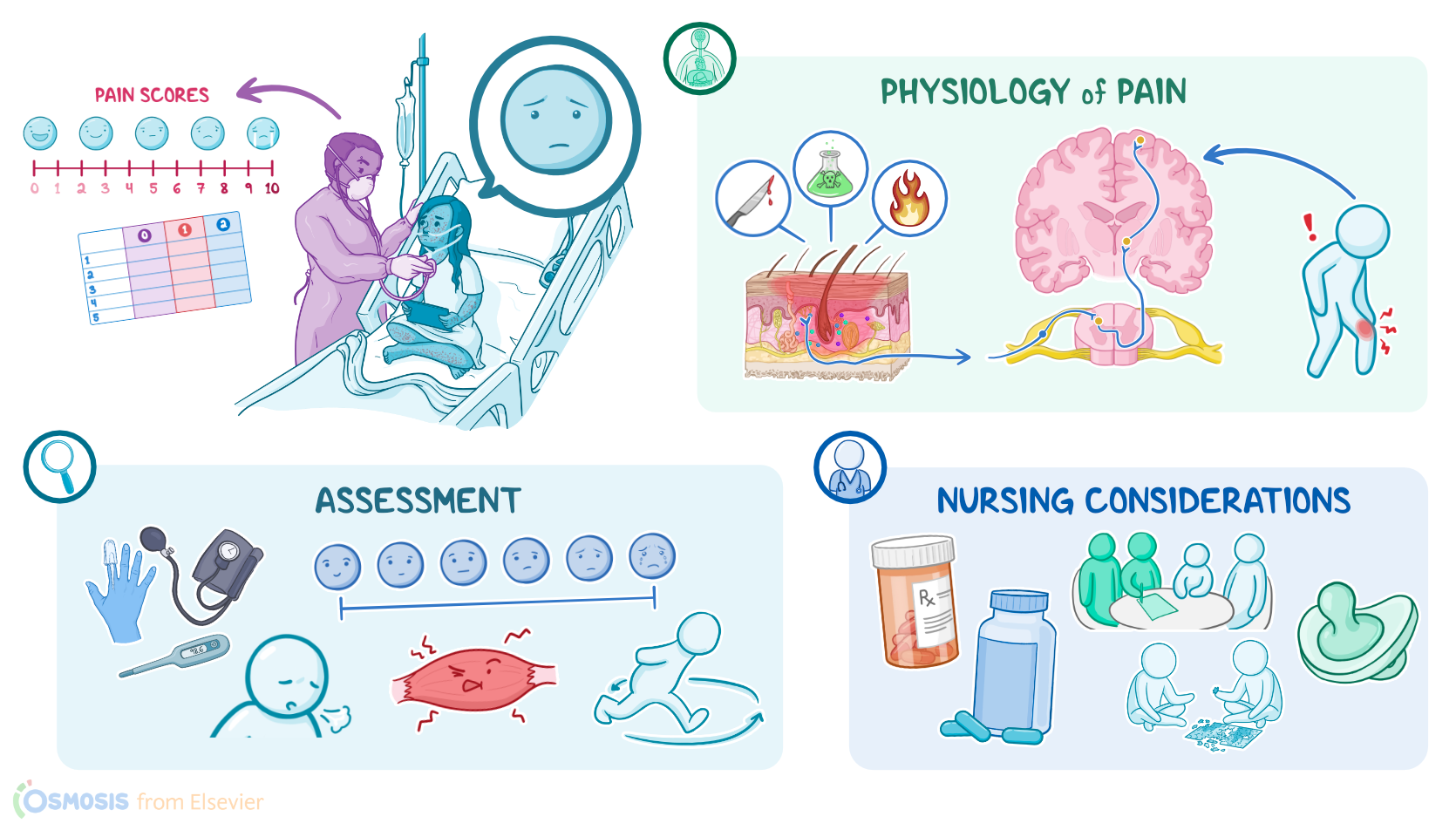
Now, pain starts with a stimulus that can be mechanical, chemical, or thermal, which causes damage to tissue, and triggers the release of molecules like prostaglandins, histamine, and bradykinin. Special pain receptors called nociceptors are activated by these molecules, and in response, they initiate an action potential that’s transmitted from the site of injury to the cortex of the brain. Once it reaches the cortex, the patient experiences the pain and its characteristics, like its location and intensity, and an emotional response to the pain occurs.
The first step in assessing your patient’s pain is by understanding their previous experience with pain. Then, to assess the severity of their pain, use a pain assessment tool. The choice of a pain assessment tool depends on the child’s age, cognitive development, and ability to communicate. Usually, older school-age children can report their pain numerically on a zero to ten scale, with zero meaning no pain, and ten meaning the worst pain they can imagine.
There’s also a verbal scale which allows children to describe their pain using adjectives, like “mild,” “moderate,” and “severe.” In addition, the Wong-Baker FACES Pain Rating Scale uses faces, each representing a level of pain, where the child points to the face that depicts how they feel.
During your assessment, remember that the most reliable indicator of pain is your patient’s own report of pain, but there may be times that you’ll need to base your pain assessment on observing your patient’s behaviors and nonverbal cues such as irritability, restlessness, grimacing, and moaning in situations where they are not able to verbalize their pain.
For example, the Premature Infant Pain Profile, known as PIPP, is a scoring system for preterm infants that uses facial expressions, behaviors, and vital signs to determine pain level.
| VITAL SIGNS - PEDIATRIC PAIN | ||
| KEY POINTS | NOTES | |
| DEFINITION |
| |
| PHYSIOLOGY OF PAIN |
| |
| ASSESSMENT |
| |
| NURSING CONSIDERATIONS |
| |
- "Wong’s essentials of pediatrics. (11th ed.)" Elsevier (2022)
- "Wong’s nursing care for infants and children. (11th ed.)" Elsevier (2019)
Aún no hay notas para este video
Intenta agregar una nota a continuación