Osmosis video - Renal and urinary calculi: Nursing
Learn deeper with Osmosis
Master this topic faster with videos, questions, and AI.
Used by 8M+ healthcare learners.
No credit card · Cancel anytime
00:00 / 00:00
Video Summary of Renal and urinary calculi: Nursing
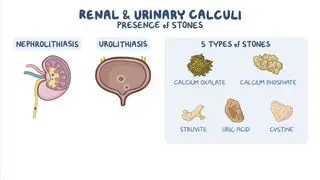
Nephrolithiasis and urolithiasis refer to stones, also called calculi, in the kidney and urinary tract, respectively. They form when solutes in the urine precipitate out and crystallize. Depending on the type of precipitated solute forming the stone, there are five main types of stones: calcium oxalate, calcium phosphate, struvite, uric acid, and cystine stones. Renal and urinary stones can cause urinary tract obstruction, infection, and even hydronephrosis, which can lead to permanent kidney damage.
Even though people with renal and urinary stones may be asymptomatic, common symptoms include renal colic and flank pain. The pain is often sharp, sudden, and severe enough that it may trigger nausea, vomiting, pallor, and sweating. There may also be hematuria, dysuria, urinary urgency and frequency, and signs of infection.
The diagnosis involves a history and physical assessment, followed by lab exams such as urinalysis and blood studies, as well as imaging like CT and ultrasound. Treatment includes medications to treat pain and surgery in some severe cases. There are also other procedures like extracorporeal shock wave lithotripsy (ESWL), which uses high-energy sound waves to break these stones into smaller fragments able to be passed in the urine. Increased fluid intake and dietary changes may be recommended to prevent stone formation in the future.