
Cushing Syndrome · What Is It, Causes, Treatment, and More

Published: Oct 07, 2025
Author: Corinne Tarantino, MPH
Editor: Alyssa Haag, MD
Editor: Emily Miao, MD, PharmD
Editor: Ahaana Singh
Editor: Kelsey LaFayette, DNP, ARNP, FNP-C
Editor: Lahav Constantini, MD
Illustrator: Jillian Dunbar
Copyeditor: David G. Walker
7-day free trial

Go deeper with Osmosis

Osmosis is a learning platform with videos, questions, and AI tools to help you master topics like this.

4.8 · 12,000+ reviews
Watch quick, visual videos
Practice with Qbank-style questions
Use AI to explain, quiz, and review
Study anytime with the mobile app
Start free trial

No credit card · Cancel anytime

What is Cushing syndrome?

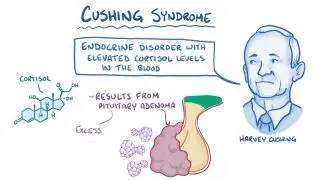
Cushing syndrome, also called hypercortisolism, is a set of symptoms resulting from exposure to high levels of the hormone cortisol. Cortisol is typically produced in response to stress; it helps regulate blood pressure and blood sugar, reduce inflammation, and metabolize food.   

Cortisol production and release is stimulated by a series of interactions with other hormones. First, the hypothalamus secretes corticotropin-releasing hormone (CRH) which then stimulates the anterior pituitary gland to produce adrenocorticotropic hormone (ACTH). Ultimately, ACTH signals cortisol production from the adrenal glands, which are small glands located on top of each kidney. 

Learn deeper with Osmosis

Master this topic faster with videos, questions, and AI.

Used by 8M+ healthcare learners.

Start free trial

No credit card · Cancel anytime

What is the difference between Cushing disease and Cushing syndrome?

Cushing disease occurs when Cushing syndrome is caused by an ACTH-producing pituitary tumor, whereas Cushing syndrome is the set of symptoms that results when there is a surplus of cortisol in the body. In other words, Cushing syndrome can be caused by any exposure to surplus cortisol whether it be endogenous, meaning cortisol from within the body, or exogenous, or from outside the body. Whereas Cushing disease is a type of Cushing syndrome that can only be caused by increased cortisol levels resulting from an ACTH-producing pituitary tumor 

What causes Cushing syndrome?

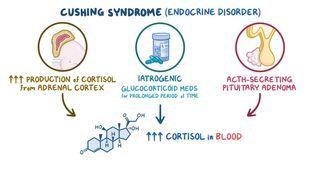
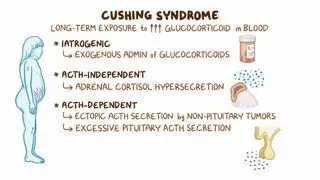
There are many potential causes of Cushing syndrome. The most common is long-term use of glucocorticoids, such as prednisone or dexamethasone, which are typically used to treat inflammatory disorders, like asthma, rheumatoid arthritis,or lupus. Glucocorticoids act as a synthetic form of cortisol, therefore long-term use can lead to Cushing syndrome.  

Less frequently, Cushing syndrome may develop due to a tumor that affects the hormones involved in stimulating cortisol production. Pituitary tumors that produce ACTH in excess, as seen in Cushing disease, are the most common tumor type. Sometimes, ectopic ACTH-producing tumors (i.e., tumors that secrete ACTH outside of the pituitary gland) may occur, such as in the lungs or pancreas, and are often cancerous.

Rarely, Cushing syndrome can be caused by an adrenal tumor, which is typically benign, or non-cancerous. 

What are the signs and symptoms of Cushing syndrome?

Most early signs and symptoms of Cushing syndrome are general and non-specific, including fatigue, diabetes, high bloodpressure, and depression. Over time, most individuals with undiagnosed Cushing syndrome develop weight gain, leading to obesity with characteristic features, such as a moon face (i.e., a rounded face shape), a buffalo hump (i.e., a bump behind the shoulders), and thin extremities. The skin may become frailer, leading to easy bruising and stretch marks. Individuals assigned female at birth who are experiencing Cushing syndrome commonly present with decreased libido; menstrual changes; and hirsutism, or thick hair growth in unexpected areas, such as on the face or back. Rarely, individuals may also experience proximal myopathy, or muscle weakness in the legs and arms, which may present as difficulty standing or climbing stairs.  

How is Cushing syndrome diagnosed?

Diagnosis of Cushing syndrome begins with a thorough medical history and a physical exam. If Cushing syndrome is suspected, laboratory tests, such as 24-hour urinary free-cortisol test, overnight low-dose dexamethasone suppression test, or late-night salivary cortisol test, are typically performed. Oftentimes, the diagnosis of Cushing syndrome is only confirmed after two or more tests demonstrate elevated levels of ACTH and cortisol. 

Further testing, including imaging tests like a CT or MRI, may be used to assess whether a tumor is the underlying cause. However, some pituitary tumors are so small they may not appear on imaging and, instead, require petrosal sinus blood samples, which involves taking blood samples from the small sinus veins that drain from the pituitary. 

How is Cushing syndrome treated?

The treatment of Cushing syndrome varies depending on the underlying cause. If caused by the use of glucocorticoids, treatment typically involves lowering the glucocorticoid dose or changing the medication to another steroid class or anti-inflammatory. If the medication is lowered or changed, it will be slowly tapered to avoid adrenal crisis caused by a sudden reduction of cortisol 

When Cushing syndrome results from a tumor, the tumor is often surgically removed. If surgery is not a viable option (e.g., the tumor has metastasized) or does not relieve symptoms, radiation therapy may be utilized. After a pituitary tumor is removed, about 6-18 months of cortisol supplementation will typically follow the surgery. If both adrenal glands are removed, cortisol and other hormone supplementation will be needed for the duration of the individual’s life. 

Can Cushing syndrome be cured?

Most of the time, Cushing syndrome can be cured since it typically results from long-term glucocorticoid use. However, despite appropriate treatment, many individuals experience residual symptoms from Cushing syndrome, including muscle weakness or cognitive impairment 

Individuals with successful surgeries of benign pituitary, adrenal, or ectopic tumors have a 5-year survival rate of 95% and a 10-year survival rate of 90%. Unlike the benign tumors, 5-year survival rates for malignant tumors range from 50-81%. 

What are the most important facts to know about Cushing syndrome?

Cushing syndrome is a set of symptoms that result from high cortisol levels. Cushing syndrome has many causes, most commonly glucocorticoid use. Less commonly, it may be caused by ACTH-secreting tumors. If Cushing syndrome is caused by an ACTH-producing pituitary tumor, it’s called Cushing disease. There are a wide range of Cushing syndrome symptoms, including weight gain, diabetes, high blood pressure, fatigue, and depression. The condition is diagnosed using a medical history, physical exam, and laboratory tests that identify elevated ACTH and cortisol levels. Treatment varies depending on the underlying cause, but may include either decreasing or discontinuing glucocorticoid medications as well as surgically or radioactively removing the tumor. Typically, Cushing syndrome can be cured, although some symptoms, such as muscle weakness, may never completely resolve. 

Key Takeaways

Definition 

Cushing syndrome, or hypercortisolism, results from exposure to high levels of the stress-response hormone cortisol.  

Cushing Disease versus Cushing Syndrome 

- Cushing disease  

     - Specific type of Cushing Syndrome caused by an ACTH-producing pituitary tumor 

- Cushing syndrome  

     - Symptoms caused by a surplus of cortisol in the body from any source (endogenous or exogenous)  

Causes

- Long-term use of glucocorticoids (prednisone, dexamethasone 

- ACTH-producing tumors  

- Pituitary tumors (Cushing disease)  

- Ectopic tumors (lungs, pancreas, typically cancerous)   

- Adrenal tumors (typically benign) 

Signs and Symptoms 

- Fatigue  

- Diabetes 

- High blood pressure 

- Depression 

- Weight gain and obesity with characteristic features 

- Moon face  

- Buffalo hump  

- Thin extremities  

- Frail skin  

- Easy bruising  

- Stretch marks  

- Proximal myopathy (muscle weakness in legs and arms) 

- In people assigned female at birth  

- Decreased libido  

- Menstrual changes 

- Hirsutism  

Diagnosis

- Medical history 

- Physical exam 

- Laboratory testing 

- Imaging 

Treatment 

- Depends on underlying cause  

- Lowering prescribed glucocorticoid dose or change to different medication  

- Taper glucocorticoids slowly to avoid adrenal crisis   

- Surgery or radiation to remove tumor or adrenal gland(s) 

- Temporary cortisol supplementation needed after tumor removal  

- Life-long cortisol and other hormone supplementation needed if both adrenal glands are removed 

Cure 

- From long-term glucocorticoid use  

     - Typically curable  

     - Some experience residual symptoms (muscle weakness, cognitive impairment)   

- From tumors 

     - Benign: 5-year survival rate of 95%, 10-year survival rate of 90%  

     - Malignant: 5-year survival rate from 50-81% 

Students say Osmosis is 100% worth it

Because Osmosis saves them time. Lowers stress. And actually helps them remember when it counts.

I used Osmosis to prepare for my first medical school licensing exam! Super helpful and interactive for people who may not do great with just pages of text info!

Cecilia Ruiz

Cecilia Ruiz

MD student

Sayan Misra

I have used Osmosis for about four years. Best thing I have ever used for my medical studies.

Sayan Misra

Sayan Misra

Med student

Osmosis videos are superior because they define simple concepts, tell a story with a clear progression, and provide context.

Jay Pate

Jay Pate

Dental student

References


Fleseriu M, Auchus R, Bancos I, et al. Consensus on diagnosis and management of Cushing's disease: A guideline update. Lancet Diabetes Endocrinol. 2021;9(12):847-875. doi:10.1016/S2213-8587(21)00235-7  


National Institute of Diabetes and Digestive and Kidney Diseases. (2018). Cushing's Syndrome. Retrieved, August 19, 2021, from: https://www.niddk.nih.gov/health-information/endocrine-diseases/cushings-syndrome  


Reincke M, Fleseriu M. Cushing syndrome: A review. JAMA. 2023;330(2):170-181. doi:https://doi.org/10.1001/jama.2023.11305 


Savas M, Mehta S, Agrawal N, van Rossum EFC, Feelders RA. Approach to the patient: Diagnosis of Cushing syndrome. The Journal of Clinical Endocrinology & Metabolism. 2022;107(11). doi:https://doi.org/10.1210/clinem/dgac492 


Wright K, van Rossum EFC, Zan E, et al. Emerging diagnostic methods and imaging modalities in Cushing’s syndrome. Frontiers in Endocrinology. 2023;14:1230447. doi:https://doi.org/10.3389/fendo.2023.1230447