
Keratoconus · What Is It, Causes and More

Published: Jan 06, 2025
Author: Maria Emfietzoglou, MD
Editor: Alyssa Haag
Editor: Emily Miao, PharmD
Editor: Kelsey LaFayette, DNP, RN, FNP-C
Illustrator: Jessica Reynolds, MS
Copyeditor: Stacy M. Johnson, LMSW
7-day free trial

Go deeper with Osmosis

Osmosis is a learning platform with videos, questions, and AI tools to help you master topics like this.

4.8 · 12,000+ reviews
Watch quick, visual videos
Practice with Qbank-style questions
Use AI to explain, quiz, and review
Study anytime with the mobile app
Start free trial

No credit card · Cancel anytime

What is keratoconus?

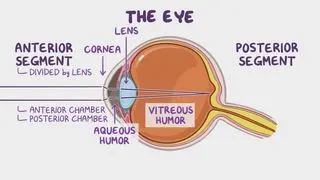
Keratoconus refers to a non-inflammatory condition in which the cornea (i.e., the thin, transparent, protective layer of the eye that covers the iris, pupil, and anterior chamber) becomes gradually thinner and protrudes in a cone shape. Keratoconus is a progressive disorder that typically presents with blurry vision or a sudden decrease in visual acuity in the second decade of life. The condition ultimately affects both eyes and can lead to significant vision impairment. 

Learn deeper with Osmosis

Master this topic faster with videos, questions, and AI.

Used by 8M+ healthcare learners.

Start free trial

No credit card · Cancel anytime

What causes keratoconus?

Although the exact cause of keratoconus is unknown, various risk factors have been identified, which include a positive family history of keratoconus, and a personal history of genetic disorders, such as Down Syndrome (i.e., Trisomy 21); Marfan syndrome (i.e., a connective tissue disorder that can affect the skeleton, blood vessels, especially the aorta, eyes, and lungs); and Ehlers-Danlos syndrome (i.e., a connective tissue disorder characterized by stretchy skin, easy bruising and super flexible joints). Additionally, keratoconus is more common in individuals with a history of other eye conditions, such as aniridia, where there is an absence of part or all of the iris, and blue sclera, where the white outer layer of the eye is blue. Finally, excessive or chronic rubbing of the eyes can also increase the risk of keratoconus. 

What are the signs and symptoms of keratoconus?

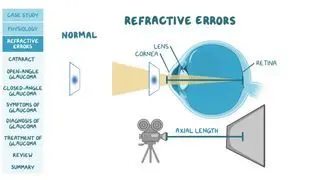
Signs and symptoms of keratoconus include visual impairment. Keratoconus typically causes refractive errors (i.e., eye problems due to abnormal eye shape), myopia (also known as nearsightedness), irregular astigmatism, or abnormal cornea curvature. The cornea may bulge outward in a cone shape. 

Rarely, people with keratoconus may present with acute hydrops, characterized by pain in the affected eye, photophobia (i.e., intolerance to bright light), and reduced vision

How is keratoconus diagnosed?

Diagnosis of keratoconus includes several eye exams that can detect the abnormal shape and thinning of the cornea and help confirm the diagnosis. Direct ophthalmoscopy and retinoscopy allow the clinician to visualize the retina or the back of the eye. In direct ophthalmoscopy, a characteristic “oil droplet” reflex can be seen in individuals with keratoconus, while in retinoscopy, those with keratoconus typically have a “scissoring” reflex. Slit lamp biomicroscopy can examine the structures at the front of the eye and inside the retina. The keratoconus slit lamp examination can reveal abnormal fine, vertical lines in the cornea, called Vogt striae. Another essential exam in detecting and monitoring patients with keratoconus is corneal topography, an imaging technique that provides a detailed visual of the corneal surface

How is keratoconus treated?

Treatment of keratoconus usually involves wearing eyeglasses or soft contact lenses to correct refractive errors. Rigid contact lenses may be needed if astigmatism is more severe. Avoiding eye rubbing is recommended. As the disease progresses, other treatment methods may improve vision. These include corneal collagen cross-linking where riboflavin eye drops are used, followed by ultraviolet light treatment to the cornea that causes it to become stiffer, thereby preventing further shape changes. 

In severe cases when there is severe corneal scarring and thinning and contact lenses no longer help, keratoplasty (i.e., corneal transplantation) may be required. The most common surgical procedure is penetrating keratoplasty or full-thickness corneal transplant.

What are the most important facts to know about keratoconus?

Keratoconus is a non-inflammatory eye condition characterized by a cone-shaped protrusion of the cornea leading to vision impairment. Risk factors include family history, genetic syndromes, other eye conditions, and excessive eye rubbing. Keratoconus typically presents with refractive errors and outward bulging of the cone-shaped cornea. Although it initially involves only one eye, eventually, both eyes may be affected. Diagnosis is based on several eye exams, including corneal topography. In the early stages, treatment includes eyeglasses or soft contact lenses, while in severe cases, a corneal transplant may be necessary. 
Students say Osmosis is 100% worth it

Because Osmosis saves them time. Lowers stress. And actually helps them remember when it counts.

I used Osmosis to prepare for my first medical school licensing exam! Super helpful and interactive for people who may not do great with just pages of text info!

Cecilia Ruiz

Cecilia Ruiz

MD student

Sayan Misra

I have used Osmosis for about four years. Best thing I have ever used for my medical studies.

Sayan Misra

Sayan Misra

Med student

Osmosis videos are superior because they define simple concepts, tell a story with a clear progression, and provide context.

Jay Pate

Jay Pate

Dental student

References


Salmon, J.F. (2019). Kanski’s Clinical Ophthalmology. 9th Edition, Elsevier, Amsterdam.


Mayo clinic. Keratoconus. Retrieved 31/05/2022 from https://www.mayoclinic.org/diseases-conditions/keratoconus/symptoms-causes/syc-20351352


Johns Hopkins Medicine. Keratoconus. Retrieved 31/05/2022 from https://www.hopkinsmedicine.org/health/conditions-and-diseases/keratoconus


Moorfields. Keratoconus. Retrieved 31/05/2022 from https://www.moorfields.nhs.uk/condition/keratoconus


NORD. Keratoconus. Retrieved 31/05/2022 from https://rarediseases.org/rare-diseases/keratoconus/


Cleveland clinic. Keratoconus. Retrieved 31/05/2022 from https://my.clevelandclinic.org/health/diseases/14415-keratoconus


Healthline. Everything you need to know about keratoconus. Retrieved 31/05/2022 from https://www.healthline.com/health/eye-health/keratoconus


Medlineplus. Keratoconus. Retrieved 31/05/2022 from https://medlineplus.gov/genetics/condition/keratoconus/


American Optometric Association. Keratoconus. Retrieved 31/05/2022 from  https://www.aoa.org/healthy-eyes/eye-and-vision-conditions/keratoconus?sso=y