Infection prevention and control - Precautions and personal protective equipment (PPE): Nursing skills
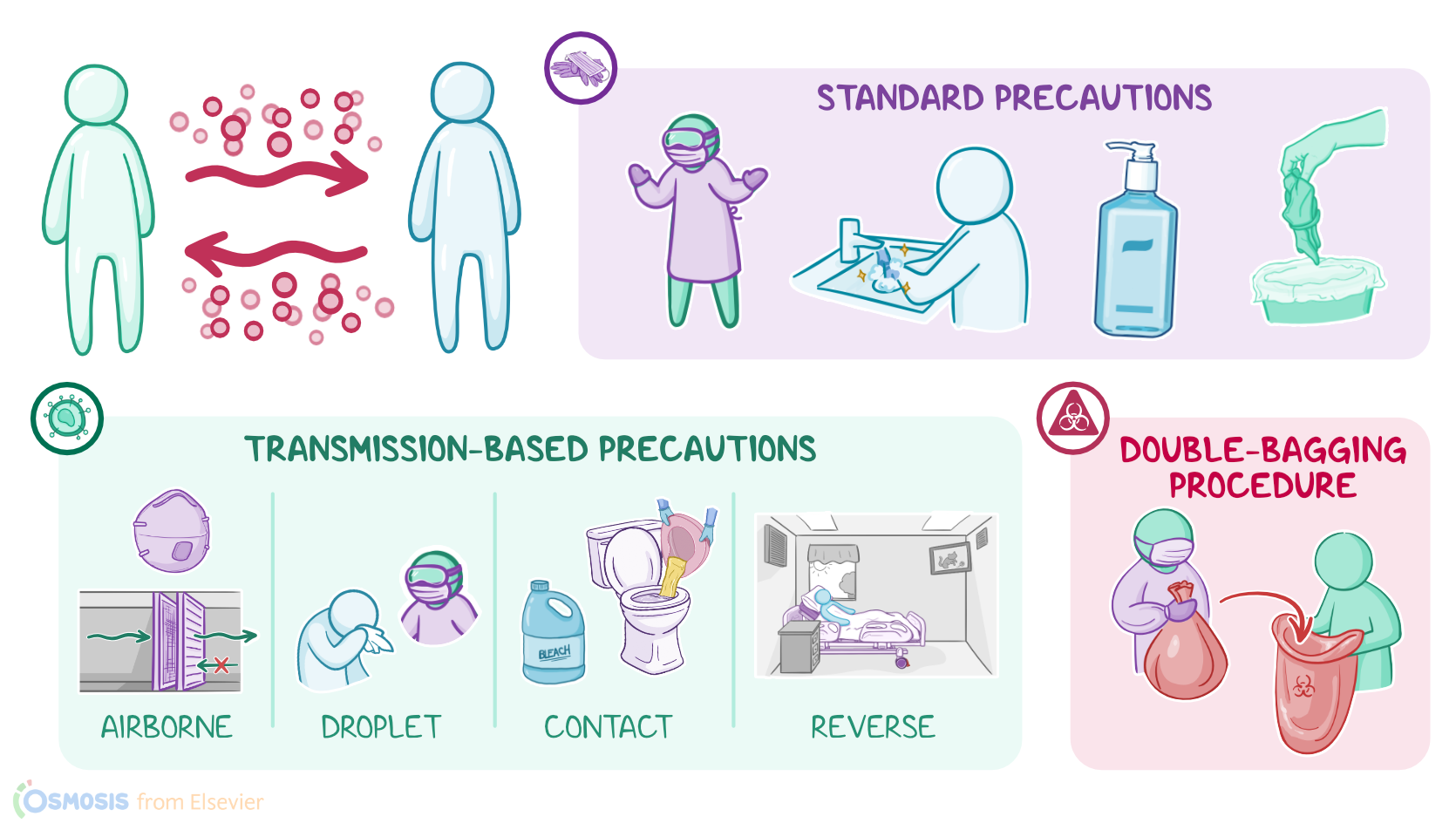
When providing client care, there are procedures you must follow to prevent the transmission of infection to and from the client. These include standard precautions, which are used for any client, at any time, in any situation; and transmission-based precautions for clients with a diagnosed or suspected infectious condition. Every time there’s a risk for exposure to blood; all types of body fluids, secretions, and excretions other than sweat; open skin lesions or rashes; mucosal surfaces; and possibly contaminated items or surfaces, make sure to utilize personal protective equipment, or PPE for short. This includes wearing gloves; a waterproof gown if there’s a possibility that your clothes get contaminated; and protective mask, face shield for procedures where splashes of body fluids are likely or goggles.
When moving from a contaminated area, like a wound, to a clean body area, like the face, remember to change your gloves and wash your hands thoroughly. If there’s no access to water or soap and your hands aren’t visibly dirty, you can also use an alcohol-based sanitizer. Remember to still wash your hands afterwards as soon as you can. Do the same after touching any surfaces in or out of the care setting. Now, in the case of unexpected contact with blood or any body fluids, wipe up any spills, disinfect the area with a facility-approved cleaning product, and practice hand hygiene right away. In any case, before leaving the client’s room or moving on to another client, remove all your personal protective equipment and practice hand hygiene.
Next, to limit the potential transmission of respiratory infections, standard precautions include wearing a mask when caring for clients with suspicious signs or symptoms, like a cough. It’s also important to instruct these clients to keep at least a 1 meter, or 3 feet, distance between themselves and others or to otherwise wear a mask. You should encourage clients to cover their nose and mouth with a tissue whenever they sneeze or cough and then immediately throw the tissue away in the nearest wastebasket and wash their hands. It might also be helpful to hang a visual reminder of the instructions next to the client’s bed to inform potential visitors.
Transmission-based precautions, or isolation precautions, are categorized based on the route of transmission of the infectious agent. There are four types of isolation precautions: airborne, droplet, contact, and reverse. So, airborne precautions refer to clients infected with pathogens transmitted via the airborne route. This means that they can survive and travel through the air over long distances and for an extended period of time, usually several hours to days. These include Mycobacterium tuberculosis; measles; varicella virus, also known as chickenpox; and SARS-CoV-2, or severe acute respiratory syndrome coronavirus 2, which is the virus that causes COVID-19. In all these cases, the client should be isolated in an airborne infection isolation room, otherwise known as a negative pressure room, with the door closed.
These rooms have a ventilation system that allows air to flow in but not out of the room to prevent cross-contamination between rooms. Then, before this air gets released to the outside environment, it passes through a special barrier called a HEPA filter to completely remove all pathogens. Before entering an airborne precaution isolation room, make sure to put on a fit-tested high-filtration respirator. If possible, all procedures should be carried out in this room. But if it’s absolutely necessary to transport the client, they should wear a surgical mask. Droplet precautions are taken when caring for a client with an infectious condition transmitted via droplets. This means every time the client talks, coughs, or sneezes, loads of tiny droplets containing the pathogen are sprayed out. These droplets can land on another person’s mouth, nose, or eyes, allowing the pathogen to enter a new person.
Some examples of these pathogens include mumps, rubella and influenza virus, diphtheria, Streptococcus, and pertussis. Droplet precautions are similar to airborne ones, with the exception that you only need to apply a face shield and simple face mask when you are closer than 1 meter, or 3 feet, to the client. Contact precautions are used for clients with infections that are transmitted by direct contact or indirect contact. Direct contact refers to touching the infected client, while indirect contact refers to touching a surface, like a contaminated doorknob, and then touching your own eyes, nose, or mouth. Such pathogens include Staphylococcus aureus; herpes simplex; varicella zoster; respiratory syncytial virus, or RSV for short; as well as SARS-CoV-2, which causes COVID 19; and Clostridioides difficile.
| INFECTION PREVENTION AND CONTROL - PRECAUTIONS AND PERSONAL PROTECTIVE EQUIPMENT (PPE) | ||
| KEY POINTS | NOTES | |
| DEFINITION |
| |
| STANDARD PRECAUTIONS |
| |
| TRANSMISSION-BASED PRECAUTIONS |
| |
| REVERSE ISOLATION |
| |
| DOUBLE-BAGGING PROCEDURE |
| |
| NURSING IMPLICATIONS |
| |
No notes for this video yet
Try adding a note below