McBurney’s Point · What Is It, Location, and More
Published: Jan 06, 2025
Author: Lily Guo•
Editor: Ahaana Singh•
Editor: Lisa Miklush, PhD, RN, CNS
Illustrator: Abbey Richard
7-day free trial
Go deeper with Osmosis
Osmosis is a learning platform with videos, questions, and AI tools to help you master topics like this.
Watch quick, visual videos
Practice with Qbank-style questions
Use AI to explain, quiz, and review
Study anytime with the mobile app
Try Osmosis Free
No credit card required
What is McBurney's point?
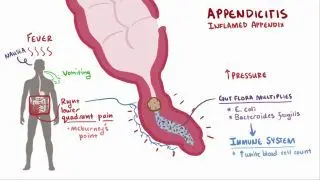
McBurney’s point refers to the point on the lower right quadrant of the abdomen at which tenderness is maximal in cases of acute appendicitis. Acute appendicitis is characterized by the inflammation, infection, or swelling of the appendix. The sign is seen in a vast majority (approximately 91%) of individuals with appendicitis.
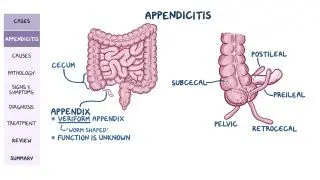
The appendix is a narrow, finger-shaped pouch that projects out from the cecum, or the beginning of the large intestine. Infection likely occurs when there is a blockage in the appendix allowing the subsequent overgrowth of bacteria. As the bacteria multiply, the appendix becomes inflamed, swollen, and filled with pus. This often requires emergency surgical intervention in both children and adults—if left untreated, the appendix can rupture in as soon as 48 to 72 hours after symptoms begin. A ruptured appendix can lead to peritonitis, which is the infection and inflammation of the peritoneum, or the membrane that lines the abdominal cavity and organs. If left untreated, peritonitis can lead to widespread infection and become potentially life-threatening.
Individuals with appendicitis will typically experience a sudden onset of pain, beginning in the area behind the navel. It can then shift to the lower right abdomen, where the appendix is located. Associated symptoms include low-grade fever, nausea, vomiting, constipation, diarrhea, and abdominal bloating.
A physical exam may reveal rebound tenderness over McBurney’s point. Rebound tenderness is a clinical sign in which there is pain upon removal of pressure rather than application of pressure to the abdomen. Other clinical signs indicative of acute appendicitis include Rovsing’s sign, Psoas sign, and a positive obturator sign. Rovsing's sign is said to be positive if pressure over the person’s left lower abdominal quadrant causes pain in the right lower abdominal quadrant. The Psoas sign is elicited in an individual lying on their left side while their right thigh is flexed backward. While in this position, the inflamed appendix may press against the right Psoas muscle, which connects the lumbar vertebrae to the femur. This can cause pain, triggering the individual to shorten the muscle by drawing up the right knee. Additionally, the appendix may also lie against the right obturator internus muscle, a deep muscle of the hip joint. The obturator sign can be elicited in an individual by flexing their right knee to a 90 degree angle while a clinician internally rotates the hip by moving the ankle away from the body. Pain associated with this maneuver can be indicative of an inflamed appendix.
To aid in the diagnosis of acute appendicitis, laboratory studies to assess for inflammation may be used. This can include looking at the white blood cell count (WBC) and C-reactive protein (CRP). Both WBC and CRP are elevated during times of inflammation and infection, and can be strongly suggestive of acute appendicitis. Imaging techniques such as computed tomography (CT) and ultrasound are commonly used to visualize the appendix. Common imaging findings include dilated or enlarged appendix, wall thickening, or detection of abscess or inflammatory masses.
Learn deeper with Osmosis
Master this topic faster with videos, questions, and AI.
Used by 8M+ healthcare learners.
Try Osmosis Free
No credit card required
Where is McBurney's point?
McBurney’s point is located two thirds the distance from the navel to the right anterior superior iliac spine, or the bony projection of the right hip bone. It is found at about 3.8–5.1 cm (1.5–2 inches) from the top of the hip bone towards the navel. This point corresponds to the base of the appendix, where it is attached to the cecum, or the beginning of the large intestine. While the relative location of the appendix can vary anatomically, this position, known as the pelvic position, is the most common.
How do you test McBurney's point?
To test McBurney's point, the individual should be lying on their back on an examination table. A clinician will apply slow pressure over McBurney’s point and then quickly release. The presence of severe pain when pressure is released is indicative of a positive test and raises the suspicion for acute appendicitis.
What are the most important facts to know about McBurney's point?
McBurney’s point refers to the point 3.8–5.1 cm (1.5–2 inches) from the navel to the right anterior superior iliac spine, which corresponds to where the appendix is located within the abdomen. If the individual has tenderness and pain upon release from palpation of the right lower quadrant, where the McBurney’s point is located, it raises suspicion for appendicitis, a condition resulting in the inflammation of the appendix. Blockage of the appendix can cause bacterial accumulation, inflammation and infection, resulting in appendicitis. Appendicitis is considered a medical emergency and requires prompt medical attention. If left untreated, the appendix can potentially rupture, spreading bacterial infection throughout the abdominal cavity and creating a potentially life-threatening situation. A physical exam to detect pain at McBurney’s point, when used in conjunction with lab tests and imaging, can be effective in diagnosing acute appendicitis.
Related topics


Students say Osmosis is 100% worth it
Because Osmosis saves them time. Lowers stress. And actually helps them remember when it counts.
I used Osmosis to prepare for my first medical school licensing exam! Super helpful and interactive for people who may not do great with just pages of text info!"

Cecilia Ruiz
MD student

I have used Osmosis for about four years. Best thing I have ever used for my medical studies."

Sayan Misra
Med student
Osmosis videos are superior because they define simple concepts, tell a story with a clear progression, and provide context."

Jay Pate
Dental student