Complete blood count (CBC) - White blood cells (WBC) and differential: Nursing
Case report0:00–0:26
A 16-year-old client is brought to the clinic by their mother, with a report of fever, malaise, nausea, and diarrhea. On assessment, you note a temporal artery temperature of 101.5 F or 38.6 C.
Based on these findings, a complete blood count, or CBC, is ordered to check their white blood cell count and differential.White blood cells, also called leukocytes or WBCs for short, are created by the bone marrow from precursor cells.
Physiology0:26–2:27
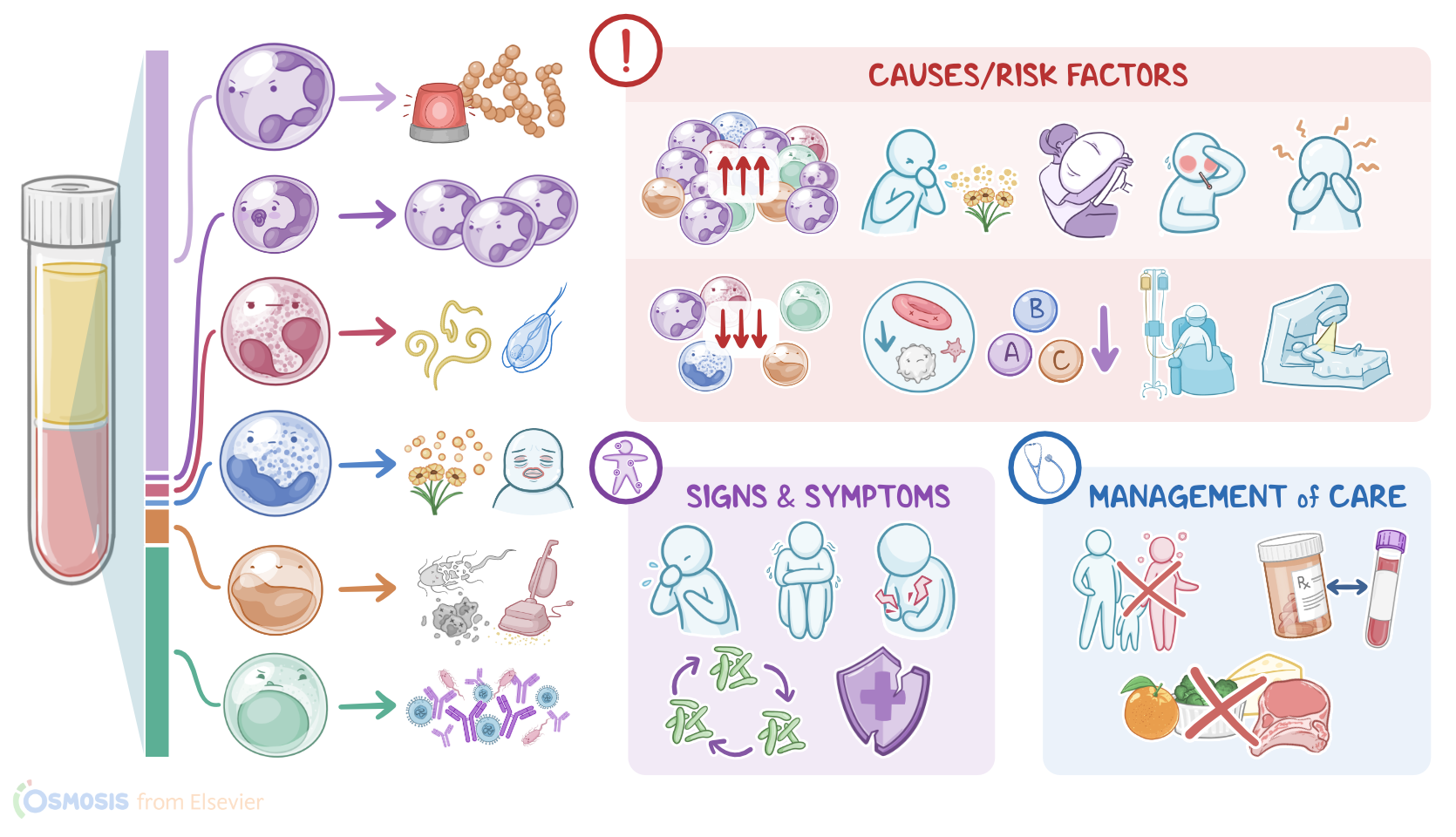
White blood cells help to ward off pathogens like bacteria and viruses, destroy cancerous cells, and neutralize toxins.There are five types of WBCs that circulate in the body.
First, there are neutrophils, which are the most plentiful WBC. They are also called polymorphonuclear leukocytes or PMNs because of their distinct nuclei, which have 2 to 5 lobes.
Immature neutrophils are called bands or stabs. Neutrophils are the first type of WBC to respond to an infection.Next, there are eosinophils, which are involved in allergic reactions, and are responsible for fighting off parasitic infections.Then there are basophils, which have granules that contain histamine, so they specialize in inflammation and allergic reactions.Next, there are monocytes that serve as the clean-up crew by removing foreign particles and dead cells.
Finally, there are lymphocytes, which respond to viral and bacterial infections. These include B cells that make antibodies and T cells which kill pathogens and help other immune cells.Now, the WBC count, also known as leukocyte count, or just white count, measures the number of WBCs in the blood, as is a part of a CBC.
A normal WBC count ranges from 4,500 to 11,000/µL. Additionally, a WBC differential can be used to measure the proportion of each type of WBC.
Usually, neutrophils make up about 50% to 70%, with 0% to 5% bands. Eosinophils make up about 1% to 3%, while basophils range from 0% to 2%, monocytes make up 2% to 11%.
Finally, lymphocytes normally make 18% to 42% of total WBCs.Alright, there are some conditions that can alter the WBC count.
Pathology2:27–4:14
An increase in the total WBC count, also called leukocytosis, is commonly caused by infections, inflammation, trauma, and physical or emotional stress.
So, if there is an acute bacterial infection, for example, the bone marrow will increase the production of neutrophils. At first, only mature neutrophils are released into the bloodstream; however, if the demand for neutrophils exceeds the bone marrow’s capacity to release them into circulation, then immature bands will also be released.
This is referred to as a left shift. Another cause of a high WBC count are malignancies like leukemia and lymphoma, while an increase in eosinophils is often seen in allergies, asthma, and parasitic infections.Alright, let’s switch gears and talk about a low WBC count.
A low WBC count can be caused by decreased production, which can happen if an overwhelming infection depletes bone marrow reserves.
Additionally, radiation, chemotherapy, and some conditions like aplastic anemia and nutritional deficiencies can also cause bone marrow suppression, so less WBCs are made.Now, a client’s WBCs will be measured when a client is experiencing a condition that can lead to an altered WBC count, or if there are signs or symptoms of high or low WBCs.
If WBCs are high, clinical manifestations most often mirror the clinical manifestations of infection like cough, fever, chills, malaise, nausea, vomiting, and diarrhea.
In contrast, symptoms of low WBCs can include recurrent infections or the presence of opportunistic infections.Okay, let’s look at the nursing implications for a client with an altered WBC count.
Nursing implications4:14–6:38
Your priority goals of care involve addressing the underlying cause and restoring a normal WBC count.First, collect a sample by venipuncture using a lavender-topped tube.
This tube contains the anticoagulant EDTA to help prevent clotting of the sample. After obtaining your sample, remember to gently invert the sample several times to ensure the EDTA mixes with the blood, but avoid shaking the tube, as this will cause hemolysis.Now, if your client has an increased WBC count, administer prescribed antibiotics or other medications based on the underlying cause.
For clients with an infection, initiate the appropriate transmission-based precautions, provide adequate nutrition and fluids, and encourage rest.
Monitor their WBC count, and immediately notify the healthcare provider if the WBCs exceed 30,000/µL, as this is a critical level; or if the differential shows an increasing number of bands.On the other hand, if your client has a decreased WBC count, initiate measures to protect them from infection, such as diligent hand hygiene and limiting visitors.
Watch them closely for signs of infection, and administer medications as prescribed, such as granulocyte colony stimulating factors or IV immunoglobulins.
Monitor their WBC count and let the healthcare provider know right away if your client develops signs of infection or if the WBCs drop below 2,500/µL, as this is a critical level.
For clients receiving cancer chemotherapy who have neutropenia, or a very low neutrophil count, implement additional precautions, including removing fresh flowers from the environment, and providing a neutropenic diet, which means avoiding fresh fruit, raw vegetables, raw or undercooked meat, and unpasteurized foods.Finally, for any client with an altered WBC count, check their medication administration record for medications that can interfere with these laboratory test results.
An elevated WBC count can be caused by medications such as allopurinol, steroids, and lithium. On the other hand, anticonvulsants and chemotherapy agents can decrease the WBC count.Alright, as a quick recap… The WBC count is part of the CBC that measures the number of WBCs in the blood, and a WBC count with a differential measures the proportion of each type of WBC.
Review6:38–7:15
An increase in WBCs can occur from infections, inflammation, and malignancies like leukemia and lymphoma. A low WBC count can be caused by decreased production, radiation, chemotherapy, and nutritional deficiencies, as well as some conditions like aplastic anemia.
Nursing implications involve addressing the underlying cause and restoring a normal WBC count.
| WHITE BLOOD CELLS (WBCs) AND DIFFERENTIAL | ||
| KEY POINTS | NOTES | |
| PHYSIOLOGY |
| |
| PATHOLOGY |
| |
| NURSING IMPLICATIONS |
| |
No notes for this video yet
Try adding a note below