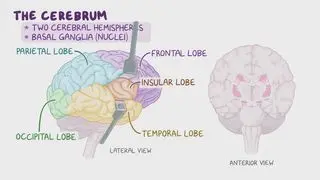
Damage to the parietal lobe may result in various symptoms related to the somatic senses, depending on the injury location. Damage to the primary somatosensory cortex may cause the inability to localize sensation, which means an individual may be able to describe where the sensation is located generally, such as a particular limb or side of the body, but cannot identify the exact location. This deficit includes the inability to separately identify two cutaneous stimuli placed closely together, which is known as two-point discrimination, as well as the inability to identify numbers or letters traced on the skin with a finger, which is known as graphesthesia. One may also lose the ability to determine changes in pressure against their body or be unable to determine the weight, texture, and form of objects.
Damage to the somatosensory association area of a parietal lobe can result in the inability to recognize complex objects or even the sense of one’s own body on the side that is opposite to the parietal injury. For example, an injury to the right parietal lobe may cause the inability to identify objects felt on their left side or the individual may become unaware that the left side of their body exists, a phenomenon known as hemispatial neglect. An example of hemispatial neglect is construction apraxia where, when asked to draw a clock, the individual draws all the numbers on half of the clock but is unaware they have not drawn the other side; or dressing apraxia, where they only dress half of their body. The individual may also experience anosognosia, which is an indifference or lack of ability to recognize their condition.
Since the parietal lobe is responsible for spatial relations and the visual mapping of one’s surroundings, symptoms in which body movements rely on this information may be present. For example, optic ataxia occurs when a person reaches out to grasp an object but incorrectly positions their arm and hand to successfully do so, missing the target.
Finally, parietal lobe damage inhibits the ability to integrate visual, acoustic, and somatosensory information in order to understand and solve problems, particularly with regards to speech and number processing. As a result, this may lead to acalculia, which is the inability to perform mathematical calculations, and agraphia, which is the inability to write. Furthermore, some lesions may result in alexia (the inability to read) and oraphasia (the inability to formulate or comprehend language).
The parietal lobe can be damaged as a result of a traumatic brain injury, including those resulting from accidents, falls, and firearm injuries. Certain neurological disorders may affect the function of the parietal lobe, including vascular conditions (e.g. stroke, cerebral hemorrhage, and cerebral artery aneurysms); infections (e.g. meningitis and encephalitis); tumors; and autoimmune diseases, such as lupus and multiple sclerosis. The parietal lobe can also be damaged as a result of severe and repetitive seizures, which can subsequently increase vulnerability for future seizures.