Biliary atresia: Nursing

Biliary atresia: Nursing

Watch later

Watch later

Infection prevention and control - Precautions and personal protective equipment (PPE): Nursing skills
Urinary tract infections (UTIs): Nursing process (ADPIE)
Modes of infectious disease transmission
Epstein-Barr virus (Infectious mononucleosis)
Pneumonia
Wound healing
Palliative and hospice care: Nursing
Postoperative care: Nursing
Biology of cancer: Nursing
Biliary atresia: Nursing
Cholecystitis: Nursing
Cholelithiasis: Nursing
Colorectal cancer: Nursing
Diarrhea: Nursing
Diverticular disease: Nursing
Esophageal cancer: Nursing
Gastric cancer: Nursing
Hepatitis: Nursing
Inflammatory bowel disease - Crohn disease and ulcerative colitis: Nursing
Intestinal obstruction: Nursing
Irritable bowel syndrome (IBS): Nursing
Jaundice: Nursing
Laryngeal cancer: Nursing
Liver cancer: Nursing
Pancreatic cancer: Nursing
Esophageal atresia and tracheoesophageal fistula: Nursing
Geriatric considerations - Gastrointestinal: Nursing
Hirschsprung disease: Nursing
Hyperemesis gravidarum: Nursing
Necrotizing enterocolitis: Nursing
Omphalocele and gastroschisis: Nursing
Appendicitis: Nursing process (ADPIE)
Celiac disease: Nursing process (ADPIE)
Cirrhosis: Nursing process (ADPIE)
Gastroesophageal reflux disease (GERD): Nursing process (ADPIE)
Hiatal hernia: Nursing process (ADPIE)
Pancreatitis: Nursing process (ADPIE)
Peptic ulcer disease (PUD): Nursing process (ADPIE)
Antacids: Nursing pharmacology
Antidiarrheals: Nursing pharmacology
Antiemetics: Nursing pharmacology
Antispasmodics (GI): Nursing pharmacology
Gallstone-dissolving agents: Nursing pharmacology
Gastric mucosal protective agents: Nursing pharmacology
Histamine H2 antagonists: Nursing pharmacology
Laxatives: Nursing pharmacology
Medications for hepatic encephalopathy: Nursing pharmacology
Pancreatic enzyme replacements: Nursing pharmacology
Proton pump inhibitors (PPIs): Nursing pharmacology
Treatment for Helicobacter pylori: Nursing pharmacology
Weight loss medications: Nursing pharmacology
Bladder tumors: Nursing
Chronic kidney disease (CKD): Nursing
Dialysis care: Nursing
Epididymitis: Nursing
Glomerulonephritis: Nursing
Nephrotic syndrome: Nursing
Polycystic kidney disease (PKD): Nursing
Prostate cancer: Nursing
Pyelonephritis: Nursing
Renal and urinary calculi: Nursing
Renal cancer: Nursing
Testicular cancer: Nursing
Urinary retention: Nursing
Bladder exstrophy: Nursing
Circumcision: Nursing
Cryptorchidism: Nursing
Enuresis: Nursing
Geriatric considerations - Urinary: Nursing
Hypospadias and epispadias: Nursing
Acute kidney injury (AKI): Nursing process (ADPIE)
Benign prostatic hyperplasia (BPH): Nursing process (ADPIE)
Urinary incontinence - Stress: Nursing process (ADPIE)
Antispasmodics (GU): Nursing pharmacology
Cholinergic therapy (GU): Nursing pharmacology
Diuretics - Osmotic and carbonic anhydrase inhibitors: Nursing pharmacology
Diuretics - Thiazide, thiazide-like, loop, and potassium-sparing diuretics: Nursing pharmacology
Anemia - Aplastic: Nursing
Anemia - Iron-deficiency: Nursing
Anemia - Macrocytic: Nursing
Arterial blood gas (ABG) - Overview: Nursing
Arterial blood gas (ABG) - Metabolic acidosis: Nursing
Arterial blood gas (ABG) - Metabolic alkalosis: Nursing
Arterial blood gas (ABG) - Respiratory acidosis: Nursing
Arterial blood gas (ABG) - Respiratory alkalosis: Nursing
Blood cultures: Nursing
Cardiac biomarkers - Creatine kinase (CK): Nursing
Cardiac biomarkers - Troponin: Nursing
Coagulation studies - Partial thromboplastin time (PTT): Nursing
Complete blood count (CBC) - Hemoglobin and hematocrit: Nursing
Complete blood count (CBC) - Platelets: Nursing
Complete blood count (CBC) - Red blood cells (RBC): Nursing
Complete blood count (CBC) - White blood cells (WBC) and differential: Nursing
Complete metabolic panel (CMP) - Blood urea nitrogen (BUN) and creatinine (Cr): Nursing
Complete metabolic panel (CMP) - Chloride: Nursing
Complete metabolic panel (CMP) - Estimated glomerular filtration rate (eGFR): Nursing
Complete metabolic panel (CMP) - Glucose: Nursing
Complete metabolic panel (CMP) - Liver function tests (LFT): Nursing
Complete metabolic panel (CMP) - Potassium: Nursing
Complete metabolic panel (CMP) - Sodium: Nursing
Complete metabolic panel (CMP) - Total protein: Nursing
Disseminated intravascular coagulation (DIC): Nursing
Multiple myeloma: Nursing
Neutropenia: Nursing
Polycythemia: Nursing
Thalassemia: Nursing
Thrombocytopenia: Nursing
Leukemia: Nursing process (ADPIE)
Anticoagulants - Direct thrombin and factor Xa inhibitors: Nursing pharmacology
Anticoagulants - Heparin: Nursing pharmacology
Anticoagulants - Warfarin: Nursing pharmacology
Antihyperlipidemics - Bile acid sequestrants and cholesterol absorption inhibitors: Nursing pharmacology
Antihyperlipidemics - Fibrates: Nursing pharmacology
Antihyperlipidemics - Miscellaneous: Nursing pharmacology
Antihyperlipidemics - Statins: Nursing pharmacology
Antiplatelet agents: Nursing pharmacology
Blood products: Nursing pharmacology
Hematopoietic growth factors: Nursing pharmacology
Hemostatics: Nursing pharmacology
Iron preparations: Nursing pharmacology
Thrombolytics: Nursing pharmacology
Autoimmunity: Nursing
Human immunodeficiency virus (HIV) and acquired immunodeficiency syndrome (AIDS): Nursing
Hypersensitivity reactions - Type I: Nursing
Hypersensitivity reactions - Type II: Nursing
Hypersensitivity reactions - Type III: Nursing
Hypersensitivity reactions - Type IV: Nursing
Immune response - Adaptive: Nursing
Immune response - Innate: Nursing
Immunodeficiency disorders - Primary: Nursing
Immunodeficiency disorders - Secondary: Nursing
Inflammatory process: Nursing
Scleroderma: Nursing
Shock - Anaphylactic: Nursing
Sjögren syndrome: Nursing
Systemic lupus erythematosus (SLE): Nursing
Toxic shock syndrome (TSS): Nursing
Erythema infectiosum (Fifth disease): Nursing
Fever: Nursing
Infectious mononucleosis: Nursing
Mumps (Parotitis): Nursing
Neonatal sepsis: Nursing
Pertussis: Nursing
Poliomyelitis: Nursing
Postpartum infections: Nursing
Roseola (Exanthem subitum): Nursing
Rubella (German measles): Nursing
Rubeola (Measles): Nursing
Smallpox: Nursing
Zika virus: Nursing
Anaphylaxis: Nursing process (ADPIE)
Lyme disease: Nursing process (ADPIE)
Rheumatoid arthritis (RA): Nursing process (ADPIE)
Antirejection immunosuppressants: Nursing pharmacology
Biologic agents: Nursing pharmacology
Disease-modifying therapy for multiple sclerosis: Nursing pharmacology
Immunoglobulins: Nursing pharmacology
Immunomodulators: Nursing pharmacology
Immunosuppressants for autoimmune diseases: Nursing pharmacology
Non-biologic disease-modifying antirheumatic drug (DMARD) therapy: Nursing pharmacology
Vaccines: Nursing pharmacology
Acne: Nursing
Animal and snake bites: Nursing
Burn injury: Nursing
Cutaneous fungal infections: Nursing
Erysipelas and cellulitis: Nursing
Folliculitis, carbuncles, and furuncles: Nursing
Herpes simplex virus (HSV): Nursing
Herpes zoster: Nursing
Impetigo: Nursing
Insect stings and bites: Nursing
Pediculosis and scabies: Nursing
Psoriasis: Nursing
Rocky Mountain spotted fever (RMSF): Nursing
Skin cancer - Basal cell carcinoma, squamous cell carcinoma, and melanoma: Nursing
Urticaria: Nursing
Geriatric considerations - Integumentary: Nursing
Atopic dermatitis: Nursing process (ADPIE)
Frostbite: Nursing process (ADPIE)
Methicillin-resistant Staphylococcus aureus (MRSA): Nursing process (ADPIE)
Pressure injury: Nursing process (ADPIE)
Antibiotics - Topical: Nursing pharmacology
Antifungals - Topical: Nursing pharmacology
Corticosteroids - Topical: Nursing pharmacology
Debridement agents: Nursing pharmacology
Keratolytics: Nursing pharmacology
Medications for acne vulgaris: Nursing pharmacology
Osteoarthritis: Nursing
Osteomyelitis: Nursing
Osteoporosis: Nursing
Hip fractures: Nursing
Developmental dysplasia of the hip: Nursing
Acute compartment syndrome: Nursing process (ADPIE)
Fractures: Nursing process (ADPIE)
Gout: Nursing process (ADPIE)
Musculoskeletal injuries: Nursing process (ADPIE)
Buerger disease: Nursing
Raynaud phenomenon: Nursing
Peripheral arterial disease (PAD): Nursing process (ADPIE)
Peripheral venous disease (PVD): Nursing process (ADPIE)
Atelectasis: Nursing
Geriatric considerations - Respiratory: Nursing
Venous thromboembolism (VTE): Nursing process (ADPIE)
Asthma: Nursing process (ADPIE)
Bacterial pneumonia: Nursing process (ADPIE)
Bronchiolitis and respiratory syncytial virus (RSV): Nursing process (ADPIE)
Carbon monoxide poisoning: Nursing process (ADPIE)
Chronic obstructive pulmonary disease (COPD): Nursing process (ADPIE)
Epiglottitis: Nursing process (ADPIE)
Foreign body aspiration and upper airway obstruction: Nursing process (ADPIE)
Laryngotracheobronchitis (LTB) and croup: Nursing process (ADPIE)
Smoke inhalation injury: Nursing process (ADPIE)
Papulosquamous and inflammatory skin disorders: Pathology review

Notes

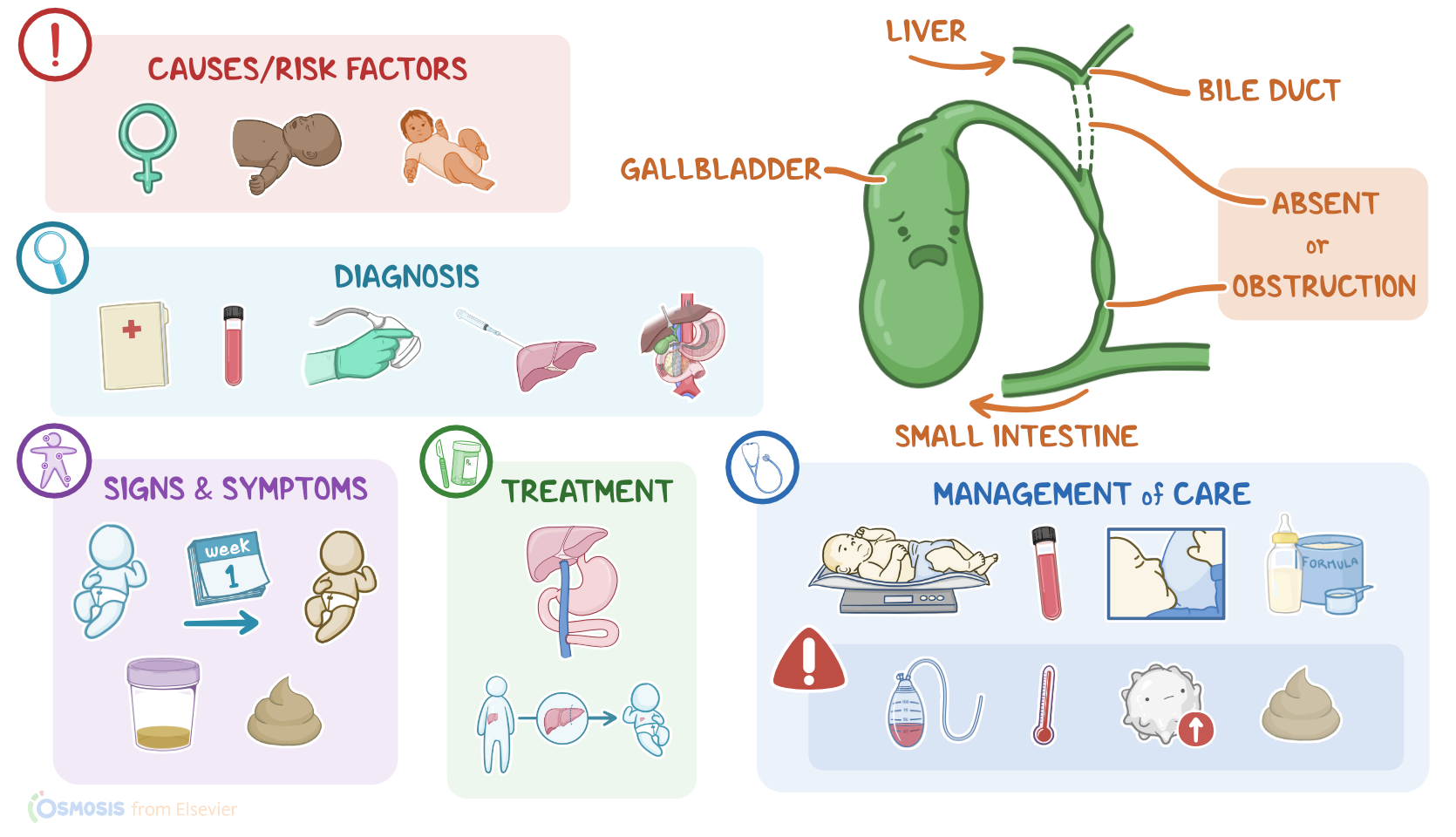
BILIARY ATRESIA

KEY POINTS
NOTES
DEFINITION
  • Obstruction or total absence of bile ducts

PHYSIOLOGY
  • Liver cells produce bile
    • Flows from liver into hepatic ducts > cystic duct > common bile duct
    • Can be stored in gallbladder
  • Eating high-fat meal stimulates cholecystokinin (CCK) release
    • Triggers bile release 
  • Bile helps digest fat
  • Bile excreted in feces or eliminated in urine

CAUSES AND RISK FACTORS
  • Causes
    • Unknown
  • Risk factors
    • Assigned female at birth
    • Asian or Black race

PATHOPHYSIOLOGY
  • Absence or obstruction of bile ducts results in impaired bile flow
  • Bile builds up in biliary tree
  • Eventually leaks into bloodstream

SIGNS AND SYMPTOMS
  • Jaundice
  • Dark urine
  • Pale stools
  • Portal hypertension

DIAGNOSIS
  • History
  • Physical assessment
  • Laboratory tests
  • Ultrasound
  • Endoscopic retrograde cholangiopancreatography (ERCP)
  • Percutaneous transhepatic cholangiography
  • HIDA scan
  • Liver biopsy
  • Exploratory laparotomy

TREATMENT
  • Hepatoportoenterostomy
  • Liver transplant

MANAGEMENT OF CARE
  • Goals of care
    • Provide pre- and postoperative care
    • Promote nutrition
    • Provide emotional support
  • Monitor weight, intake and output, and laboratory results
  • Provide feedings or administer parenteral nutrition
  • Administer bile replacements and fat-soluble vitamins
  • Promote rest
  • Prepare for surgery
  • Provide postoperative care
    • Bowel rest
    • Maintain nasogastric tube
    • Keep surgical drain dependent and monitor output
      • Report to HCP
        • Leakage or disruption to site
    • Administer IV antibiotics and corticosteroids as prescribed
      • Report to HCP
        • Fever
        • Increased WBCs
        • Worsening jaundice
        • Colorless stools
  • Refer to support systems
  • Collaborate with pediatric case manager

PATIENT AND FAMILY TEACHING
  • Explain condition, plan of care, and how to safely self-administer medications
  • Keep follow-up appointments
  • Notify HCP immediately
    • Fever
    • Recurrent or worsening jaundice
    • Pale stools
    • Abdominal swelling or distention
    • Poor growth

Transcript

Watch video only

Biliary atresia refers to the obstruction or total absence of bile ducts, which results in an impaired bile flow from the liver into the gallbladder and small intestine.

Let’s start with some basic anatomy and physiology of the liver and gallbladder. Liver cells produce bile, which helps digest fats in the intestines.

The bile flows from the liver into the right and left hepatic ducts which merge to form the common hepatic duct. The common hepatic duct is where the cystic duct opens. The cystic duct functions like a two way street, allowing the passage of bile from the liver to the gallbladder, where it’s stored in between meals; while at the same time allowing bile to pass from the gallbladder, into the common bile duct, which is the part of the bile duct below the opening of the cystic duct.

Remember that the gallbladder, is a pear-shaped hollow organ found beneath the liver that stores and concentrates the bile.

So, after a high-fat meal, the gallbladder contracts and pushes the bile through the cystic duct, down the common bile duct, and into the duodenum, to help with digestion.

Afterwards, some of the bile is excreted through feces, giving them their characteristic color, while some is reabsorbed into the blood and then eliminated through urine.

Now, the exact cause of the biliary atresia is still unknown. Some theories suggest that genetic mutations can result in the abnormal fetal development of the biliary system; while others propose that biliary atresia results from some sort of inflammation of the bile ducts. The ultimate cause of this inflammation is not fully known, but it’s thought to occur because of perinatal exposure to viruses or toxic substances. This inflammation causes destruction of the bile ducts, eventually impairing bile flow from the liver.

No matter what the cause is, important risk factors that have been associated with biliary atresia include being assigned female at birth, as well as black or Asian race.

Next, let’s look at the pathology of biliary atresia. The obstruction or total absence of bile ducts results in cholestasis or impaired bile flow.

As bile starts to build up within the biliary tree, pressure in the ducts increases and the bile will eventually push its way through the tight junctions between epithelial cells lining the ducts and leak out into the blood.

A key component of bile is bilirubin, and specifically, conjugated bilirubin, also called direct bilirubin. This increases the amount of conjugated bilirubin in the blood which causes jaundice, or yellowing of skin and eyes.

At the same time, excess bilirubin makes its way into urine, and no bile gets to the intestines, which impairs absorption of fats and fat soluble vitamins, and causes pale stools.

Over time, the accumulation of bile in the liver can result in cirrhosis or even liver failure. Furthermore, since there’s no bile in the intestines, normal absorption of fat is affected and this can cause malnutrition in newborns.

In addition, other congenital defects are often present in neonates with biliary atresia. These include esophageal or intestinal atresia, intestinal malrotation, umbilical and inguinal hernias, renal anomalies, congenital heart defects, and situs inversus which is a condition where the position of the major organs are inverted, so the heart is on the right side of the body and the liver on the left side.

Clinically, newborns with biliary atresia appear normal at birth and pass normal stools. After the first week of life, they develop jaundice, or yellowing of the skin, mucosa, and eyes. As direct bilirubin increases, the infant’s skin can take on a greenish bronze color Additionally, there can be dark urine and pale stools. Finally, with biliary atresia can develop portal hypertension hepatomegaly,abdominal pain, ascites, and nausea.

The diagnosis of biliary atresia starts with the client’s history and physical assessment, followed by laboratory testing. This typically reveals elevated levels of conjugated bilirubin, aspartate aminotransferase or AST, alanine aminotransferase or ALT, and gamma-glutamyltransferase or GGT.

Imaging tests can also be used to assess the biliary system and visualize the site of obstruction, including abdominal ultrasound, endoscopic retrograde cholangiopancreatography, or ERCP; as well as percutaneous transhepatic cholangiography, and hepatobiliary or HIDA scan.

Diagnosis can be confirmed with a liver biopsy, which reveals enlarged portal tracks with fibrosis and bile duct proliferation. If the diagnosis remains unclear, an exploratory laparoscopy can be done to directly enter the abdominal cavity and inspect the condition of internal organs.

Finally, treatment includes a surgical procedure called hepatoportoenterostomy, which is often referred to as the Kasai procedure.

With the Kasai procedure, damaged bile ducts are removed, and a loop of the newborn’s intestine is cut and used as a bridge between the liver and intestines.

Although this procedure can be effective at re-establishing bile flow, a lot of newborns continue to have slowly progressing liver disease, and will often need a liver transplant.

Okay, now let’s look at the nursing care you will provide for a client with biliary atresia.

Your priority nursing goals are to provide supportive care before and after surgery, promote nutrition, and provide emotional support.