Cardiac biomarkers - Creatine kinase (CK): Nursing
Case Report0:00–0:21
A 71-year-old female arrives at the emergency department with reports of chest pressure and nausea. She has a history of high cholesterol and diabetes mellitus.
Based on this assessment, the provider suspects acute coronary syndrome, and orders a creatine kinase level to be drawn.
Physiology0:21–0:52
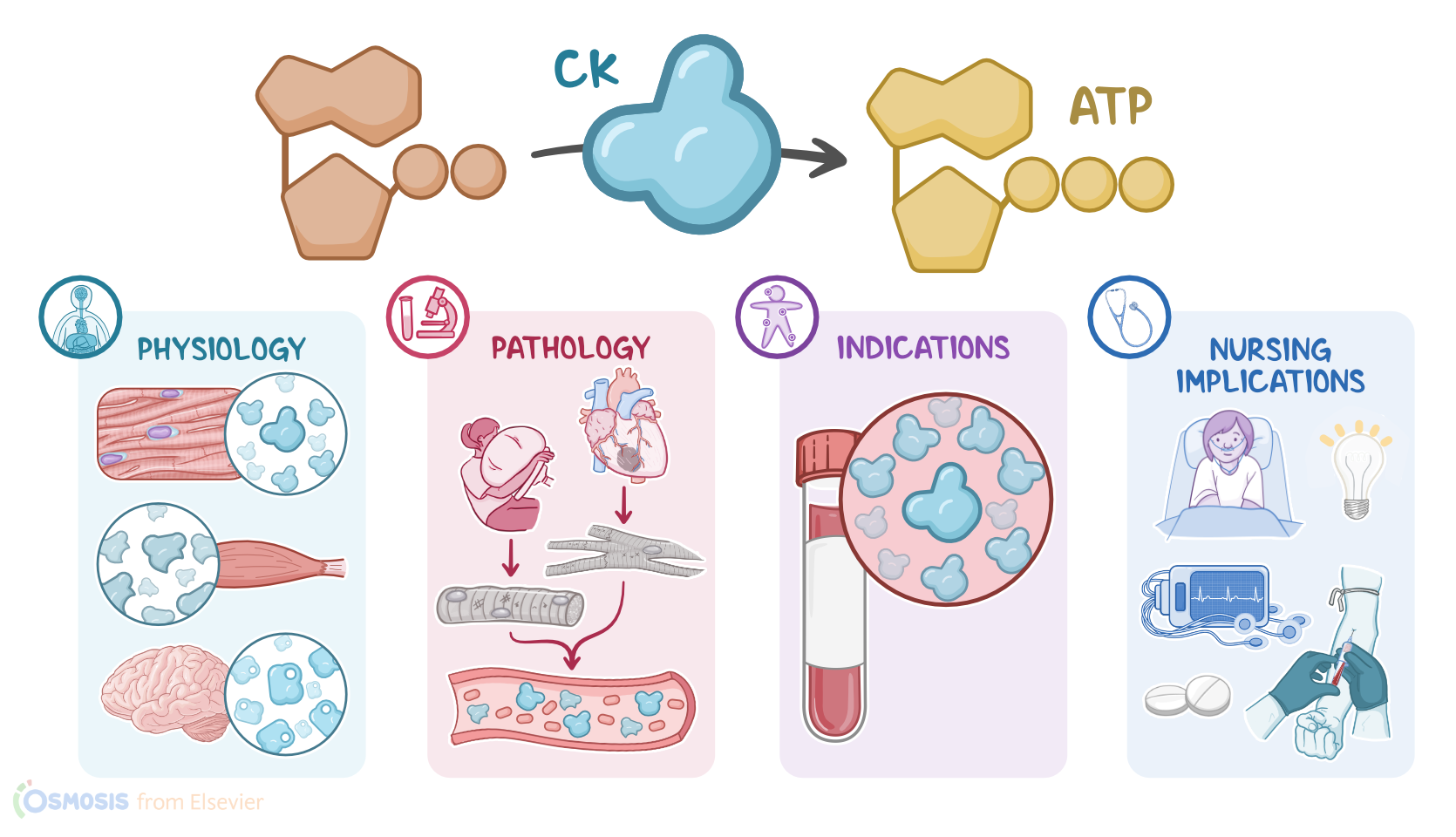
Okay, creatine kinase, or CK for short, also known as creatine phosphokinase or CPK, is an enzyme that helps create adenosine triphosphate, or ATP, which is an energy source, to supply to body tissues.
Now, there are three types of CK: CK-MB, found mostly in heart muscle cells, or myocytes, with small amounts found in the skeletal muscle; CK-MM, found in skeletal muscle; and CK-BB, found in the brain.
Alright, let’s focus on the cardiac biomarker, CK-MB. There are certain conditions that can cause an increased CK-MB level, most commonly any condition that causes damage to cardiac or skeletal muscle cells.
Pathology0:52–2:17
Cardiac muscle cell damage can occur with acute coronary syndrome, which is any condition that decreases blood flow to the heart muscle, such as angina or myocardial infarctions, or MI for short.
Decreased blood flow causes an imbalance between myocardial oxygen demand and supply from the coronary arteries, resulting in myocardial ischemia, a depletion of ATP, and a severe reduction in the ability of the heart to contract.At the cellular level, damage to myocytes disrupts their membranes, causing the cellular contents, including CK-MB, to be released into the bloodstream.
Now, when skeletal muscle cells are damaged, it can cause a condition called rhabdomyolysis, where the damaged muscle cells release their cellular contents into the bloodstream causing damage to the heart and kidneys.Skeletal muscle can also be damaged by crushing trauma, which causes a traumatic form of rhabdomyolysis; and muscular dystrophy, a genetic condition causing progressive muscle weakness and loss of muscle mass.Alright, so CK-MB is usually measured when there is a concern about cardiac ischemia or muscle damage.
Indications for Measuring CK-MB2:17–2:27
Nursing Implications2:27–3:34
Let’s look at the nursing implications for a client with an elevated CK-MB level. Your priority goal of care is to assist with treatment and prevent complications.
Begin by collecting a sample through venipuncture, typically using a tube with a red, red-gray, green, or gold top. Gently invert the tube five times to ensure mixing of the clot activator in the tube.
After collecting the sample, deliver it promptly to the laboratory. Next, administer prescribed medications, like aspirin to inhibit platelet aggregation and clot formation; morphine and nitroglycerin to promote vasodilation of the coronary arteries; and oxygen, to increase oxygen delivery to the heart.
Place your patient on continuous cardiac monitoring and create a calm environment by dimming the lights and limiting noise.
Then, be sure to monitor your client’s repeat laboratory results, and prepare them for cardiac interventions, as needed.
Alright, as a quick recap…. Creatine kinase, also known as creatine phosphokinase, is an enzyme that helps create adenosine triphosphate, which is an energy source used by body tissues.
Review3:34–4:18
The three types are CK-MB, found mostly in the heart muscle, or myocytes, with small amounts found in the skeletal muscle; CK-MM, found in skeletal muscle; and CK-BB, found in the brain.
CK-MB levels increase when there’s damage to myocytes or skeletal muscle cells, which causes the release of CK-MB and other cellular contents into the bloodstream.
Nursing implications include assisting with treatment and
| CARDIAC BIOMARKERS - CREATINE KINASE (CK) | ||
| KEY POINTS | NOTES | |
| PHYSIOLOGY |
| |
| PATHOLOGY |
| |
| INDICATIONS |
| |
| NURSING IMPLICATIONS |
| |
No notes for this video yet
Try adding a note below