Case study - Acute coronary syndrome: Nursing
Introduction0:00–0:44
Nurse. Cameron works on a cardiovascular inpatient unit and is caring for Kevin a 55 year old with a history of coronary artery disease for which he's prescribed aspirin at home.
He was admitted the previous day after undergoing percutaneous coronary intervention or PCI with placement of one stent to treat an ST segment elevation, myocardial infarction or stemi.
For short. In collaboration with the registered nurse, R and Rachel nurse.
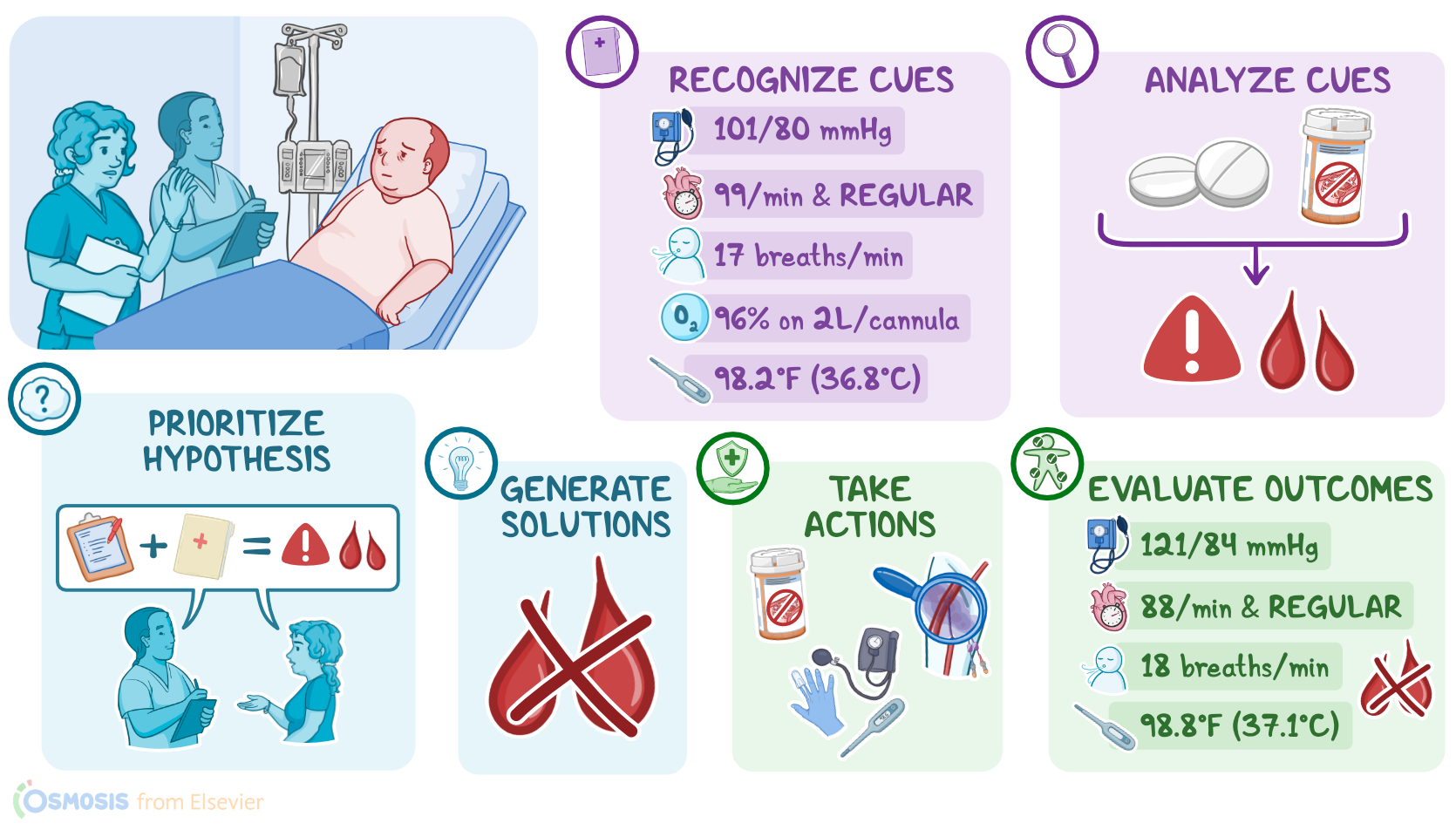
Cameron goes through the steps of the clinical judgment measurement model to make clinical decisions about Kevin's care by recognizing and analyzing cues, prioritizing hypotheses, generating solutions, taking action and evaluating outcomes.
Recognizing and Analyzing Cues0:44–2:26
First, nurse, Cameron recognizes important cues including Kevin's vital signs which are BP 10 8/80 millimeters of mercury, heart rate, 99 BPM and regular R 17 breaths per minute oxygen saturation, 96% on 2 L per nasal cannula and temperature.
98.2 °F or 36.8 °C. When asked about pain.
Kevin reports a current pain level of three out of 10 in his groin incision nurse, Cameron notes that Kevin has a small amount of dried blood on his groin dressing and the surrounding area is ecchymotic and tender to palpation.
Nurse, Cameron also notes Kevin is prescribed the antiplatelet medication, clopidogrel. Next, nurse Cameron analyzes these cues.
He understands that PC is a minimally invasive procedure that involves inserting a catheter through the radial or femoral artery to locate blockages in the coronary arteries.
After the blockage is located, a tiny balloon is inserted in the obstructed coronary artery to compress plaque against the artery wall if needed, a stent can be placed during PCI to keep the artery patent.
After the procedure, patients are typically given antiplatelet medications like clopidogrel to prevent additional clot formation, especially around the new stent.
Nurse. Cameron realizes that Kevin's history of aspirin therapy combined with clopidogrel places him at risk for bleeding.
Nurse. Cameron recognizes that Kevin needs management of his bleeding risk to maintain perfusion and support healing and recovery.
Prioritizing Hypotheses, Generating Solutions, and Taking Action2:26–4:44
Now, using the information he's gathered along with Kevin's medical history. Nurse, Cameron reports his findings to R and Rachel and together they choose a priority hypothesis of risk for bleeding.
Then they generate solutions to address Kevin's risk for bleeding and they establish the expected outcome that after intervening, Kevin will not experience complications from bleeding.
During the shift. Nurse, Cameron and RN Rachel then take action to implement these solutions.
They review the electronic health record or E hr and note that Kevin's clopidogrel is due within the hour. They also know in order to monitor Kevin's groin incision and to gradually increase activity while following their facility's protocol for post PCI care.
Then nurse Cameron and RN Rachel work together to care for Kevin. RN Rachel plans to reassess Kevin's incision site pulses, sensation, movement and skin temperature, distal to the incision site every four hours.
Meanwhile, nurse Cameron will continue to monitor Kevin's vital signs and administer Kevin's clopidogrel together they enter Kevin's room, RN Rachel greets him.
Hi, Kevin. I'm going to check your groin incision to make sure it's healing as expected.
Kevin replies. Ok.
I don't want to have any bleeding problems. I'm worried that it's so bruised.
It's normal for the site to be a little bruised and tender. We're going to monitor you closely for bleeding.
But in the meantime, it's important that you rest to minimize the risk of bleeding. I understand.
But what if I need to go to the bathroom? Nurse, Cameron interjects, please ring your call bell and we'll assist you to the bathroom.
It's important to resume activity like walking slowly and avoid straining while going to the bathroom as this can cause pressure to build up near your incision site.
If you feel like you're straining because of constipation, your healthcare provider has ordered a stool softener to help prevent the need to strain.
Ok. Thank you.
Before leaving the room, nurse, Cameron administers the prescribed clopidogrel according to the principles of safe medication administration and ensures that Kevin's call bell is in reach at the end of the shift, nurse, Cameron and R and Rachel reenter the room to evaluate the outcome of their actions.
Evaluating Outcomes4:44–5:30
Nurse Cameron takes Kevin's vital signs which are BP. 1 21/84 millimeters of mercury, heart rate, 88 BPM and regular respirations, 18 breaths per minute.
Oxygen saturation of 98% on 2 L, nasal cannula and pain. Two out of 10 with temperature, 98.8 °F or 37.1 °C.
Together, they look at the incision site and note that Kevin's dressing shows no additional bleeding and the surrounding ecchymosis is unchanged.
They also check blood flow to Kevin's extremity which shows warm dry skin, strong pedal pulses and intact sensation and movement.
All right, it's a quick recap. Nurse, Cameron recognized and analyzed cues related to Kevin's risk for bleeding and in collaboration with RN Rachel prioritized hypotheses and generated solutions to address this problem.
Review5:30–5:58
Nurse Cameron and RN Rachel then took action and evaluated Kevin's outcomes and compared them to the expected outcome. Since Kevin didn't experience complications from bleeding during the shift, they determined that the plan of care was successful.
| CASE STUDY - ACUTE CORONARY SYNDROME | ||
| KEY POINTS | MY NOTES | |
| INTRODUCTION |
| |
| RECOGNIZING AND ANALYZING CLUES |
| |
| PRIORITIZING HYPOTHESES, GENERATING SOLUTIONS, AND TAKING ACTIONS |
| |
| EVALUATING OUTCOMES |
| |
- "Adult health nursing (9th ed.)" Elsevier (2023)
- "Medical-surgical nursing (8th ed.)" Elsevier (2023)
- "Medical-surgical nursing: Concepts and practice (5th ed.)" Elsevier (2023)
No notes for this video yet
Try adding a note below