Case study - Anaphylaxis: Nursing
Introduction0:00–0:33
Nurse Milagros works on a Medical-Surgical unit and is caring for Jessica, a 32-year-old female with a history of intravenous drug use, who was recently admitted for endocarditis.
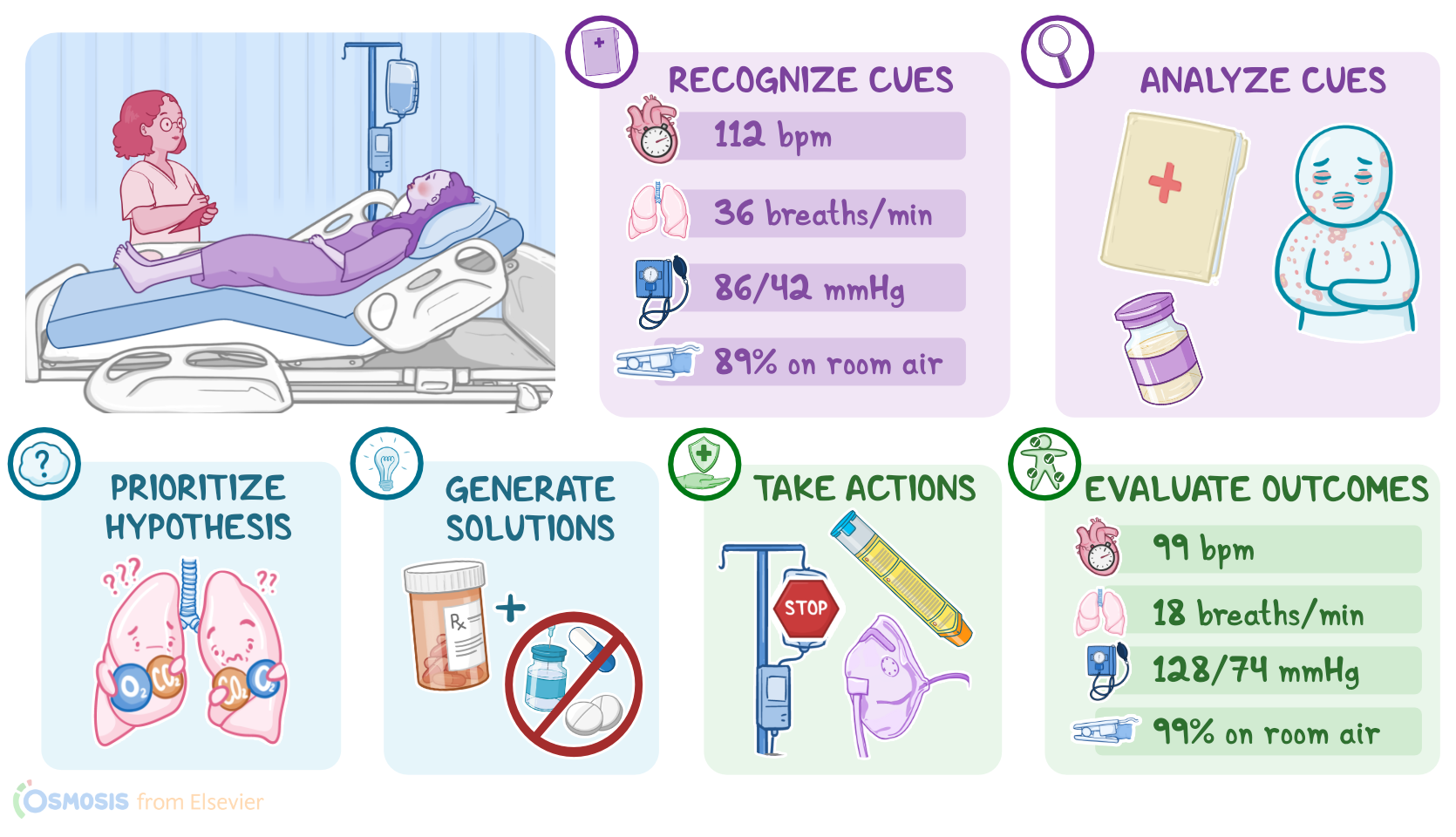
After settling Jessica in her room, Nurse Milagros goes through the steps of the Clinical Judgement Measurement Model to make clinical decisions about Jessica’s care by recognizing and analyzing cues, prioritizing hypotheses, generating solutions, taking action, and evaluating outcomes.
First, Nurse Milagros recognizes important cues including Jessica’s vital signs, which are blood pressure 86/42 mmHg, heart rate 112 beats per minute, respirations 36 breaths per minute, and pulse oximetry 89 percent on room air.
Recognizing and Analyzing Cues0:33–1:36
Upon auscultation, Nurse Milagros hears expiratory wheezes in all of Jessica’s lung fields and she also notes Jessica’s restless, fearful appearance.
She reviews the electronic health record, or EHR, and notes that Jessica has no known allergies to foods or medications.
Also, Jessica hasn’t received any medications except the infusion of penicillin in the last four hours. Based on her assessment and recent infusion of penicillin, Nurse Milagros realizes Jessica is likely experiencing anaphylaxis.
Now, using the information she's gathered along with Jessica’s medical history, Nurse Milagros chooses a priority hypothesis of impaired gas exchange.
Prioritizing Hypotheses, Generating Solutions, and Taking Action1:36–4:02
Then, she generates solutions to address Jessica's impaired gas exchange that will include pharmacologic and nonpharmacologic interventions; and she establishes the expected outcome that 30 minutes after intervening, Jessica’s respiratory status will stabilize.
Nurse Milagros then takes action to implement these solutions. First, she stops the infusion of penicillin.
Then, she calls the hospital operator and requests that a rapid response be called to Jessica’s room. Next, the intensivist arrives at the bedside, and gives a verbal order for a one-time injection of intramuscular epinephrine STAT.
The nurse from the rapid response team retrieves the epinephrine from the unit’s crash cart and confirms the dose with Nurse Milagros.
Nurse Milagros then injects it into Jessica’s left vastus lateralis muscle. Other staff members in the room assist Nurse Milagros, by placing Jessica in low-Fowler position, placing a non-rebreather mask over her nose and mouth and providing 100% oxygen at 10 liters per minute, infusing a rapid bolus of normal saline to expand Jessica’s circulating volume, administering the ordered IV diphenhydramine to block the release of histamine, and monitoring her vital signs every five minutes.
After fifteen minutes, Jessica’s breathing becomes more regulated and she's able to speak. Jessica: What happened?
My tongue felt so itchy, and I couldn’t breathe! Nurse Milagros: Well, it seems like you may have had an allergic reaction to the antibiotic you were getting, but we stopped the antibiotic and gave you medicine to help stop the reaction.
Jessica: My sister is allergic to penicillin, but I’ve never had to take it before. That was scary.
Nurse Milagros: Allergic reactions can be mild, but yours was severe. How are you feeling now?
Jessica: A little shaky, but better. Nurse Milagros: Shaking can be expected after receiving epinephrine.
I’m going to stay with you until you feel better. The rapid response team prepares to leave, and Nurse Milagros calls Jessica’s health care provider from her bedside to update them on the situation.
She documents penicillin as an allergy in Jessica’s medical record, making sure to add that Jessica had a severe, anaphylactic reaction to the medication.
Thirty minutes later, Nurse Milagros evaluates the outcomes of her actions. Jessica’s vital signs are blood pressure 128/74 mmHg, heart rate 90 beats per minute, respiratory rate 18 breaths per minute, and pulse oximetry 99 percent on room air.
Evaluating Outcomes4:02–4:29
Jessica’s breathing remains regular and nonlabored. Faint expiratory wheezes are heard on auscultation with proper air movement throughout.
Alright, as a quick recap...Nurse Milagros recognized and analyzed cues related to Jessica’s anaphylactic reaction to the penicillin infusion, and prioritized hypotheses and generated solutions to address this problem.
Review4:29–5:02
Nurse Milagros, together with the rapid response team, then implemented pharmacologic and nonpharmacologic measures to address Jessica’s impaired gas exchange and evaluated Jessica’s outcomes, comparing them to the expected outcome.
Since Jessica’s respiratory distress was resolved, Nurse Milagros determined that the plan of care was successful.
| CASE STUDY - ANAPHYLAXIS | ||
| KEY POINTS | NOTES | |
| INTRODUCTION |
| |
| RECOGNIZING AND ANALYZING CUES |
| |
| PRIORITIZING HYPOTHESES, GENERATING SOLUTIONS, AND TAKING ACTIONS |
| |
| EVALUATING OUTCOMES |
| |
- "Lewis's medical-surgical nursing: Assessment and management of clinical problems. (12th ed.)" Elsevier (2022)
- "Medical-surgical nursing: Concepts for interprofessional and collaborative care. (10th ed.)" Elsevier (2021)
- "Lewis’s medical-surgical nursing in Canada: Assessment and management of clinical problems. (5th ed.)" Elsevier (2023)
No notes for this video yet
Try adding a note below