Case study - Anemia: Nursing
Introduction0:00–0:35
Nurse. Lucia works on a medical surgical unit and is caring for Ahmed.
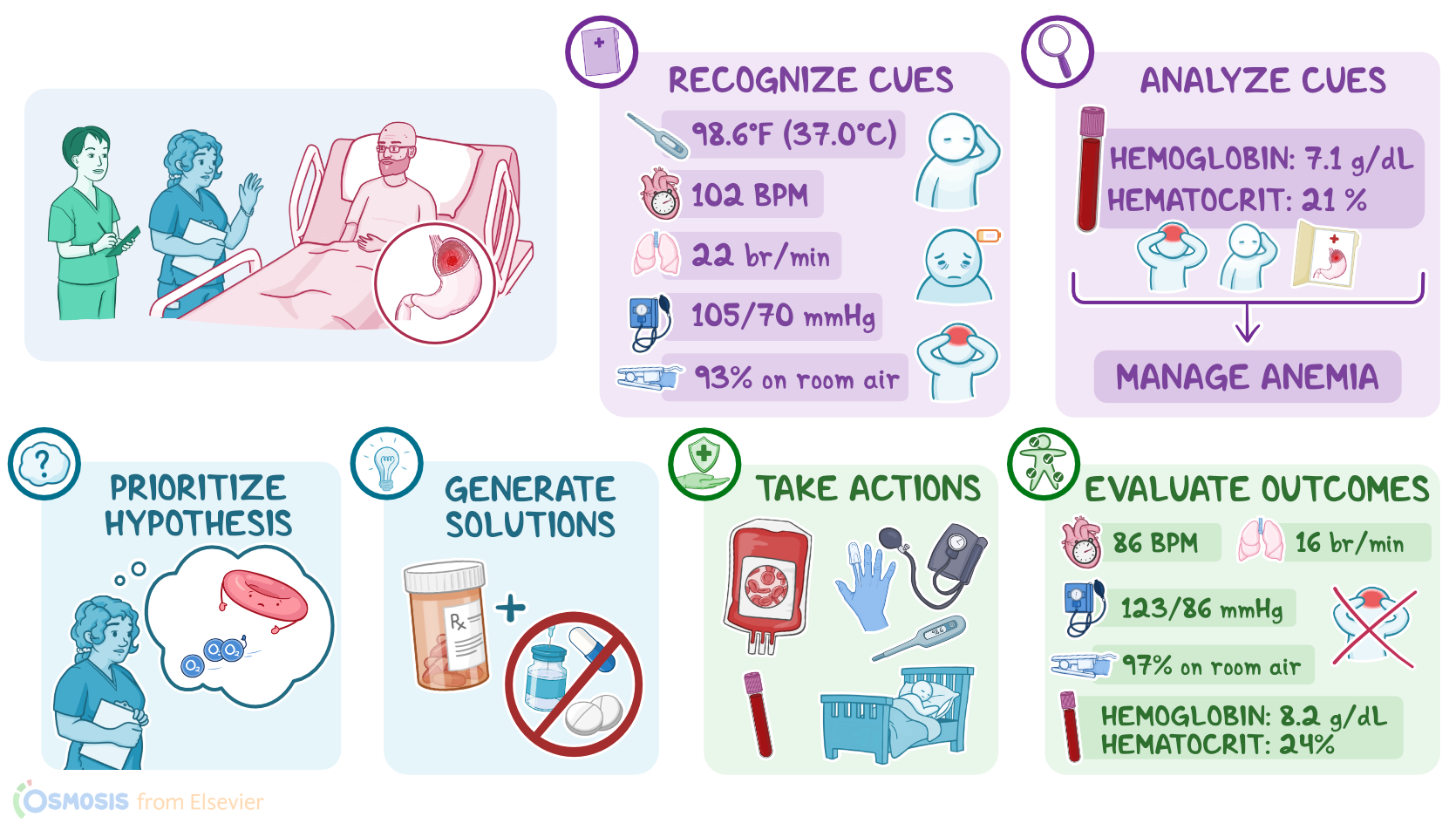
A 61 year old with a history of peptic ulcer disease who was admitted several days ago for gastrointestinal bleeding. In collaboration with the registered nurse, RN Juma, nurse, Lucia goes through the steps of the clinical judgment measurement model to make clinical decisions about Ahmed's care by recognizing and analyzing cues, prioritizing hypotheses, generating solutions taking action and evaluating outcomes.
Recognizing and Analyzing Cues0:35–2:03
First, nurse, Lucia recognizes important cues including Ahmed's vital signs which are temperature 98.6 °F or 37 °C. Heart rate, 100 and two BPM respirations, 22 breaths per minute BP, 10 5/70 millimeters of mercury and oxygen saturation.
93% on room, air. Ahmed appears pale and states that he has no energy.
He also reports mild headache pain which he rates as three out of 10. Next.
Nurse, Lucia analyzes these cues. She reviews the electronic health record or EHR and notes that Ahmed's latest hemoglobin is 7.1 g per deciliter and his hematocrit is 21%.
Nurse. Lucia recognizes that Ahmed is exhibiting clinical manifestations of anemia that can occur when a bleeding peptic ulcer causes gastrointestinal blood loss.
She also knows that blood loss can result in loss of iron which is needed to sustain normal hemoglobin production. This impairs the oxygen carrying capacity of the blood resulting in impaired tissue perfusion and symptoms like weakness, fatigue, headaches, as well as signs like pallor and tachycardia.
Nurse. Lucia realizes that Ahmed needs management of his anemia to promote effective tissue perfusion and oxygenation.
Prioritizing Hypotheses, Generating Solutions, and Taking Action2:03–3:37
Now using the information she's gathered along with Ahmed's medical history. Nurse, Lucia works in collaboration with RN Juma to choose a priority hypothesis of impaired peripheral tissue perfusion.
Then along with ARN Juma, she generates solutions to address Ahmed's impaired perfusion that will include pharmacologic and non pharmacologic measures.
And they establish the expected outcome that after intervening Ahmed will demonstrate evidence of improved tissue perfusion by the end of the shift.
Then they take action to implement these solutions. RN Ju notifies the health care provider about Ahmad's assessment findings and a transfusion of packed red blood cells is ordered.
Um and nurse Lucia gather the necessary supplies and enter Ahmed's room. RN initiates the blood transfusion and monitors Ahmed for the first hour after that, nurse, Lucia continues to monitor.
Ahmed collects his vital signs per facility protocol and watches him for any adverse reactions of the transfusion. While the blood infuses nurse Lucia promotes rest to decrease Ahmed's oxygen consumption by dimming the lights in Ahmed's room and providing a warm blanket.
She also gives him a cool cloth for his headache. When the transfusion is complete.
Nurse, Lucia takes Ahmed's vital signs and draws a repeat hemoglobin and hematocrit. As ordered.
At the end of the shift, nurse, Lucia enters Ahmed's room to evaluate the outcome of her actions. She takes ahmed's vital signs which are temperature 98.6 °F or 37 °C.
Evaluating Outcomes3:37–4:25
Heart rate, 86 BPM R 16 breaths per minute BP, 1 28/86 millimeters of mercury and oxygen saturation. 97% on room air.
She then reviews the results of ahmed's blood work which is hemoglobin 8.2 g per deciliter and hematocrit. 24%.
Ahmed reports. His headache has resolved and his pain is zero out of 10.
Nurse. Lucia also notes that he appears less pale.
Review4:25–4:59
All right. As a quick recap.
Nurse, Lucia recognized and analyzed cues related to Ahmed's impaired peripheral tissue perfusion and in collaboration with RN Je prioritized hypotheses and generated solutions to address this problem.
Nurse, Lucia and RN Juma then implemented pharmacologic and non pharmacologic measures and evaluated Ahmed's outcomes and compared them to the expected outcome.
Since Ahmed demonstrated evidence of improved peripheral tissue perfusion. They determined the plan of care was successful
| CASE STUDY - ANEMIA | ||
| KEY POINTS | MY NOTES | |
| INTRODUCTION |
| |
| RECOGNIZING AND ANALYZING CUES |
| |
| PRIORITIZING HYPOTHESES, GENERATING SOLUTIONS, AND TAKING ACTIONS |
| |
| EVALUATING OUTCOMES |
| |
- "Adult health nursing (9th ed.)" Elsevier (2023)
- "Medical-surgical nursing (8th ed.)" Elsevier (2023)
- "Medical-surgical nursing: Concepts and practice (5th ed.)" Elsevier (2023)
No notes for this video yet
Try adding a note below