Case study - Benign prostatic hyperplasia (BPH): Nursing

Case study - Benign prostatic hyperplasia (BPH): Nursing

Renal/Urinary

Renal/Urinary

Case study - Benign prostatic hyperplasia (BPH): Nursing
Case study - Chronic kidney disease (CKD): Nursing
Case study - Pediatric urinary tract infection: Nursing
Case study - Pyelonephritis: Nursing
Bladder tumors: Nursing
Chronic kidney disease (CKD): Nursing
Complete metabolic panel (CMP) - Blood urea nitrogen (BUN) and creatinine (Cr): Nursing
Complete metabolic panel (CMP) - Estimated glomerular filtration rate (eGFR): Nursing
Complete metabolic panel (CMP) - Total protein: Nursing
Dialysis care: Nursing
Epididymitis: Nursing
Glomerulonephritis: Nursing
Nephrotic syndrome: Nursing
Polycystic kidney disease (PKD): Nursing
Prostate cancer: Nursing
Pyelonephritis: Nursing
Renal and urinary calculi: Nursing
Renal cancer: Nursing
Testicular cancer: Nursing
Urinary retention: Nursing
Critical care case study - Acute kidney injury: Nursing
Bladder and bowel training: Clinical skills notes
Collecting a urine specimen: Clinical skills notes
Condom catheters: Clinical skills notes
Hygiene - Perineal care: Nursing skills
Hygiene - Urinary catheter care: Nursing skills
Monitoring fluid intake and output: Clinical skills notes
Performing urine testing: Clinical skills notes
Removing indwelling catheters: Clinical skills notes
Urinary catheters and routine indwelling catheter care: Clinical skills notes
Kidney disease: Nursing pathophysiology
Geriatric considerations - Urinary: Nursing
Hypospadias and epispadias: Nursing
Antispasmodics (GU): Nursing pharmacology
Cholinergic therapy - Overview: Nursing pharmacology
Cholinergic therapy (GU): Nursing pharmacology
Diuretics - Osmotic and carbonic anhydrase inhibitors: Nursing pharmacology
Diuretics - Thiazide, thiazide-like, loop, and potassium-sparing diuretics: Nursing pharmacology
Acute kidney injury (AKI): Nursing process (ADPIE)
Benign prostatic hyperplasia (BPH): Nursing process (ADPIE)
Urinary incontinence - Stress: Nursing process (ADPIE)
Urinary tract infections (UTIs): Nursing process (ADPIE)
Liver anatomy and physiology
Renal system anatomy and physiology
Hydration
Body fluid compartments
Movement of water between body compartments
Renal clearance
Glomerular filtration
Proximal convoluted tubule
Loop of Henle
Distal convoluted tubule
Renin-angiotensin-aldosterone system
Sodium homeostasis
Potassium homeostasis
Phosphate, calcium and magnesium homeostasis
Osmoregulation
Antidiuretic hormone
Physiologic pH and buffers
The role of the kidney in acid-base balance
Acid-base map and compensatory mechanisms
Plasma anion gap
Anatomy of the abdominal viscera: Kidneys, ureters and suprarenal glands

Notes

CASE STUDY - BENIGN PROSTATIC HYPERPLASIA (BPH)

KEY POINTS
NOTES
INTRODUCTION
  • Surgical step-down unit
  • 55-year-old man
  • Transurethral resection of the prostate (TURP)

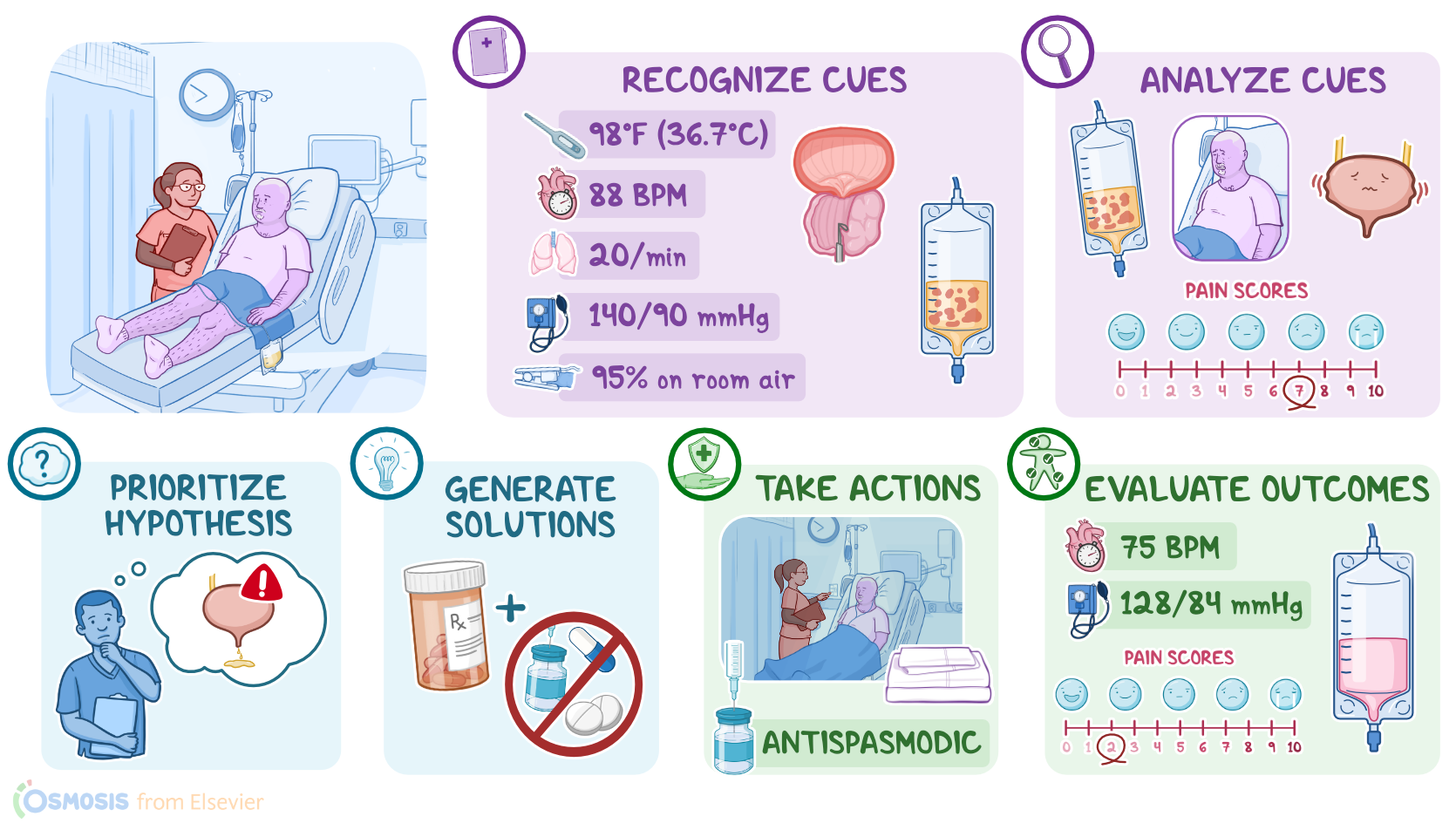
RECOGNIZING AND ANALYZING CUES
  • Recognize cues
    • Temperature: 98.0 F (36.7 C)
    • Blood pressure: 140/90 mmHg
    • Heart rate: 88
    • Respirations: 20
    • Oxygen saturation: 95% room air
    • Grimacing, shifting uncomfortably
    • Large blood clots and amber-colored drainage in continuous bladder irrigation (CBI)
  • Analyze cues
    • CBI should be light pink 
    • Discomfort due to ineffective urinary irrigation
    • Bladder spasms can cause additional pain
    • Last pain medication was 4 hours ago

PRIORITIZING HYPOTHESES, GENERATING SOLUTIONS, AND TAKING ACTIONS
  • Priority hypothesis
    • Impaired urinary elimination
  • Generate solutions
    • Effective urinary elimination within 1 hour
  • Take action
    • Flushes catheter
    • Increases rate of CBI
    • Administer medications as prescribed
    • Dims lights, provides warm blankets, encourages use of soothing music

EVALUATING OUTCOMES
  • Temperature: 98.4 F (36.8 C)
  • Blood pressure; 128/84 mmHg
  • Heart rate: 75
  • Respirations: 14
  • Oxygen saturation: 100% room air
  • Draining clear, light pink urine
  • Free of clots
  • Pain: 3/10
  • Outcome met

Transcript

Watch video only

Nurse Suleena works on a Surgical Step-Down Unit and is caring for Pedro, a 55-year-old male with a history of benign prostatic hyperplasia, or BPH, who was admitted two days ago following a transurethral resection of the prostate, or TURP. After settling Pedro in his room, Nurse Suleena goes through the steps of the Clinical Judgment Measurement Model to make clinical decisions about Pedro’s care by recognizing and analyzing cues, prioritizing hypotheses, generating solutions, taking action, and evaluating outcomes

First, Nurse Suleena recognizes important cues, including vital signs, which are temperature 98.0 F or 36.7 C, blood pressure 140/ 90 mmHg, heart rate 88 beats per minute, respirations 20 breaths per minute, and oxygen saturation 95 percent on room air. She also notices Pedro grimacing and shifting uncomfortably in bed. When examining the collection bag for Pedro’s continuous bladder irrigation, or CBI, Nurse Suleena notices large blood clots and amber-colored drainage.  

Next, Nurse Suleena analyzes these cues. She knows that the CBI output should be light pink, and that blood clots and amber-colored urine in the CBI drainage bag can indicate that the irrigation rate likely needs to be increased. Also, Pedro’s non-verbal cues and vital signs indicate he’s experiencing discomfort, which is also likely due to his ineffective urinary drainage. She also recognizes that bladder spasms resulting from his TURP procedure can cause additional pain. Then, she reviews the electronic health record, or EHR, and notes that Pedro’s last dose of pain medication was four hours ago. 

Nurse Suleena: Pedro, how are you feeling after your procedure? 

Pedro: I’m fine. Isn’t there a male nurse on this floor?  

Nurse Suleena: I understand that having a female nurse care for you after your TURP procedure can be unfamiliar. There are no male nurses available today, but I’m going to do my best to take care of you and make you comfortable. Is there anything I can do to help you? 

Pedro: I feel like I need to go to the bathroom a lot. I don’t like having the catheter.  

Nurse Suleena: I can imagine it’s uncomfortable, but the catheter is meant to help your prostate heal. How would you rate your pain from 0 to 10? 

Pedro: Seven, it really hurts and feels like pressure. 

Sources

  1. "Lewis's medical-surgical nursing: Assessment and management of clinical problems. (12th ed.)" Elsevier (2022)
  2. "Medical-surgical nursing: Concepts for interprofessional and collaborative care. (10th ed.)" Elsevier (2021)
  3. "Lewis’s medical-surgical nursing in Canada: Assessment and management of clinical problems. (5th ed.)" Elsevier (2023)