Case study - Chronic obstructive pulmonary disease (COPD): Nursing
Introduction0:00–0:36
Nurse Seema works on a medical-surgical unit and is caring for Richard, a 75-year-old male with a history of smoking, who was admitted for an acute exacerbation of chronic obstructive pulmonary disease, or COPD.
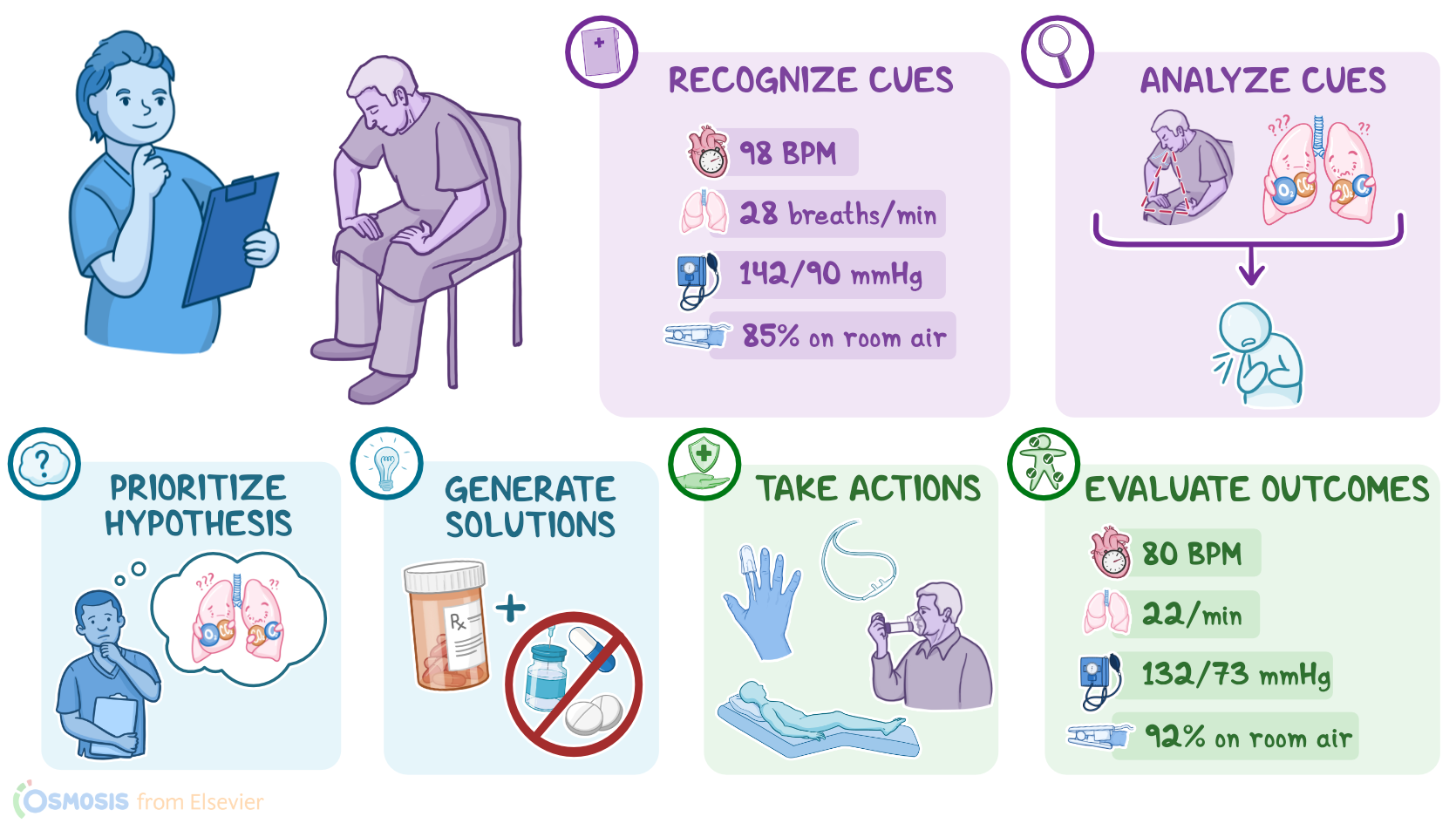
After settling Richard in his room, Nurse Seema goes through the steps of the Clinical Judgment Measurement Model to make clinical decisions about Richard’s care by recognizing and analyzing cues, prioritizing hypotheses, generating solutions, taking action, and evaluating outcomes.
First, Nurse Seema recognizes important cues including Richard’s vital signs, which are temperature 99.6 F or 37.5 C, heart rate 98 beats per minute, respirations 28 breaths per minute, blood pressure 142/90 mmHg, and oxygen saturation 85 percent on room air.
Recognizing and Analyzing Cues0:36–1:50
When asked about pain, Richard reports a current pain level of 0 out of 10. Upon assessment, Nurse Seema notes that Richard’s respirations are labored, he has expiratory wheezing, and he’s leaning over in a tripod position.
Next, Nurse Seema analyzes these cues. She reviews the electronic health record, or EHR, and notes Richard’s arterial blood gas, or ABG, shows a low PaO2, indicating hypoxemia.
She also recognizes COPD causes airway inflammation, leading to obstructed airflow out of the lungs, causing CO2 retention, making gas exchange difficult.
Nurse Seema knows that Richard’s hypoxemia, wheezing, and tripod positioning indicate he’s experiencing impaired respiratory function and needs effective respiratory management.
Now, using the information she’s gathered, Nurse Seema chooses a priority hypothesis of impaired gas exchange. Then, she generates solutions to address Richard’s impaired gas exchange that will include pharmacologic and nonpharmacologic interventions.
Prioritizing Hypotheses, Generating Solutions, and Taking Action1:50–3:25
She establishes an expected outcome that after intervening, Richard will maintain an oxygenation saturation between 89 to 92 percent on 2 liters nasal cannula within one hour.
Nurse Seema then takes action to implement these solutions. She places Richard on continuous pulse oximetry monitoring and applies 2 liters of oxygen using a nasal cannula.
Nurse Seema: I’m going to put some oxygen in your nose and then administer a breathing treatment to make it easier for you to breathe.
This will help you exhale the air in your lungs and make breathing easier. As Richard practices pursed lip breathing, Nurse Seema administers his prescribed breathing treatment according to the principles of safe medication administration.
After the treatment is complete, Nurse Seema raises the head of the bed to 45 degrees to assist with lung expansion and helps Richard to lie back.
She places the call bell in reach and exits his room. An hour later, Nurse Seema enters Richard’s room to evaluate the outcomes of her actions.
Evaluating Outcomes3:25–4:02
She takes Richard’s vital signs which are temperature 99.6 F or 37.5 C, heart rate 80 beats per minute, respirations 22 breaths per minute, blood pressure 132/73 mmHg, and pain 0 out of 10.
His oxygen saturation is 92 percent on 2 liters of oxygen. She also listens to Richard’s lungs and notes that expiratory wheezing is still present, but airflow is improved.
Alright, as a quick recap...Nurse Seema recognized and analyzed cues related to Richard’s impaired gas exchange and prioritized hypotheses and generated solutions to address this problem.
Review4:02–4:26
Nurse Seema then implemented pharmacologic and nonpharmacologic measures to address Richard’s COPD exacerbation, and evaluated his outcomes, comparing them to the expected outcomes.
Since Richard’s oxygen saturation goal was achieved, Nurse Seema determined that the plan of care was successful.
| CASE STUDY - CHRONIC OBSTRUCTIVE PULMONARY DISEASE (COPD) | ||
| KEY POINTS | NOTES | |
| INTRODUCTION |
| |
| RECOGNIZING AND ANALYZING CUES |
| |
| PRIORITIZING HYPOTHESES, GENERATING SOLUTIONS, AND TAKING ACTIONS |
| |
| EVALUATING OUTCOMES |
| |
- "Lewis's medical-surgical nursing: Assessment and management of clinical problems. (12th ed.)" Elsevier (2022)
- "Medical-surgical nursing: Concepts for interprofessional and collaborative care. (10th ed.)" Elsevier (2021)
- "Lewis’s medical-surgical nursing in Canada: Assessment and management of clinical problems. (5th ed.)" Elsevier (2023)
No notes for this video yet
Try adding a note below