Case study - Deep vein thrombosis (DVT): Nursing
Introduction0:00–0:33
Nurse Hakeem works on a Medical-Surgical unit and is caring for Lucille, a 72-year-old female who's being admitted for a deep vein thrombosis, or DVT in her left iliofemoral vein.
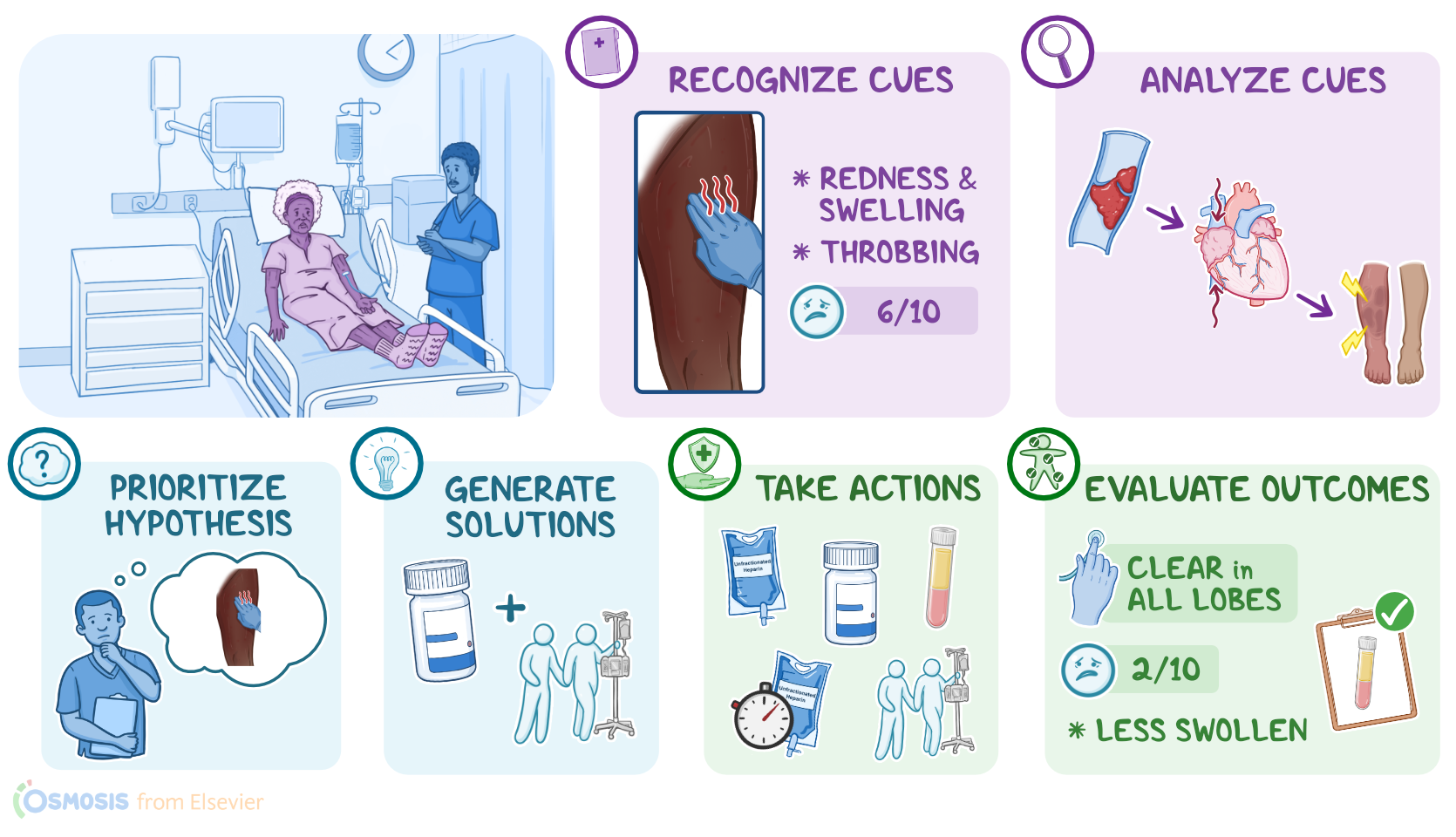
After settling Lucille in her room, Nurse Hakeem goes through the steps of the Clinical Judgment Measurement Model to make clinical decisions about Lucille’s care by recognizing and analyzing cues, prioritizing hypotheses, generating solutions, taking action, and evaluating outcomes.
Nurse Hakeem starts by recognizing important cues. He notes signs and symptoms consistent with Lucille's diagnosis of DVT, including redness and swelling of the affected area.
Recognizing and Analyzing Cues0:33–1:42
Upon light palpation, Nurse Hakeem notes Lucille’s leg is warm, the skin is taut and tender, and she rates her pain as 6 out of 10 and describes it as throbbing.
Then, Nurse Hakeem analyzes these cues. He reviews the electronic health record, or EHR, and sees that Lucille recently had surgery to repair a fractured left hip, and that an ultrasound report identified the DVT.
He knows that immobility after surgery increased Lucille’s risk for a DVT, and that the thrombus lodged in her vein is causing inflammation and decreasing venous return to her heart, causing swelling and pain in her leg.
He also understands that Lucille is at risk of a venous thromboembolism, or VTE, if the thrombus breaks free and travels up through the inferior vena cava, to the right side of the heart, and then into her lungs, causing a pulmonary embolism, or PE.
Now, using the information he's gathered, Nurse Hakeem chooses a priority hypothesis of impaired tissue integrity. Next, he generates solutions to address Lucille’s DVT that will include pharmacologic and nonpharmacologic interventions, and he establishes the expected outcome that after intervening, Lucille’s tissue integrity will show signs of improvement by the end of the shift.
Prioritizing Hypotheses, Generating Solutions, and Taking Action1:42–3:58
Nurse Hakeem then takes action to implement these solutions. He reviews the health care provider’s orders, and sees that Lucille is prescribed a continuous IV infusion of unfractionated heparin to prevent new clots from forming; acetaminophen by mouth every 4 hours as needed for pain; and physical therapy twice daily to promote mobility.
There are also orders for serial coagulation tests, as well as a protocol for titrating the unfractionated heparin dose based on Lucille’s lab results.
Nurse Hakeem gathers the medications and supplies and reenters Lucille’s room. Nurse Hakeem: Okay Lucille, your health care provider has ordered acetaminophen tablets for your pain, and a medication called heparin that will go through your IV that will help thin your blood and keep you from getting more blood clots.
And we’ll be drawing your blood to make sure we’re giving you the right amount of medicine. Lucille: Okay, that sounds fine.
Nurse Hakeem administers Lucille’s acetaminophen using principles of safe medication administration. As he begins setting up her IV, he continues to explain the treatment plan.
Nurse Hakeem: Walking will help improve the circulation in your legs and help decrease the swelling and pain. So physical therapy will help you to get up and walk several times a day.
Does that sound alright? Lucille: Yes, but how will I know if the blood clot’s starting to cause other problems?
Nurse Hakeem: We’ll continue to monitor your skin and circulation in your leg, but I want you to tell us right away if you start having shortness of breath, cough, or chest pain.
That could indicate the clot has moved to your lungs. Do you have any other questions?
Lucille: Not right now. Nurse Hakeem begins Lucille’s infusion following principles of safe medication administration.
Before he leaves the room, he helps her to reposition herself for comfort. At the end of his shift, Nurse Hakeem evaluates the outcomes of his interventions.
Evaluating Outcomes3:58–4:30
Lucille’s leg is still warm to the touch but is less swollen. Also, Lucille rates the pain in her leg at 2 out of 10.
Then, Nurse Hakeem auscultates her lung sounds, which are clear in all lobes, and Lucille reports no shortness of breath or chest pain.
Next, he reviews Lucille’s most recent anticoagulation lab results, which are within the therapeutic range, so he maintains the heparin drip rate.
Alright, as a quick recap…Nurse Hakeem recognized and analyzed cues related to Lucille’s DVT, prioritized hypotheses and generated solutions to address this problem.
Review4:30–4:57
Nurse Hakeem then took actions by implementing pharmacologic and nonpharmacologic measures to address Lucille’s impaired tissue integrity, and evaluated Lucille’s outcomes, comparing them to the expected outcome.
Since Lucille’s tissue integrity improved, Nurse Hakeem determined that the
| CASE STUDY - DEEP VEIN THROMBOSIS (DVT) | ||
| KEY POINTS | NOTES | |
| INTRODUCTION |
| |
| RECOGNIZING AND ANALYZING CUES |
| |
| PRIORITIZING HYPOTHESES, GENERATING SOLUTIONS, AND TAKING ACTIONS |
| |
| EVALUATING OUTCOMES |
| |
- "Lewis's medical-surgical nursing: Assessment and management of clinical problems. (12th ed.)" Elsevier (2022)
- "Medical-surgical nursing: Concepts for interprofessional and collaborative care. (10th ed.)" Elsevier (2021)
- "Lewis’s medical-surgical nursing in Canada: Assessment and management of clinical problems. (5th ed.)" Elsevier (2023)
No notes for this video yet
Try adding a note below