Case study - Dependent adult abuse and neglect: Nursing
Introduction0:00–0:27
Nurse Madison works night shift in a long-term care facility, and is caring for Edward, a 71-year-old patient with a history of dementia.
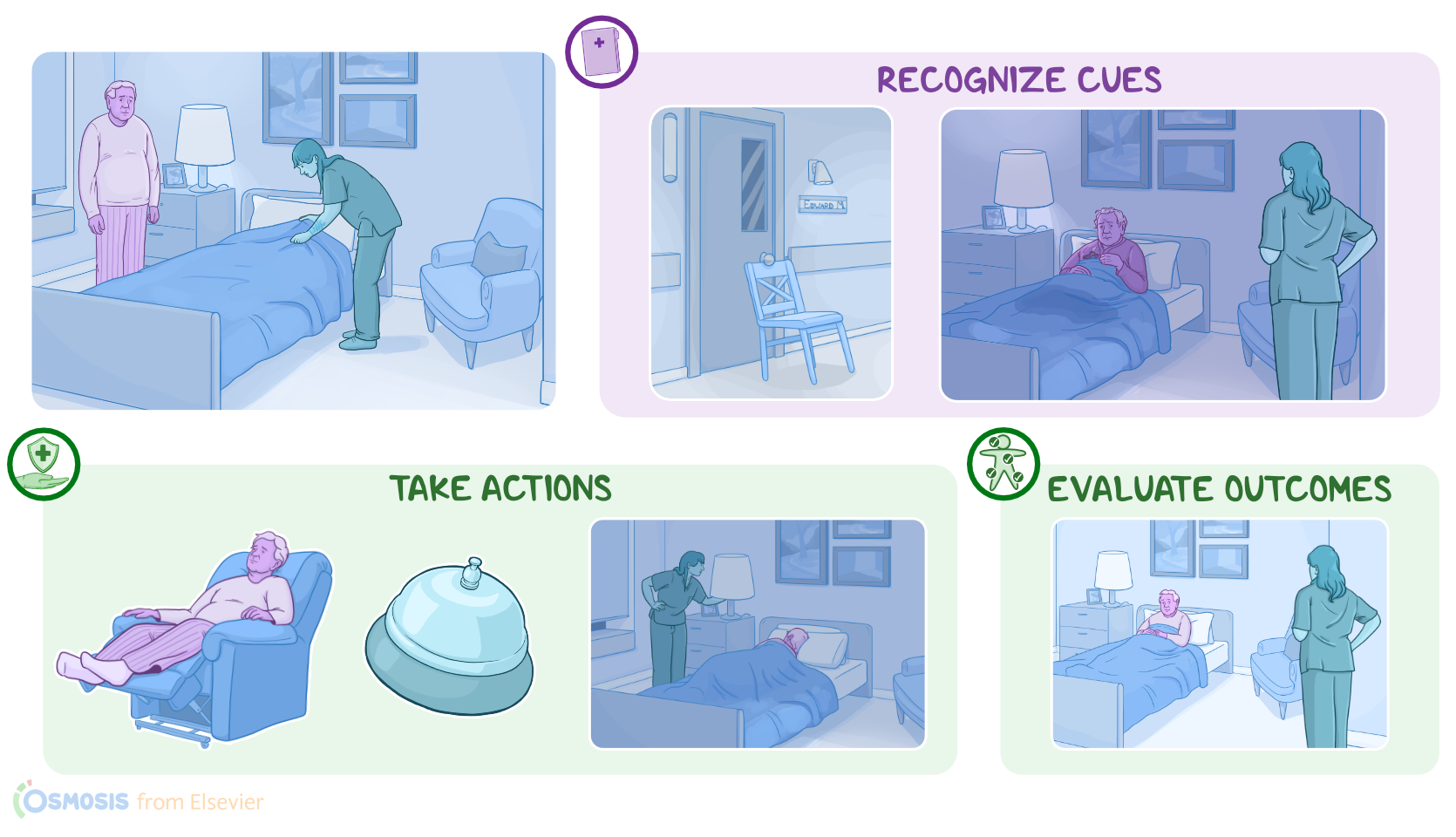
Nurse Madison goes through the steps of the Clinical Judgment Measurement Model to make clinical decisions about Edward’s care by recognizing and analyzing cues, prioritizing hypotheses, generating solutions, taking action, and evaluating outcomes.
First, Nurse Madison recognizes important cues. As she approaches Edward’s room, she notices a chair has been placed in front of the door, preventing it from opening all the way.
Recognizing and Analyzing Cues0:27–1:40
When Nurse Madison asks the unlicensed assistive personnel, or UAP, about it, the UAP admits they placed the chair there to prevent Edward from wandering off the unit.
Then, upon entering the room, Nurse Madison notes Edward's hair is unkempt, and his shirt is stained with dried food. She also sees that Edward’s bed sheets are soaked with urine and he’s visibly upset.
Next, Nurse Madison analyzes these cues. She recalls that the electronic health record, or EHR, documents that Edward is at high risk for elopement, and that he’s attempted to leave the unit several times before being stopped by security.
She also notes that Edward is normally continent of urine. Nurse Madison recognizes that preventing Edward from leaving his room by forcing him into physical confinement is considered restraints abuse.
It also appears that Edward has been neglected, meaning that his basic needs, such as hygiene, haven’t been met. Now, using the information she’s gathered, Nurse Madison chooses a priority hypothesis of powerlessness.
Prioritizing Hypotheses, Generating Solutions, and Taking Action1:40–3:57
Then, she generates solutions to address Edward’s powerlessness, and she establishes the expected outcome that after intervening, Edward will have his basic needs met while remaining safe in his environment.
Nurse Madison then takes action to implement these solutions. She makes sure Edward is safe by ensuring he's free from injuries and confirming his room is safe and clear of anything he could trip or slip on, like blankets or urine on the floor.
Then, she helps him to clean up and change clothes, and she replaces his linens. Since Edward is currently alert and responsive, Nurse Madison attempts to explain the situation to Edward.
Nurse Madison: Edward, I want you to know you’re no longer trapped in your room, and no one is going to lock you in your room again.
I’m here to keep you safe. Edward: I was scared because it was so dark.
Nurse Madison: That sounds very frightening. I’m going to have you sit in a reclining chair in the hallway until you’re ready to go to sleep.
That way you can see me and the other staff members if you need us. How does that sound?
Edward: Okay, I don’t want to be locked in that room again. Nurse Madison then helps Edward into the recliner and assists him to a comfortable position.
She obtains a set of vital signs, which are temperature 98.0 F or 36.6 C, heart rate 68 beats per minute, respirations 16 breaths per minute, blood pressure 116/64 mmHg, and pain zero out of 10.
She turns on the chair alarm and provides him with a manual call bell. After sitting in the recliner in the hallway for an hour, Nurse Madison assists Edward back to his room, helps him into bed, where he falls asleep.
Nurse Madison also notifies the charge nurse of the event. The charge nurse speaks to the UAP and plans a meeting in the morning with the nurse manager.
Nurse Madison files an incident report explaining the event. At the end of the shift, Nurse Madison enters Edward’s room to evaluate the outcome of her actions.
Evaluating Outcomes3:57–4:26
When she enters the room, Edward is sitting comfortably on his bed waiting for breakfast. His vital signs are temperature 98.4 F or 36.8 C, heart rate 72 beats per minute, respirations 16 breaths per minute, blood pressure 112/70 mmHg, and pain zero out of 10.
Alright, as a quick recap...Nurse Madison recognized and analyzed cues related to Edward’s dependent adult abuse and neglect and prioritized hypotheses and generated solutions to address this problem.
Review4:26–4:53
Nurse Madison then took action and implemented measures, then evaluated Edward’s outcomes and compared them to the expected outcome.
Since Edward had his basic needs met while remaining safe in his environment, Nurse Madison determined the plan of
| CASE STUDY - DEPENDENT ADULT ABUSE | ||
| KEY POINTS | NOTES | |
| INTRODUCTION |
| |
| RECOGNIZING AND ANALYZING CUES |
| |
| PRIORITIZING HYPOTHESES, GENERATING SOLUTIONS, AND TAKING ACTIONS |
| |
| EVALUATING OUTCOMES |
| |
- "Varcarolis’s Canadian psychiatric mental health nursing." Elsevier (2023)
- "Keltner’s psychiatric nursing." Elsevier (2023)
No notes for this video yet
Try adding a note below