Case study - Hip fracture: Nursing
Introduction0:00–0:37
Nurse Kenji works on an orthopedic unit and is caring for Sharon, a 74-year-old female with a history of osteoporosis who was recently admitted for a left hip fracture requiring an open reduction and internal fixation, or ORIF.
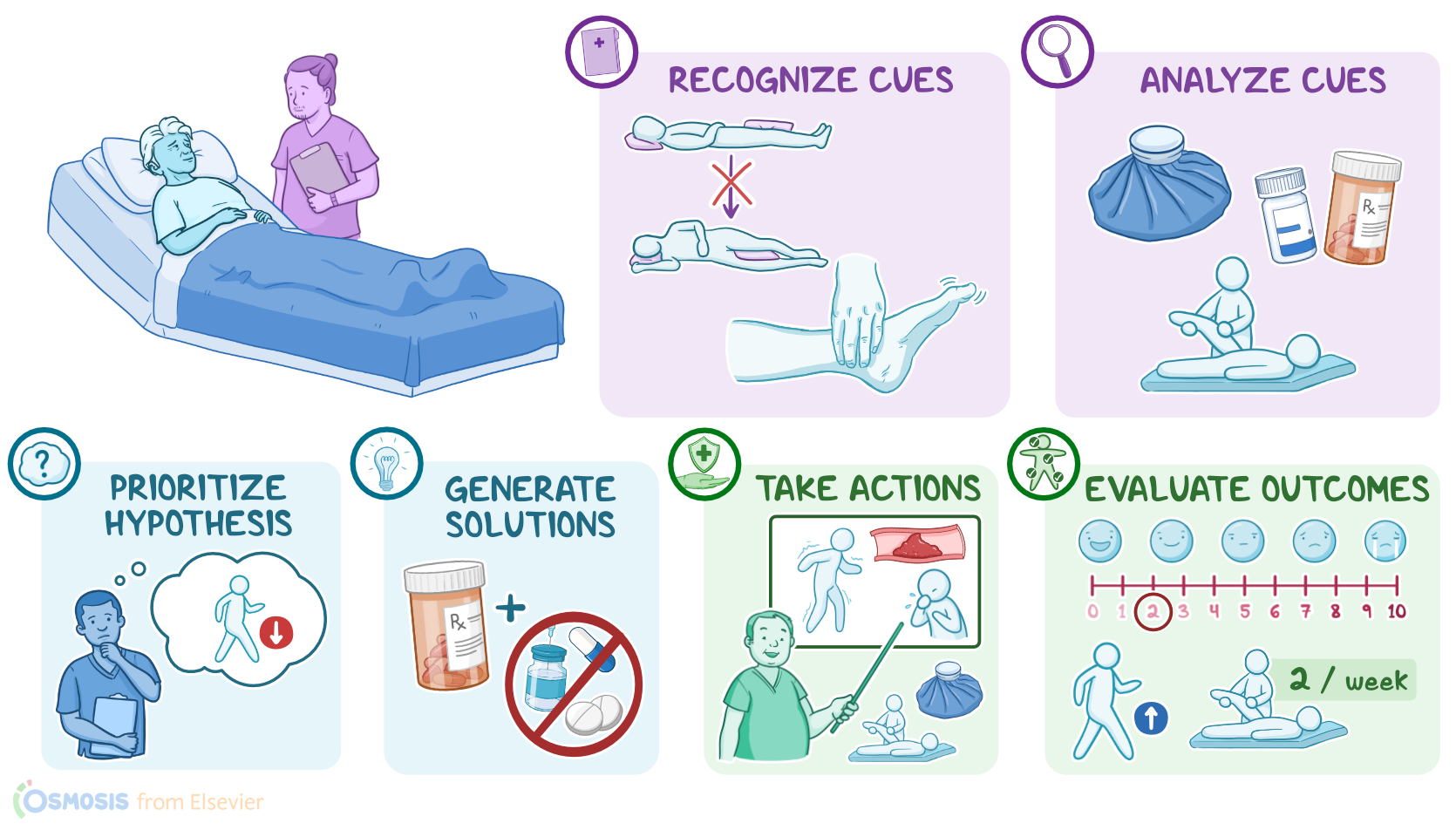
After settling Sharon in her room, Nurse Kenji goes through the steps of the Clinical Judgment Measurement Model to make clinical decisions about Sharon’s care by recognizing and analyzing cues, prioritizing hypotheses, generating solutions, taking action, and evaluating outcomes.
First, Nurse Kenji recognizes important cues, including Sharon’s vital signs, which are temperature 98.6 F or 37 C, heart rate 90 beats per minute, respirations 19 breaths per minute, and blood pressure 123/88 mmHg.
Recognizing and Analyzing Cues0:37–2:11
During the bedside report, Nurse Kenji learned that Sharon declined repositioning during the night shift. Upon assessment, he notes that her hip appears mildly swollen and her surgical dressing is clean and dry.
Nurse Kenji also notes that Sharon’s left foot is warm with intact sensation, 2+ palpable pulses, and she can wiggle her toes.
Nurse Kenji asks Sharon about her comfort. Nurse Kenji: I see that you stayed in the same position throughout the night.
Could you tell me your current pain level? Sharon: I don’t have any pain right now, but I don’t want to move because I know it'll hurt my hip.
Nurse Kenji: I understand. Have you considered taking the prescribed medications to manage your pain?
Sharon: I really don’t like pain medicine because I’m worried about becoming addicted. Next, Nurse Kenji analyzes these cues.
He reviews the electronic health record, or EHR, and notes that Sharon is scheduled to begin physical therapy today. He also notes that Sharon is prescribed ice packs to reduce hip swelling, as well as oxycodone and acetaminophen every four hours as needed for pain management but hasn’t taken any medication since early yesterday evening.
Nurse Kenji realizes that Sharon’s fear of pain is limiting her mobility. With the information he's gathered, Nurse Kenji develops a priority hypothesis of impaired mobility.
Prioritizing Hypotheses, Generating Solutions, and Taking Action2:11–3:54
Then, he generates solutions to address Sharon’s pain and promote mobility that will include pharmacologic and nonpharmacologic interventions.
He establishes the expected outcome that after intervening Sharon will successfully demonstrate at least two recommended activities by the end of her physical therapy session.
Nurse Kenji then takes action to implement these solutions. He talks to Sharon about the importance of mobility following surgery in order to prevent complications of prolonged inactivity, such as delayed recovery, blood clots, and pneumonia.
Then, he teaches Sharon about her prescribed pain medications. Nurse Kenji: I understand you're concerned about taking pain medications.
The risk for addiction is low if oxycodone is taken as prescribed and for a short period of time. I recommend that you take pain medication before activity.
When you’re resting, you can use other therapies like ice and acetaminophen, which can help with your pain, but isn’t habit-forming.
Sharon: Thanks for explaining. In that case, maybe I’ll try some pain medication before my physical therapy session.
Since Nurse Kenji knows that the physical therapist will arrive in one hour, he administers the oxycodone according to safe medication practices to allow enough time for it to take effect before her activity.
Then, he applies an ice pack to Sharon’s left hip. When the physical therapist arrives, Nurse Kenji works with them to help Sharon reposition herself in bed using the trapeze bar, to sit up at the edge of the bed, and then stand briefly at the side of the bed.
After Sharon’s physical therapy session, Nurse Kenji evaluates the outcomes of his actions. He evaluates Sharon’s pain level, which is 2 out of 10 following the activity.
Evaluating Outcomes3:54–4:14
Since Sharon’s pain was controlled and she was able to participate in her physical therapy session, Nurse Kenji determines the expected outcome has been met.
Alright, as a quick recap...Nurse Kenji recognized and analyzed cues related to Sharon’s reluctance to increase mobility following ORIF of her left hip, and he prioritized hypotheses and generated solutions to address this problem.
Review4:14–4:47
Nurse Kenji then took action to implement pharmacologic and nonpharmacologic strategies to control pain and promote mobility, and he evaluated outcomes by comparing them to the expected outcome.
Since Sharon was able to demonstrate at least two physical therapy activities, Nurse Kenji determined that the plan of
| CASE STUDY - HIP FRACTURE | ||
| KEY POINTS | NOTES | |
| INTRODUCTION |
| |
| RECOGNIZING AND ANALYZING CUES |
| |
| PRIORITIZING HYPOTHESES, GENERATING SOLUTIONS, AND TAKING ACTIONS |
| |
| EVALUATING OUTCOMES |
| |
- "Lewis's medical-surgical nursing: Assessment and management of clinical problems. (12th ed.)" Elseiver (2022)
- "Medical-surgical nursing: Concepts for interprofessional and collaborative care. (10th ed.)" Elseiver (2021)
- "Lewis’s medical-surgical nursing in Canada: Assessment and management of clinical problems. (5th ed.)" Elseiver (2023)
No notes for this video yet
Try adding a note below