Case study - Hypothyroidism: Nursing
Notes
| CASE STUDY - HYPOTHYROIDISM | ||
| KEY POINTS | NOTES | |
| INTRODUCTION |
| |
| RECOGNIZING AND ANALYZING CUES |
| |
| PRIORITIZING HYPOTHESES, GENERATING SOLUTIONS, AND TAKING ACTIONS |
| |
| EVALUATING OUTCOMES |
| |
Transcript
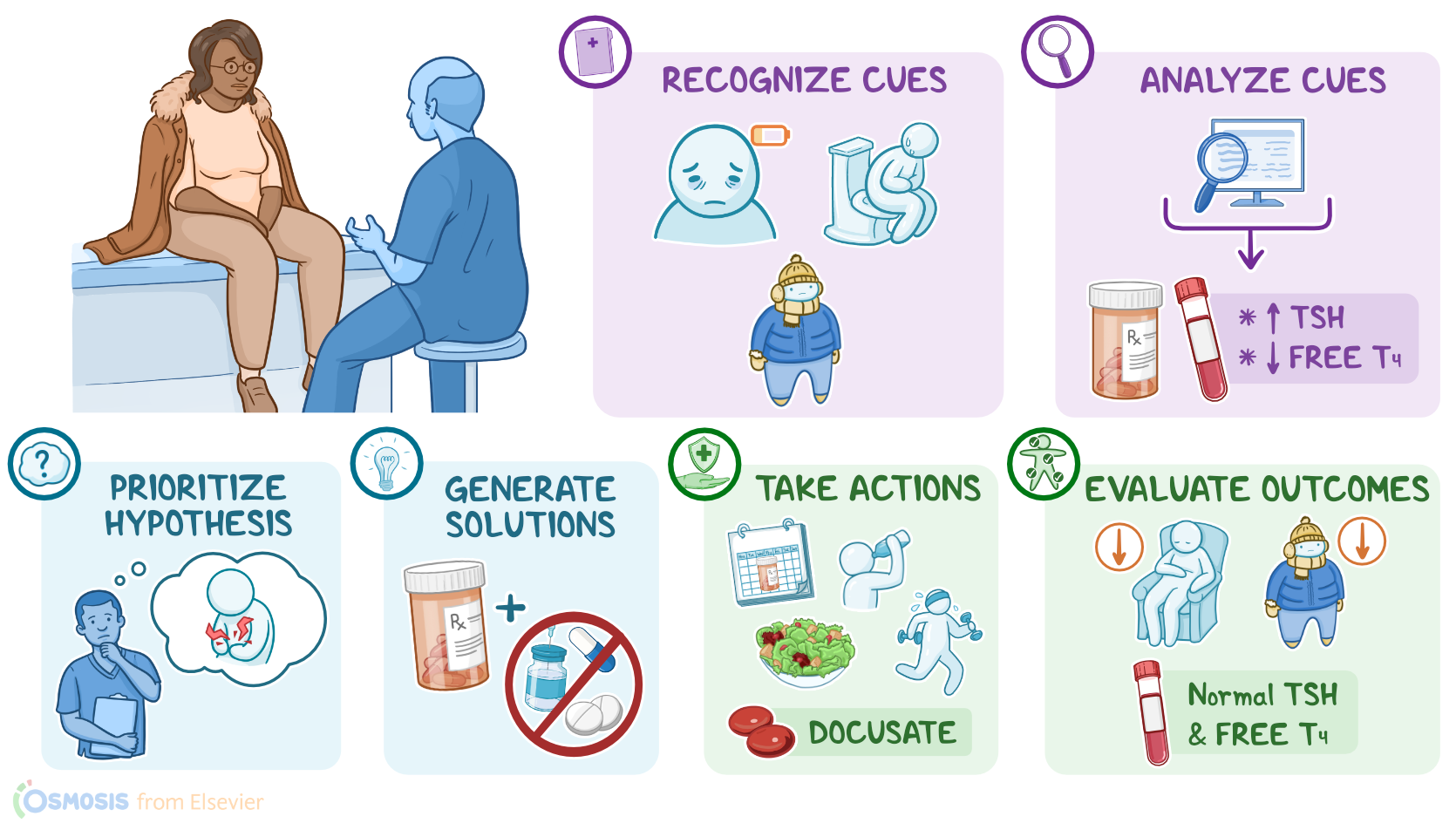
Nurse Kyle works at a family practice clinic and is caring for Amara, a 54-year-old female who presents for a follow-up appointment after being prescribed levothyroxine 3 months ago for newly diagnosed hypothyroidism. After settling Amara in her room, Nurse Kyle goes through the steps of the Clinical Judgment Measurement Model to make clinical decisions about Amara’s care by recognizing and analyzing cues, prioritizing hypotheses, generating solutions, taking action, and evaluating outcomes.
Nurse Kyle recognizes important cues, including Amara’s report of fatigue and constipation. He also notes that Amara shivers and pulls her jacket around her shoulders.
Nurse Kyle: Amara, tell me about what’s been going on since your last appointment.
Amara: A lot of the same things, like I still feel tired and cold. But my main issue is that I’m really constipated and it's making my stomach hurt.
Next, Nurse Kyle analyzes these cues. He reviews the electronic health record, or EHR, and notes that Amara started levothyroxine 3 months ago. He also notes her labs today show an elevated thyroid stimulating hormone, or TSH, and low free T4. Nurse Kyle realizes that since Amara is not yet therapeutic on her medication, she is still experiencing symptoms of hypothyroidism.
Now, using the information he’s gathered, along with Amara’s medical history, Nurse Kyle chooses a priority hypothesis of constipation.
Then, he generates solutions to address Amara’s complaint of constipation that will include pharmacologic and nonpharmacologic interventions. Nurse Kyle establishes the expected outcome that after intervening, Amara will have one bowel movement each day by the time she has her next follow-up in 6 weeks.
Nurse Kyle then takes action to implement these solutions. He knows that although Amara started on levothyroxine 3 months ago, it can take time for the medication to correct her thyroid hormone level, so she may still experience symptoms of hypothyroidism.
He also recognizes that Amara needs support to relieve her constipation, so he steps out of the exam room to collaborate with the health care provider. Nurse Kyle explains Amara’s symptoms and the health care provider prescribes docusate tablets for Amara and increases her current dose of levothyroxine. Nurse Kyle then re-enters Amara’s exam room.
Sources
- "Lewis's medical-surgical nursing: Assessment and management of clinical problems. (12th ed.)" Elsevier (2022)
- "Medical-surgical nursing: Concepts for interprofessional and collaborative care. (10th ed.)" Elsevier (2021)
- "Lewis’s medical-surgical nursing in Canada: Assessment and management of clinical problems. (5th ed.)" Elsevier (2023)