Case study - Knee osteoarthritis: Nursing
Introduction0:00–0:34
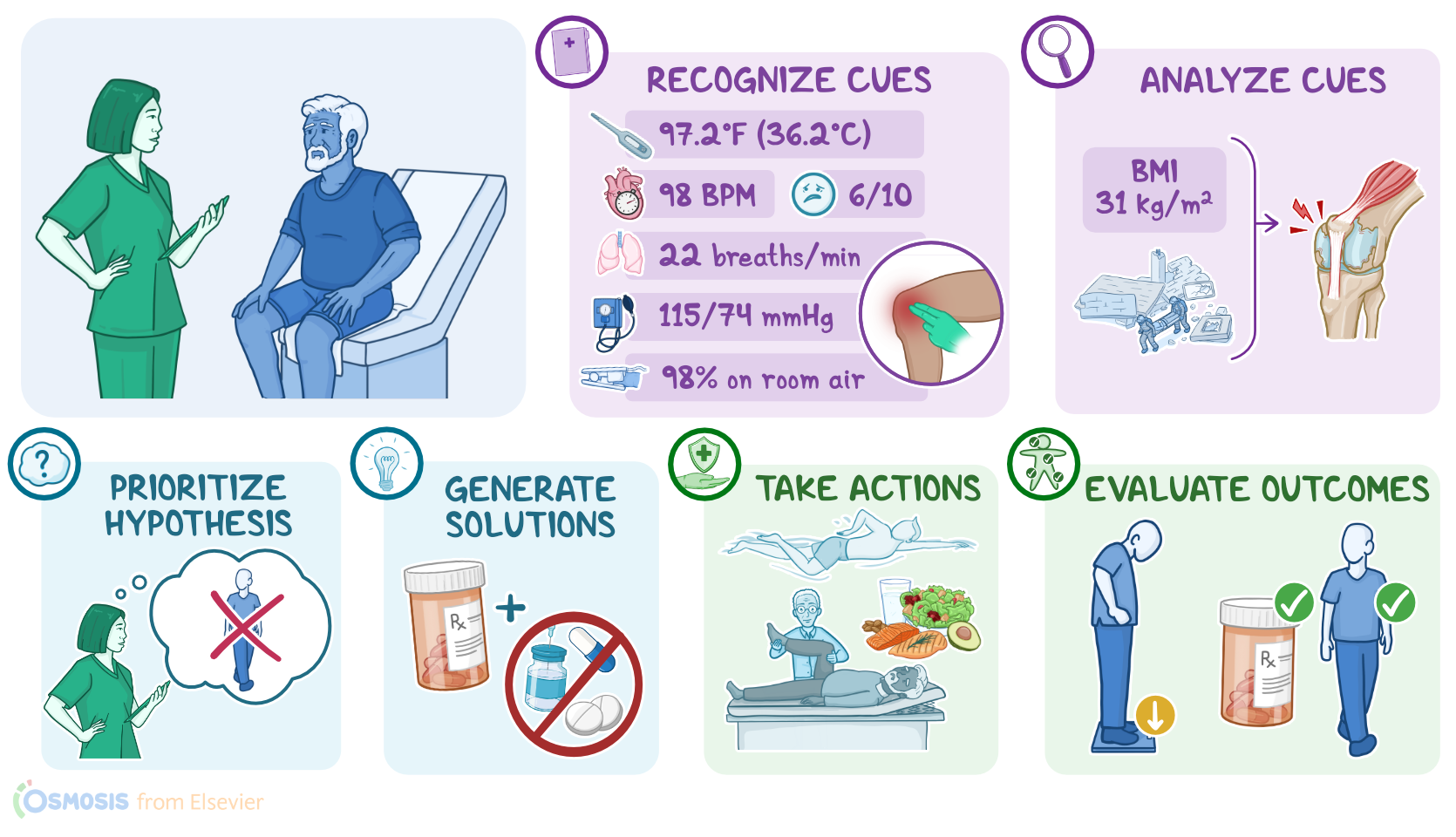
Nurse Mary works at a family practice clinic and is caring for Reicher, a 70 year old male with a history of osteoarthritis who presents to the office for worsening bilateral knee pain.
In collaboration with the registered nurse, RN Ron. Nurse Mary goes through the steps of the clinical judgment measurement model to make clinical decisions about Reker care by recognizing and analyzing cues, prioritizing hypotheses, generating solutions, taking action and evaluating outcomes.
Recognizing and Analyzing Cues0:34–2:57
First, nurse Mary recognizes important cues including Riker's vital signs which are temperature 97.2 °F or 36.2 °C. Heart rate, 98 BPM respirations, 22 breaths per minute BP, 115/74 millimeters of mercury and oxygen saturation.
98% on room air. He currently rates his pain as six on a 0 to 10 numeric scale.
Nurse Mary Notes R and Ron's assessment revealed Reicher has swelling tenderness to palpation and a decreased range of motion or R OM in both of his knees.
I noticed you had quite a bit of pain when R and Ron touched your knees. Can you tell me more about your knee pain.
I used to really enjoy taking walks several times a day. But over the last few years, my knees have felt so stiff when I wake up and they hurt so much when I'm walking.
So I haven't been walking much. It just keeps getting worse.
I've been gaining a bit of weight too since I haven't been walking as much as I used to. Is there anything that makes the pain feel better?
Usually sitting down and resting, makes the pain go away? I try acetaminophen sometimes which helps a little, I guess.
Nurse Mary analyzes these cues. She reviews the electronic health record or EHR and notes.
Reicher's BMI is calculated as 31 kg per meter squared. And that before retiring, he was a firefighter for many years.
Nurse Mary knows that osteoarthritis is a degenerative disease that occurs when there's a gradual destruction of the cartilage that covers the end of each bone found in most joints like the knees.
She also knows this can occur due to factors such as being overweight, experiencing prolonged mechanical wear and tear, like with occupations involving heavy physical activity along with the production of proinflammatory mediators.
Together, these processes result in joint tissue destruction and narrowing of the joint space, causing the bones to rub against each other.
The result is pain, swelling, decreased R OM and impaired function. Nurse Mary recognizes that Reicher needs management of his osteoarthritis to improve his activity tolerance.
Prioritizing Hypotheses, Generating Solutions, and Taking Action2:57–4:16
Now, using the information she's gathered along with Riker's medical history. Nurse Mary reports, her findings to RN run and together they choose a priority hypothesis of activity and tolerance.
Then they generate solutions to address Reicher's activity intolerance that will include pharmacologic and non pharmacologic interventions and establish the expected outcome that after intervening Reicher will be able to tolerate one walk daily.
Nurse Mary then takes action to implement these solutions. After Reicher has visited with the health care provider and R and Ron nurse Mary re enter his room to review the plan of care.
Ok. Your health care provider has prescribed a medication called naproxen to help with the pain and inflammation in your knees.
The health care provider also placed a referral for physical therapy which can help improve your range of motion. That's great.
I hope this helps. Is there anything else I can do Nurse Mary reviews with Reicher about alternative activities that can keep him active but have less stress on his joints like swimming or bicycling and reinforces maintaining a healthy diet to avoid gaining weight which could add to the stress on his knees.
She also encourages him to discuss his goals with the physical therapist. One month later, Reiher returns to the clinic for a follow up appointment and nurse Mary evaluates the outcome of her actions.
Evaluating Outcomes4:16–4:36
Reker states that most days he's able to take a daily walk with minimal pain and that the naproxen really helps. He also reports he's lost a bit of weight since he's been able to move around more.
Mhm. All right.
It's a quick recap. Nurse Mary recognized and analyzed cues related to Riker's activity intolerance.
Review4:36–5:08
And together with R and Ron prioritized hypotheses and generated solutions to address this problem. They then implemented pharmacologic and nonpharmacologic interventions to address Riker's activity intolerance, evaluated reicher's outcomes and compared them to the expected outcome since Reker was able to tolerate one walk a day with minimal pain.
Nurse Mary determined the plan of care was successful.
| CASE STUDY - KNEE OSTEOARTHRITIS | ||
| KEY POINTS | NOTES | |
| INTRODUCTION |
| |
| RECOGNIZING AND ANALYZING CUES |
| |
| PRIORITIZING HYPOTHESES, GENERATING SOLUTIONS, AND TAKING ACTION |
| |
| EVALUATING OUTCOMES |
| |
- "Basic geriatric nursing" Elsevier (2023)
No notes for this video yet
Try adding a note below