Case study - Pediatric appendicitis: Nursing
Introduction0:00–0:33
Nurse Cameron works in the emergency department and is caring for Trevor, a 14-year-old patient who was brought in by his father, Steve, because of abdominal pain and vomiting.
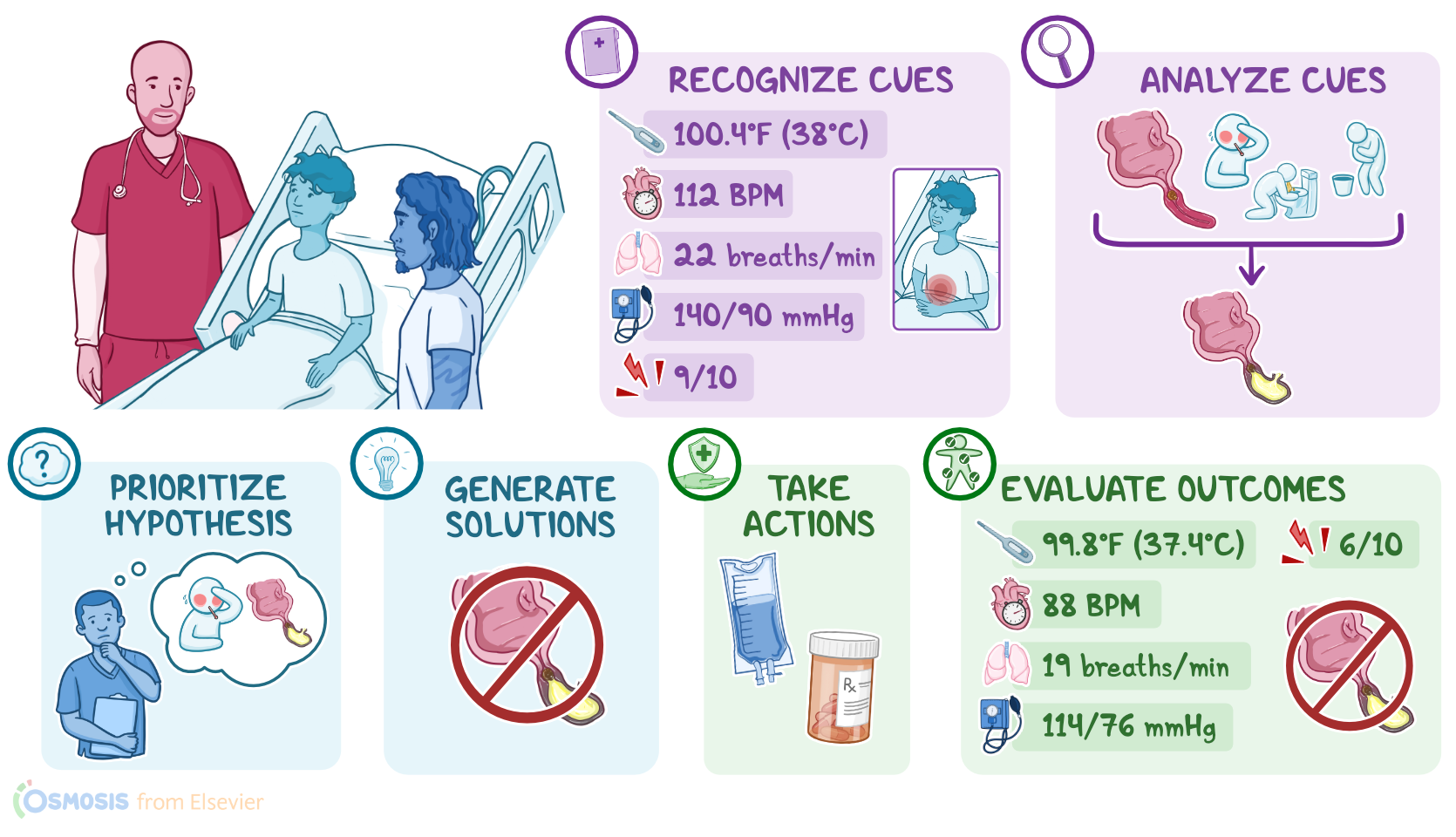
After settling Trevor in his room, Nurse Cameron goes through the steps of the Clinical Judgment Measurement Model to make clinical decisions about Trevor’s care by recognizing and analyzing cues, prioritizing hypotheses, generating solutions, taking action, and evaluating outcomes.
First, Nurse Cameron recognizes important cues such as Trevor’s vital signs, which are temperature 100.4 F, or 38 C, heart rate 112 beats per minute, blood pressure 140/90 mmHg, respiratory rate 22 breaths per minute, and pain 9 out of 10 in his abdomen.
Recognizing and Analyzing Cues0:33–2:57
He also notices Cameron appears anxious, grimacing, and is holding on to his right lower abdomen. Nurse Cameron: Trevor, can you tell me more about your pain?
Trevor: I don’t know, it just really hurts. Steve: He hasn’t been acting like himself all week.
Yesterday, he missed soccer practice because he didn’t feel good and then he threw up and had diarrhea last night. He can’t really keep any food or liquids down.
I thought it was a stomach bug, but his pain got much worse this morning, so I brought him here. Nurse Cameron: Did Trevor have any injuries to his abdomen?
Steve: Not that I know of. Nurse Cameron then performs an abdominal assessment and notes tenderness in Trevor’s right lower quadrant.
Then, in the area between Trevor’s navel and anterosuperior iliac spine, known as the McBurney point, he presses down and quickly releases, which reveals rebound tenderness.
Next, Nurse Cameron analyzes these cues. He reviews the electronic health record, or EHR, and sees that Trevor’s blood work shows leukocytosis with a left shift, and an elevated C-reactive protein, or CRP.
Nurse Cameron notifies the health care provider who comes to the bedside and performs abdominal ultrasound which is positive for appendicitis.
Trevor will need to undergo an emergency appendectomy. Nurse Cameron understands that appendicitis occurs due to an obstruction in the appendix which causes inflammation, accompanied by other symptoms like fever, nausea, and vomiting.
After some time, the appendix can start to irritate the nearby parietal membrane lining the walls of the abdominal cavity, causing the pain to intensify and migrate to the right lower quadrant.
If not treated immediately, it can lead to rupture and peritonitis. Nurse Cameron recognizes that Trevor needs effective management of his acute appendicitis to prevent complications.
Now, using the information he’s gathered, Nurse Cameron selects a priority hypothesis of risk for infection. Then, he generates solutions to address this hypothesis, and he establishes the expected outcome that after intervening, Trevor will be free from complications while he waits to be transferred to surgery.
Prioritizing Hypotheses, Generating Solutions, and Taking Action2:57–4:13
Nurse Cameron then takes action to implement these solutions. He reviews the EHR and sees that Trevor is prescribed continuous IV fluids, pre-operative antibiotics, analgesics, and antipyretics.
Nurse Cameron obtains these supplies and enters Trevor’s room. Nurse Cameron: Hi Trevor, I’ve got some medicine for you to help you feel better and get you ready for surgery.
Do either of you have questions for me about the procedure? Trevor: Will my stomach feel better after I wake up from surgery?
Nurse Cameron: Yes, when you wake up, your stomach will feel much better, you’ll just be a little sleepy. Steve: I’m just so happy we got here in time before his appendix burst.
Nurse Cameron: You did the right thing. Nurse Cameron then administers the prescribed fluids and medications according to the principles of safe medication administration.
He completes the pre-operative checklist and prepares Trevor for surgery. One hour later, Nurse Cameron evaluates the outcome of his actions.
Evaluating Outcomes4:13–4:45
Trevor’s vital signs are temperature 99.8 F, or 37.4 C, heart rate 88 beats per minute, blood pressure 114/76 mmHg, and respiratory rate 19 breaths per minute.
Trevor also reports his pain is 6 out of 10. Nurse Cameron then calls the pre-operative nurse and gives nurse-to-nurse report and transfers Trevor to the operative suite.
Alright, as a quick recap...Nurse Cameron recognized and analyzed cues related to Trevor’s abdominal pain and prioritized hypotheses and generated solutions to address this problem.
Review4:45–5:13
Nurse Cameron then implemented pharmacologic measures to manage Trevor’s risk for infection and evaluated the outcomes and compared them to the expected outcome.
Since Trevor did not develop complications of appendicitis before surgery, Nurse Cameron determined that the plan of care was successful.
| CASE STUDY - PEDIATRIC APPENDICITIS | ||
| KEY POINTS | NOTES | |
| INTRODUCTION |
| |
| RECOGNIZING AND ANALYZING CUES |
| |
| PRIORITIZING HYPOTHESES, GENERATING SOLUTIONS, AND TAKING ACTIONS |
| |
| EVALUATING OUTCOMES |
| |
- "Wong’s essentials of pediatrics. (11th ed.). " Elsevier (2022)
- "Wong’s nursing care for infants and children. (11th ed.)." Elsevier (2019)
No notes for this video yet
Try adding a note below