Case study - Pediatric asthma: Nursing
Introduction0:00–0:34
Nurse Lin works at a primary care clinic and is caring for Joey, an 8-year-old who’s had a cough for two months and recently developed chest tightness over the last two days.
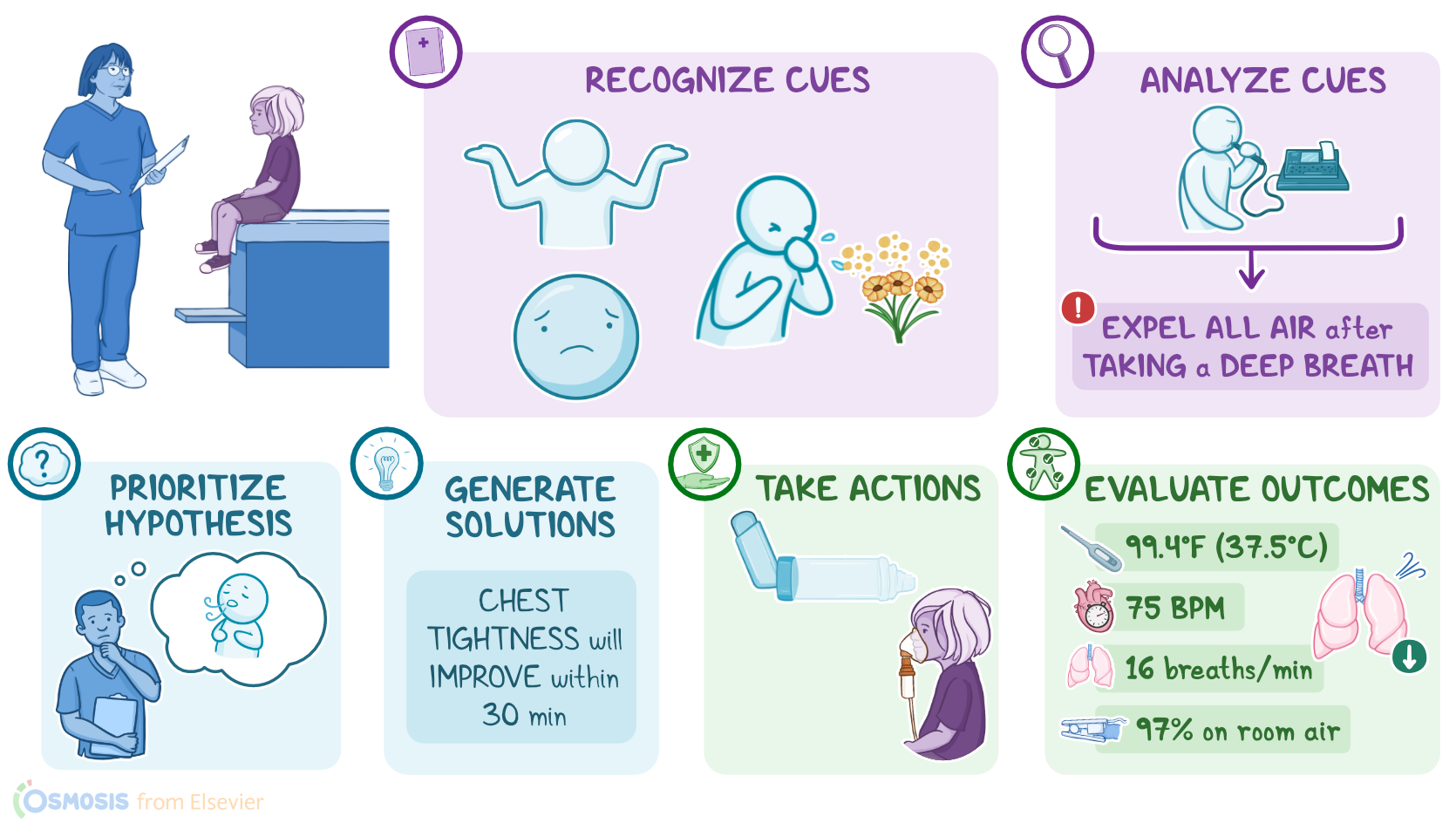
After settling Joey in the examination room, Nurse Lin goes through the steps of the Clinical Judgment Measurement Model to make clinical decisions about Joey’s care by recognizing and analyzing cues, prioritizing hypotheses, generating solutions, taking action, and evaluating outcomes.
First, Nurse Lin recognizes important cues, including Joey’s vital signs which are temperature 98 F or 36.6 C, heart rate 94 beats per minute, respirations 26 breaths per minute, and oxygen saturation 93 percent on room air.
Recognizing and Analyzing Cues0:34–3:10
Nurse Lin then completes a respiratory assessment and finds that Joey has expiratory wheezes in all lobes. She gathers additional information from Joey and his aunt, Angel, who’s at the bedside.
Nurse Lin: Joey, I notice you’re having a hard time taking deep breaths, can you tell me more about that? Joey: My chest feels so tight.
It’s hard to breathe. Nurse Lin: That must be very uncomfortable.
When did you start feeling like this? Joey: I don’t know, I don’t feel good.
Angel: He’s had a nagging cough for a while now. At first, I thought it was just the change in the weather making his allergies flare up, but his allergies don’t normally affect his breathing.
That’s why I made the appointment. Nurse Lin: I’m glad you brought Joey in.
Next, Nurse Lin analyzes these cues. She reviews the electronic health record, or EHR, and notes that Joey has no relevant medical history, other than seasonal allergies.
She performs the ordered spirometry testing by having Joey breathe into a mouthpiece that’s connected to a device to measure the amount of air he’s able to breathe in and out.
Nurse Lin understands that asthma is an inflammatory condition that causes airway narrowing and obstruction of airflow. She recognizes that asthma can be stimulated by environmental triggers, like pollution, cigarette smoke, dust, and pollen.
As the triggering substance travels into the airway, immune cells release chemical mediators that cause the smooth muscles in the bronchioles to spasm and goblet cells to produce mucus.
The combination of mucus and bronchospasm narrows the airway, making it harder to breathe, leading to Joey’s symptoms like wheezing, chest tightness, and cough.
Nurse Lin recognizes that Joey needs effective respiratory management. Now, using the information she's gathered along with Joey’s medical history, Nurse Lin chooses a priority hypothesis of ineffective breathing pattern.
Then, she generates solutions to address Joey’s ineffective breathing pattern; and she establishes the expected outcome that after intervening, Joey’s chest tightness will improve within 30 minutes.
Prioritizing Hypotheses, Generating Solutions, and Taking Action3:10–4:53
Nurse Lin then takes action to implement these solutions. She gathers the prescribed short-acting beta 2-agonist, a nebulizer, and an inhaled corticosteroid, and enters Joey’s room with the medications.
Nurse Lin: Hi Joey, the health care provider ordered two medicines to help you breathe better. Joey: I don’t wanna have a shot!
Nurse Lin: I know, but these medicines aren’t like a shot. Instead, you’ll breathe them in through your nose and mouth.
Joey: Will it hurt? Nurse Lin: Not at all, in fact, it’ll make your chest feel better.
Joey: Okay. Nurse Lin then administers the nebulized medication according to the principles of safe medication administration.
While the medication flows through the mask, Nurse Lin teaches Angel about how to use Joey’s nebulizer at home. Once the nebulizer treatment has finished, Nurse Lin shows Angel and Joey how to use the inhaler and spacer to administer the corticosteroid.
Nurse Lin also provides Angel with an asthma action plan to prevent and control asthma attacks; and she teaches them how to avoid asthma triggers and how to recognize symptoms that warrant a call to the health care provider.
Thirty minutes later, Nurse Lin evaluates the outcomes of her actions. She reassesses Joey’s vital signs which are temperature 98 F or 36.6 C, heart rate 92 beats per minute, respirations 20 breaths per minute, and oxygen saturation 97 percent on room air.
Evaluating Outcomes4:53–5:26
Nurse Lin auscultates Joey’s lungs and notes that the expiratory wheezes are present, but less audible. Joey also reports that his chest tightness is resolved.
Alright, as a quick recap… Nurse Lin recognized and analyzed cues related to Joey’s ineffective breathing pattern, prioritized hypotheses, and generated solutions to address this problem.
Review5:26–5:54
Nurse Lin then took action to address Joey’s asthma and evaluated Joey’s outcomes, comparing them to the expected outcome.
Since Joey’s chest tightness resolved within thirty minutes, Nurse Lin determined that the plan of care was successful. Nurse Lynn determined that the plan of care was successful
| CASE STUDY - PEDIATRIC ASTHMA | ||
| KEY POINTS | NOTES | |
| INTRODUCTION |
| |
| RECOGNIZING AND ANALYZING CUES |
| |
| PRIORITIZING HYPOTHESES, GENERATING SOLUTIONS, AND TAKING ACTIONS |
| |
| EVALUATING OUTCOMES |
| |
- "Wong’s essentials of pediatrics. (11th ed.)" Elsevier (2022)
- "Wong’s nursing care for infants and children. (11th ed.)" Elsevier (2019)
No notes for this video yet
Try adding a note below