Case study - Pyelonephritis: Nursing
Introduction0:00–0:32
Nurse Alfred works on a Medical-Surgical unit and is caring for Alma, a 72-year-old Spanish-speaking female with a history of multiple sclerosis, or MS, who was recently admitted for pyelonephritis.
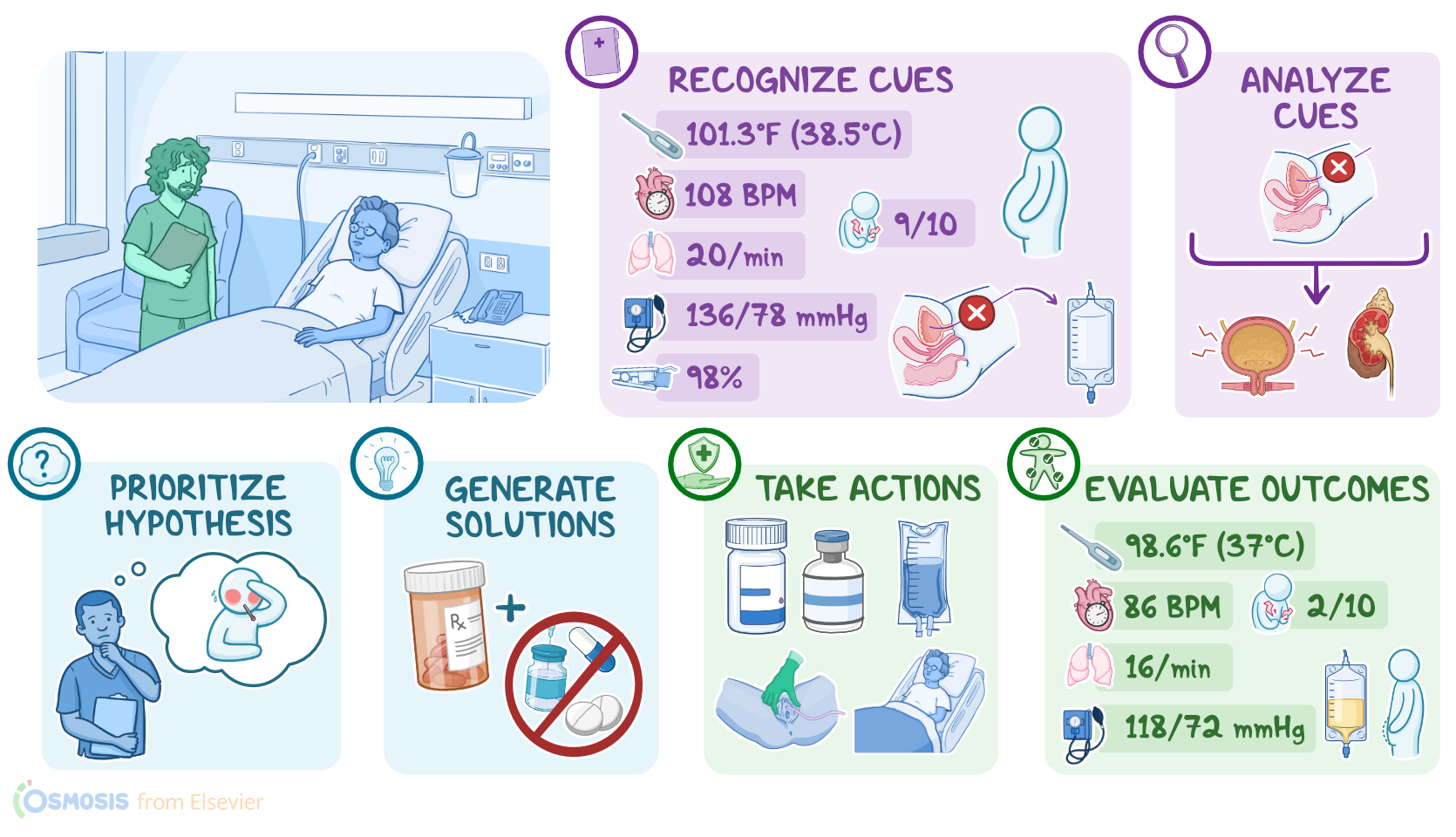
After settling Alma in her room, Nurse Alfred goes through the steps of the Clinical Judgment Measurement Model to make clinical decisions about Alma's care by recognizing and analyzing cues, prioritizing hypotheses, generating solutions, taking action, and evaluating outcomes.
First, Nurse Alfred recognizes important cues, including Alma’s vital signs, which are temperature 101.3 F, or 38.5 C, heart rate 108 beats per minute, respirations 20 breaths per minute, blood pressure 136/78 mmHg, and oxygen saturation 98 percent on room air.
Recognizing and Analyzing Cues0:32–2:03
Nurse Alfred knows that Alma’s primary language is Spanish, so he uses an interpreter to communicate with her over the phone.
Alma's lower abdomen is moderately distended, and she rates her abdominal pain at 9 out of 10. Nurse Alfred gathers that, at home, Alma usually empties her bladder via straight catheterization every four hours, but has been having difficulty due to increasing weakness from her MS.
She reports that yesterday, she was too weak to catheterize herself. Next, Nurse Alfred analyzes these cues.
He reviews the electronic health record, or EHR, and notes a straight catheterization was performed on Alma in the emergency department to obtain a urine sample, which revealed the presence of leukocytes and nitrites and drained 150 milliliters.
Nurse Alfred realizes that, due to her inability to catheterize herself properly, Alma developed urinary retention which likely contributed to her pyelonephritis.
Nurse Alfred realizes Alma needs effective urinary elimination and infection management. Now, using the information he's gathered, along with Alma’s medical history, Nurse Alfred chooses a priority hypothesis of infection.
Prioritizing Hypotheses, Generating Solutions, and Taking Action2:03–3:17
Then, he generates solutions to address Alma’s infection that will include pharmacologic and nonpharmacologic interventions, and he establishes the expected outcome that after intervening, Alma’s urinary tract infection symptoms will improve by the end of the shift.
Nurse Alfred then takes action to implement these solutions. First, with the help of a Spanish interpreter on speakerphone, Nurse Alfred let’s Alma know that her health care provider has ordered acetaminophen for her fever, IV cefazolin to treat her infection, and IV fluids.
Then he administers the medications following principles of safe medication administration. He then inserts an indwelling urinary catheter, as he explains each step in the procedure.
Following insertion, 825 mL of cloudy urine with sediment is drained from Alma’s bladder. After emptying the collection bag, Nurse Alfred assists Alma into a comfortable, position provides a warm blanket, and places the call bell with Alma’s reach before leaving the room.
Toward the end of the shift, Nurse Alfred enters the room to evaluate the outcome of his actions. He reassesses Alma’s vital signs, which are temperature 98.6 F or 37 C, heart rate of 86 beats per minute, respirations 16 per minute, blood pressure 118/72 mmHg, and oxygen saturation 98 percent on room air.
Evaluating Outcomes3:17–3:54
Alright, as a quick recap…Nurse Alfred recognized and analyzed cues related to Alma’s pyelonephritis and prioritized hypotheses and generated solutions to address this problem.
Review3:54–4:25
Nurse Alfred then implemented pharmacologic and nonpharmacologic measures to address Alma’s impaired urinary elimination and infection and evaluated the outcomes and compared them to the expected outcome.
Since Alma’s bladder is no longer distended, her pain has decreased, and her fever has been reduced, Nurse Alfred determined that the plan of care was met.
| CASE STUDY - PYELONEPHRITIS | ||
| KEY POINTS | NOTES | |
| INTRODUCTION |
| |
| RECOGNIZING AND ANALYZING CUES |
| |
| PRIORITIZING HYPOTHESES, GENERATING SOLUTIONS, AND TAKING ACTIONS |
| |
| EVALUATING OUTCOMES |
| |
- "Lewis's medical-surgical nursing: Assessment and management of clinical problems. (12th ed.)" Elsevier (2022)
- "Medical-surgical nursing: Concepts for interprofessional and collaborative care. (10th ed.)" Elsevier (2021)
- "Lewis’s medical-surgical nursing in Canada: Assessment and management of clinical problems. (5th ed.)" Elsevier (2023)
No notes for this video yet
Try adding a note below