Case study - Substance use disorder (SUD): Nursing
Introduction0:00–0:34
Nurse Jacob works on a medical-surgical unit and is caring for Dallas, a 62-year-old patient with a history of substance use disorder, who was admitted three days ago for alcohol detoxification.
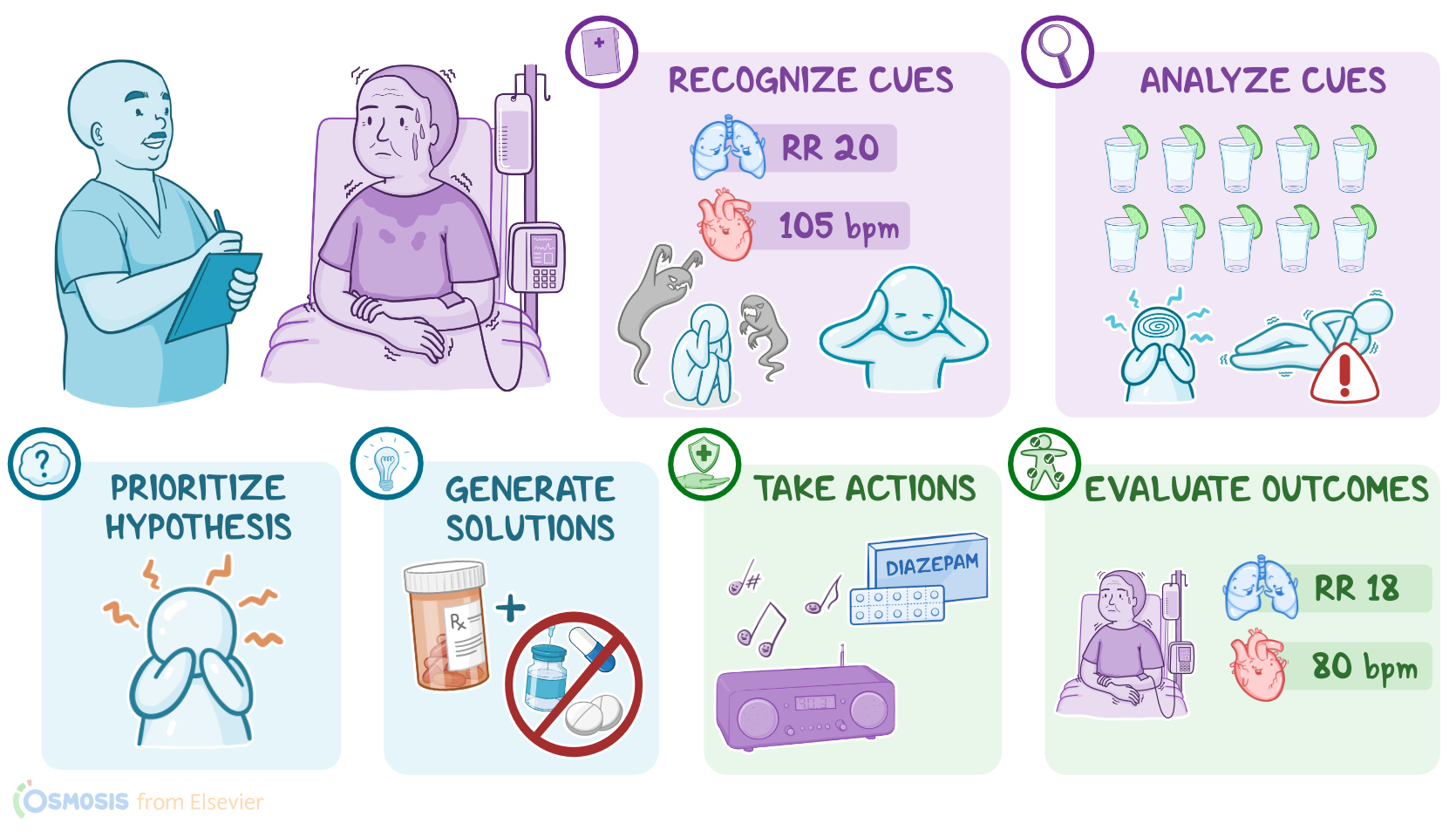
After settling Dallas in his room, Nurse Jacob goes through the steps of the Clinical Judgment Measurement Model to make clinical decisions about Dallas’ care by recognizing and analyzing cues, prioritizing hypotheses, generating solutions, taking action, and evaluating outcomes.
First, Nurse Jacob recognizes important cues, including Dallas’ vital signs, which are temperature 98.6 F or 37 C, heart rate 105 beats per minute, respirations 20 breaths per minute, and blood pressure 140/90 mmHg.
Recognizing and Analyzing Cues0:34–2:36
He also notices Dallas' hands are trembling, he’s sweating, and he has IV fluids infusing in his left antecubital peripheral IV.
Nurse Jabob: Hi Dallas, how are you feeling? Dallas: I have a pounding headache, I can’t concentrate, and I just can’t relax.
Nurse Jacob: I understand. Are you hearing or seeing anything that isn’t normally there?
Dallas: No, I’m not hallucinating, I just feel super nervous, I can’t explain it. Next, Nurse Jacob analyzes these cues.
He reviews the electronic health record, or EHR, and notes that, prior to admission, Dallas was drinking about ten shots of vodka per day.
Nurse Jacob completes the Clinical Institute Withdrawal Scale-Alcohol Revised, or CIWA-Ar, and tallies Dallas’ CIWA score as 15, indicating moderate withdrawal symptoms.
Nurse Jacob knows that the maximum CIWA score is 67, and as withdrawal symptoms become more severe, the score increases.
Nurse Jacob recognizes that when patients with alcohol use disorder stop drinking abruptly, they can develop symptoms like anxiety, irritability, tachycardia, diaphoresis, and auditory and visual hallucinations, and they can develop delirium tremens, a severe complication that can lead to seizures and death.
Nurse Jacob realizes Dallas needs effective management of his alcohol withdrawal. Now, using the information he's gathered, along with Dallas’ medical history, Nurse Jacob chooses a priority hypothesis of anxiety.
Prioritizing Hypotheses, Generating Solutions, and Taking Action2:36–4:34
Then, he generates solutions to address Dallas’ anxiety that will include pharmacologic and nonpharmacologic interventions; and he establishes the expected outcome that after intervening, Dallas will report a decreased anxiety level within two hours.
Nurse Jacob then takes action to implement these solutions. He reviews the EHR and sees that Dallas is prescribed diazepam every two hours as needed for anxiety, and he received his last dose three hours ago, so he's due to receive his next dose at any time.
Nurse Jacob gathers the supplies and enters Dallas’ room. Nurse Jacob: Hi Dallas, I have a medication called diazepam for you.
It’ll help with some of the anxiety symptoms you’re having. Dallas: Oh yeah, that really helped me in the emergency department.
I was hoping you’d bring in some medicine. Nurse Jacob administers the diazepam according to the principles of safe medication administration.
Nurse Jacob: Now, in addition to the medicine, is there anything that’s helped you to relax in the past? Dallas: I used to be in a band, so listening to country music always helps me calm down.
However, I don't have my phone, which has all my music on it. Nurse Jacob: I see.
We have a radio on the unit that I could set up in your room. What do you think?
Dallas: Great! Nurse Jacob retrieves the radio and sets it up on Dallas’ bedside table.
He turns the radio to the country music station and then dims the lights to promote relaxation. He tells Dallas that he’ll give him some time to rest, but to use the call bell if he needs something.
Two hours later, Nurse Jacob re-enters the room to evaluate the outcome of his actions. He takes Dallas’ vital signs, which are temperature 98.6 F or 37 C, heart rate 80 beats per minute, respirations 18 breaths per minute blood pressure 128/85 mmHg.
Evaluating Outcomes4:34–5:15
Nurse Jacob notes that Dallas continues to have hand tremors and remains slightly diaphoretic. When asked, Dallas reports that he’s feeling less anxious, his headache has decreased and he’s more comfortable.
Nurse Jacob reassesses Dallas’ CIWA score, which is now 10. Alright, as a quick recap....
Review5:15–5:45
Nurse Jacob recognized and analyzed cues related to Dallas’ anxiety and prioritized hypotheses and generated solutions to address this problem.
Nurse Jacob then implemented pharmacologic and nonpharmacologic interventions and evaluated Dallas’ outcomes and compared them to the expected outcome.
Since Dallas reported his anxiety decreased, Nurse Jacob determined that the plan of care was successful.
| CASE STUDY - SUBSTANCE USE DISORDER (SUD) | ||
| KEY POINTS | NOTES | |
| INTRODUCTION |
| |
| RECOGNIZING AND ANALYZING CUES |
| |
| PRIORITIZING HYPOTHESES, GENERATING SOLUTIONS, AND TAKING ACTIONS |
| |
| EVALUATING OUTCOMES |
| |
- "Varcarolis’s Canadian psychiatric mental health nursing (3rd ed.)" Elsevier (2023)
- "Keltner’s psychiatric nursing. (9th ed.)" Elsevier (2023)
No notes for this video yet
Try adding a note below