Cataracts: Nursing
Introduction0:00–0:15
Physiology0:15–0:57
Normally, the lens is a transparent biconvex structure that lies behind the iris, dividing the anterior and posterior segments of the eye.
The lens is held in place by the ciliary processes, which are tiny projections from a structure called the ciliary body.
The ciliary body also controls the degree to which the lens becomes flatter or rounder. And this in turn bends the light entering the eye to focus images onto the retina.
If we zoom into the lens, we’ll see that it’s composed of three layers: the capsule, cortex, and nucleus. The nucleus is made up of concentric layers of transparent proteins called crystallins.
Now, cataracts are caused by the opacification or clouding of the lens. When this occurs at birth, it's called congenital cataracts.
Causes & risk factors0:57–2:03
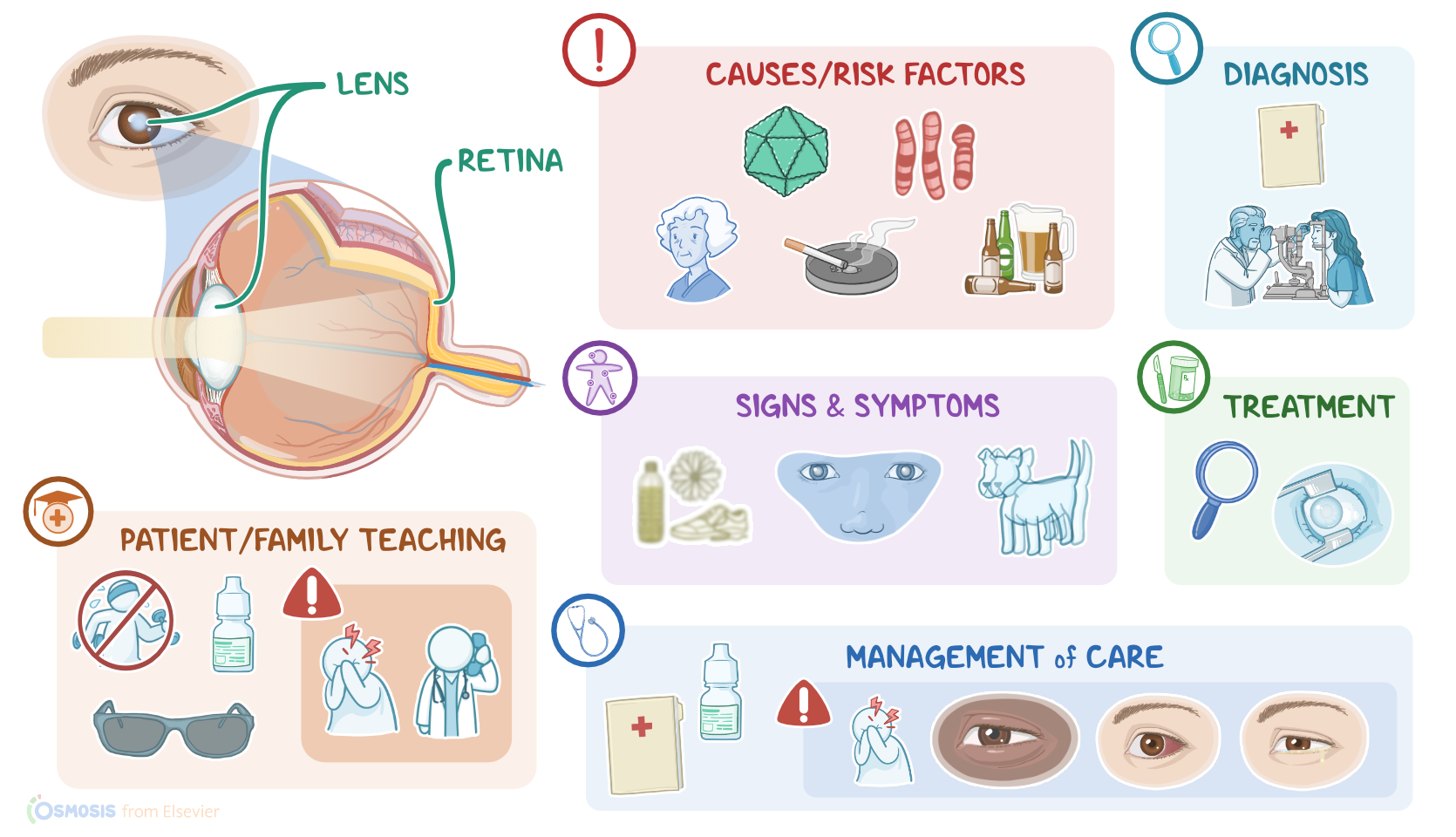
So, risk factors for congenital cataracts include congenital infections, such as toxoplasmosis and rubella, as well as genetic conditions, such as trisomy 13, which causes Down syndrome, Wilson’s disease, in which extra copper is stored in the body tissues, and myotonic dystrophy, which is characterized by progressive muscle weakness and loss.
Other risk factors for congenital cataracts include inborn errors of metabolism, like galactosemia, which is a hereditary condition that impairs the conversion of galactose to glucose in newborns.Now, cataracts can also develop later in life, in which case it's acquired.
Acquired cataracts are often associated with advanced age, usually above 60, smoking, excessive alcohol use, penetrating eye trauma, and infections.
Other risk factors for acquired cataracts include exposure to UV light, prolonged use of medications like glucocorticoids, and diabetes mellitus.Regardless of the cause, the pathological outcome is a change in the structure and composition of the lens.
Pathology2:03–2:24
So, crystallins start clumping together, which causes decreased transparency of the lens, making it cloudy. At the same time, the lens becomes stiffer, which reduces its ability to refract light and focus images on the retina.
Clinical manifestations2:24–2:44
Now, the main symptom of cataracts is blurred vision that’s often bilateral, and progresses slowly over many years. This might be accompanied by decreased color perception, and diplopia or double vision.
Congenital cataracts can also manifest as a gray or cloudy pupil or lack of red reflex. Diagnosis of cataracts starts with the client’s history and physical assessment, followed by slit lamp examination, which shows a loss of lens transparency.
Diagnosis2:44–2:54
Treatment of cataracts involves non-surgical and surgical options. Non-surgical management aims at relieving visual discomfort and might include anti-glare glasses or magnifiers, increased lighting, and lifestyle changes, such as limiting alcohol intake.
Treatment2:54–3:50
Definitive treatment, though, is surgical and consists of phacoemulsification, or extracapsular extraction. In phacoemulsification, the lens is emulsified and absorbed with the help of ultrasonography, and then replaced with an artificial lens.
Extracapsular extraction involves removing the lens nucleus while sparing the posterior part of the capsule to allow for the implantation of an artificial lens.
Post-operative care for clients who underwent surgical treatment of cataracts includes administering topical antibiotics and anti-inflammatory agents, in addition to analgesics and eye patches or shields.Now, let’s look at the nursing care you would provide for a client with cataracts who has chosen to undergo a surgical revision.
Management and care3:50–5:31
Your priority goals are to prepare your client for their surgery, monitor for postoperative complications, and promote safety.Start preparing your client for surgery by reviewing their medical history and their current level of visual acuity.
Take special note of the visual acuity in the unoperative eye, since they will be depending on that eye for vision while their other eye heals.
Once your assessment is complete, administer the ordered preoperative medications, including nonsteroidal anti-inflammatory drops, mydriatic drops to dilate the pupil, as well as anxiolytics to reduce anxiety.
Then, right before your client enters the operative suite, administer the prescribed anesthetic drops. After the procedure is complete, monitor your client closely for complications related to the procedure.
Assess them for pain and administer the prescribed analgesics, as needed. Immediately report to the health care provider if your client has severe eye pain, since this could indicate increased intraocular pressure.
Then, assess your client’s operative site for bleeding, signs of infection, and inflammation; and administer antibiotics to prevent infection and corticosteroid drops to minimize inflammation and swelling.
Report to the healthcare provider immediately if there's excessive swelling, bleeding, or discharge from the eye.Now, your client will have an eye patch on the affected eye for protection after surgery, so be sure you keep them safe from falls by orienting them to their environment, keeping the side rails up, and assisting them with ambulation.
Okay, moving on to client and family teaching. Begin by explaining that cataracts is an eye condition in which the normal transparent eye lens becomes cloudy.
General client and family teaching5:31–7:22
This distorts the image projected onto the retina and causes cloudy vision. Then, provide instructions on how they can care for themselves at home during recovery.
Teach them about their medications and how to administer them using aseptic technique. Stress the importance of taking all medications exactly as prescribed.
Also teach them to watch for signs of infection, and instruct them to notify their healthcare provider immediately if they notice significant swelling, yellow or green drainage, fever, or excessive redness.Next, teach them to avoid activities that increase intraocular pressure, like bending over, coughing forcefully, lifting objects that are heavier than ten pounds, or straining when having a bowel movement; and instruct them to immediately contact their healthcare provider if they experience uncontrollable pain unrelieved by analgesics, or a severe headache.
Now, be sure to remind them that while their eye patch is in place, they could have problems with depth perception until the patch is removed; so emphasize the importance of asking for assistance whenever they need to use stairs or when walking on uneven ground.
Also advise them to protect their eye or wear dark glasses when outdoors. Finally, teach your client about lifestyle modifications that can slow the progression of a cataract, including wearing sunglasses when outdoors, avoiding unnecessary exposure to radiation, maintaining a healthy diet that includes vitamins C and E, and avoiding excessive consumption of alcohol.
If they have a history of smoking, provide them with counseling and resources for smoking cessation. Lastly, remind them of the importance of keeping all of their scheduled follow-up appointments.Alright, as a quick recap….
Review7:22–8:46
Cataracts are an eye condition where the lens of the eye becomes opacified, causing cloudy vision. They can either be congenital or acquired.
Risk factors for congenital cataracts include infections and some genetic or metabolic conditions. Acquired cataracts are often associated with old age, smoking, excessive alcohol use, and eye trauma or infection.
Other risk factors include exposure to UV light and diabetes mellitus.The main symptom of cataracts is progressively worsening blurry vision, often bilaterally and over many years.
The client can also experience decreased color perception and double vision. Cataracts can be diagnosed by a physical exam and use of a slit lamp to evaluate the transparency of the lens.
There are two treatment options for a client who has cataracts. The first is lifestyle changes to maintain comfort and safety despite decreased visual acuity.
The only definitive treatment option is surgery, where the cloudy lens is removed and replaced with an artificial lens. Goals of nursing care include preparing the client for their surgery, monitoring for postoperative complications, and promoting safety.
Client and family education focuses on self-care after discharge, lifestyle modifications to prevent cataracts, and when to contact the healthcare provider.
| CATARACTS | ||
| KEY POINTS | NOTES | |
| DEFINITION |
| |
| PHYSIOLOGY |
| |
| CAUSES AND RISK FACTORS |
| |
| PATHOPHYSIOLOGY |
| |
| CLINICAL MANIFESTATIONS |
| |
| DIAGNOSIS |
| |
| TREATMENT |
| |
| MANAGEMENT OF CARE |
| |
| PATIENT AND FAMILY TEACHING |
| |
No notes for this video yet
Try adding a note below