Celiac disease: Nursing process (ADPIE)
Client Report0:00–0:29
Samantha Wilberson is a 29 year old female client who was admitted to the medical surgical floor during the night. Miss Wilberson has a history of celiac disease and was directly admitted to the department by her gastroenterologist after a severe bout of watery diarrhea, vomiting, and dehydration.
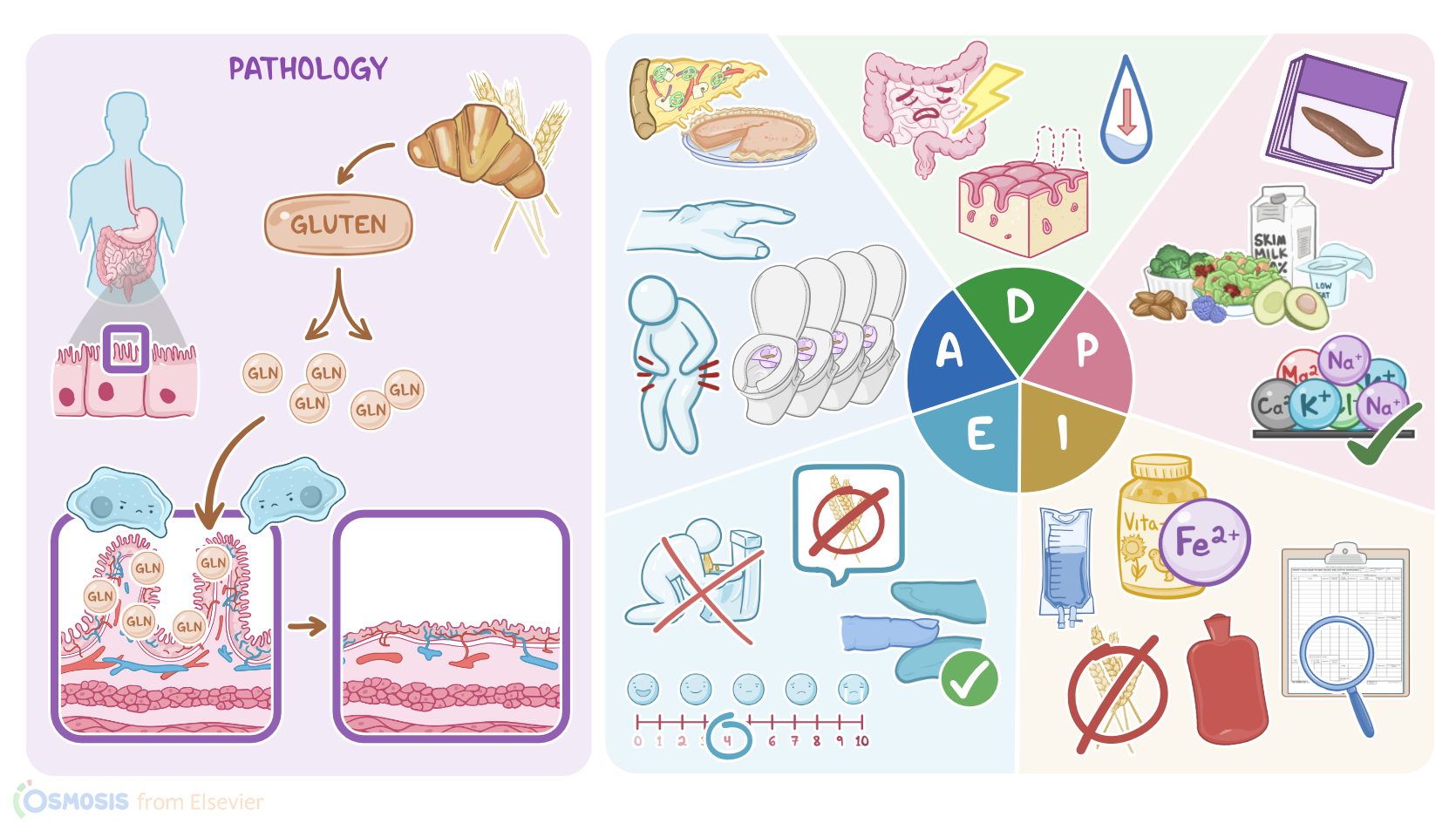
She says the last time she remembers feeling this sick was over a year ago after she had a bad case of the flu. Celiac disease, also known as gluten enteropathy or celiac sprue, is currently understood as an immune-mediated disorder where the gluten in food triggers the body's immune cells to attack the cells in the small intestine.
Pathology0:29–3:18
Celiac disease is hereditary, and people with a first degree relative with celiac disease, like a parent or sibling, have a 1 in 10 risk of developing it.
Some people may be genetically predisposed to celiac disease. In fact, it is estimated to affect 1 in 100 people worldwide.
Now gluten's found in all sorts of wheats and grains including rye and barley and is the main culprit in celiac disease.
The intestine's inability to fully digest the protein fractions of gluten leads to a buildup of the amino acid glutamine.
This accumulation is toxic to the intestinal mucosa, damaging the intestinal villa, which are those small finger-like projections that line the small intestine and help promote nutrient absorption.
When the villa become damaged, they can atrophy. This leads to complications like diarrhea, vomiting, fatty stools, abdominal distention, and malabsorption of important nutrients like iron and vitamin B12, which can lead to anemia.
Symptoms of celiac disease are commonly first noticed between the ages of 1 and 5. Usually there's a period of time anywhere between 3 to 6 months from the time gluten is introduced in the diet, and the manifestations of celiac disease are apparent.
And of course, because gluten intake leads to complications, lifelong dietary changes are necessary in order to prevent flare-ups.
Occasionally, a client like Miss Wilberson can experience an acute episode where symptoms of celiac disease are exacerbated.
This is called a celiac crisis. The severe loss of GI contents through diarrhea and vomiting can cause complications like electrolyte imbalances, severe dehydration, and metabolic acidosis.
People living with celiac disease have a greater risk for developing coronary artery disease and small bowel cancers. And left untreated, celiac disease can increase the chance of developing other autoimmune disorders like type one diabetes mellitus and multiple sclerosis.
Now that we've gone over the pathology, let's look at how the nursing process can be applied. The process consists of assessment, diagnosis, planning, implementation, and evaluation, also known as ADP.
Assessment3:18–5:25
So after you greet Miss Wilberson and introduce yourself as her nurse, you begin your assessment by first asking her how she's feeling today.
She tells you that her stomach hurts really bad and she's feeling bloated. She then continues on to express that she has no appetite and thinks she overdid it with the food at her company party a night ago, sharing that she had lots of pastries, breaded chicken tenders, and pizza, and expresses that she understands she made improper food choices.
She states that she's had several loose stools since she was admitted last using the bathroom just before you entered and has vomited only a few times last night.
You check the bathroom and observe that there's a toilet hat in place with stool present, foul smelling and fatty in appearance.
You ask Ms. Wilberson how many bowel movements she's had since admission, and she reports 4 or 5.
As you listen to Miss Wilberson describe her symptoms, you're visually assessing her and notice that her arms and legs appear very thin.
Her lips and mucous membranes are dry. Upon closer inspection of her abdomen, you observe its distended and auscultate hyperactive bowel sounds.
You assess her capillary refill and skin trigger and notice both are decreased. Ms.
Wilberson's vital signs are heart rate 117, respiratory rate 20, BP 108/70, oral temperature 99.9 °F, pain 7 out of 10. Next, you review her recent lab results and note the following BUN level of 22 mg per deciliter, sodium level of 150 milliequivalents per liter, hemoglobin 11 g per deciliter, hematocrit 33%.
RBC 3.8 cells per microliter, MCH 22.3 picograms, MCHC 32.2 g per deciliter, MCV is 75 femoliters, RDW 18.1%. Finally, you document all your assessment findings before leaving the room.
Now, after you've completed your assessment, you prepare a few nursing diagnoses or clinical judgments about Ms. Wilberson's responses to her health problem, celiac disease.
Diagnosis5:25–6:12
These diagnoses help nurses determine what to anticipate or watch out for in your clients. In doing so, you can think ahead and make a plan to address these issues.
Based off the assessment data you've collected, your diagnoses include acute pain related to intestinal inflammation, readiness for enhanced knowledge related to dietary restrictions, diarrhea related to malabsorption secondary to celiac disease, dehydration related to excessive gastric losses, electrolyte imbalance related to increased gastrointestinal losses, and anemia related to malabsorption secondary to celiac disease.
Planning6:12–7:05
As you begin planning Miss Wilberson's care, you're sure to keep in mind prioritizing her most important needs first. Well, now that you've gathered lots of information and have formed some great nursing diagnoses, it's time to actively collaborate with other members of the interdisciplinary team to provide and develop a holistic plan of care to help Miss Wilberson achieve the goals and desired outcomes to restore her overall well-being.
Reflecting on the assessment data you've collected and the nursing diagnoses you've created, you determine the prioritization of goals include restoration of normal bowel habits by discharge, adequate fluid volume status by discharge, her electrolyte values will be within normal limits by discharge, she'll adopt adequate daily intake of dietary iron by discharge, she'll be pain-free by the end of shift, and understanding and commitment to lifelong dietary modifications by discharge.
Implementation7:05–8:54
After collaborating with the team and obtaining the necessary orders, you review the plan of care with the nursing assistant assigned to help Miss Wilberson with her basic care needs.
So you delegate the collection of I and O's. Collecting this information is important to monitor Miss Wilberson's diarrhea and to determine her fluid volume status.
Ms. Wilberson is receiving IV fluids as well, so you remind the nursing assistant to alert you if the fluid bag is running low.
In the meantime, you'll focus on assessing skin trigger and mucous membranes to determine if fluid balance restoration has been effective, then follow up to ensure the physician's order for labs has been inputted so you can continue to monitor her lab results.
Now, in order to ensure that Miss Wilberson understands the importance of dietary iron and adhering to lifelong dietary modifications, you teach her about taking daily multivitamin supplements with iron.
However, before continuing to educate Miss Wilberson, you want to ensure she's comfortable and ready to learn. Miss Wilberson prefers not to take any medications for pain, but expresses that warm compresses on my belly really help.
So you decide to also delegate this to the NA. You'll follow up after to see if that's been effective.
You sit with her and review how to maintain a gluten-free diet, how to read food labels to identify any hidden gluten. And appropriate substitutions for grain sources like corn, rice, and millet, then finish by teaching Miss Wilberson about the potential complications that can occur in celiac disease if it's not managed appropriately.
You also provide her information about the dietitian who she's been referred to by her healthcare provider. Finally, before leaving the room, you make sure her bed is locked and in the lowest position and her call bell is nearby in case she needs any assistance.
It's nearing the end of your shift, and the nursing assistant documents, then reports to you that Miss Wilberson's frequency of stools has decreased, and she hasn't had any more vomiting since your initial assessment, then updates you on her INOs.
Evaluation8:54–10:22
Miss Wilverson is scheduled to be discharged home tomorrow, so it'll be important to evaluate then if her bowel habits have been restored to normal, that way you'd know if the goal has been achieved or not.
Her vital signs are heart rate 100, respiratory rate 16, BP 118/76, oral temperature 98.9 °F. Her lips and mucous membranes appear much more pink and moist than this morning, and her capillary refill time is less than 2 seconds.
Her latest lab results aren't back just yet, but you'll continue to monitor those CBC and electrolyte reports. As you continue to reassess Miss Wilberson, she expresses that her pain is 4 out of 10 now.
Miss Wilburson does return teaching to confirm she's understood and can successfully stick to the diet plan. So let's keep reassessing, re-evaluating, and documenting Miss Wilberson's outcomes before the end of your shift to determine if the goals you've created in the plan of care have been met or unmet, and if there are any tweaks that should be made in order to help Miss Wilberson reach the planned goals.
If there's a decline or worsening in Miss Wilverson's condition, such as an increase in diarrhea or vomiting, you'll be sure to communicate that with the healthcare team immediately.
OK, so your assigned client, Miss Wilberson, has celiac disease and appears to be experiencing an acute exacerbation of symptoms.
Summary10:22–12:34
Celiac disease is an immune-mediated disorder where the gluten in food triggers the body's immune cells to attack the cells in the small intestine.
This disease is hereditary, and some people may be genetically predisposed to it. Gluten's found in all sorts of wheats and grains and is the main culprit in this disease.
The intestine's inability to fully digest the protein fractions of gluten leads to a build-up of the amino acid glutamine, which is toxic to the intestinal mucosa, damaging the intestinal villi, leading to complications like diarrhea, vomiting, fatty stools, abdominal distention, and malabsorption of important nutrients.
Lifelong dietary changes are necessary in order to prevent flare-ups. An acute episode where symptoms of celiac disease are exacerbated is called a celiac crisis, which can cause complications like electrolyte imbalances, severe dehydration, and metabolic acidosis.
Left untreated, celiac disease can increase the chance of developing other autoimmune disorders like type one diabetes mellitus and multiple sclerosis.
Your assessment of Miss Wilberson reveals diarrhea, pain, and signs and symptoms of dehydration. You also learn about her recent poor dietary intake.
Your nursing diagnosis centers around the physical and psychosocial responses to her health problem and includes things like diarrhea related to exacerbation of celiac disease, acute pain related to intestinal inflammation, and dehydration related to excessive gastric losses.
The goals of the plan of care are to resolve those responses and restore Miss Wilberson's health and well-being, as well as educate her on lifelong dietary changes that must be in place.
Along with your nursing assistant. You both implement actions to help Miss Wilberson successfully achieve these goals.
Throughout your shift and up until discharge. You'll continue to work along with the rest of the healthcare team to evaluate if these goals have been met, and if not, modify the plans and implementations to ensure they are.
| CELIAC DISEASE | ||
| KEY POINTS | NOTES | |
| PATIENT REPORT |
| |
| PATHOPHYSIOLOGY |
| |
| ASSESSMENT |
| |
| NURSING DIAGNOSES |
| |
| PLANNING |
| |
| IMPLEMENTATION |
| |
| EVALUATION |
| |
- "Ackley and Ladwig’s Nursing Diagnosis Handbook: An Evidence-Based Guide to Planning Care, 13th edition" Mosby (2022)
- "The Gluten-Free Diet for Celiac Disease and Beyond" Nutrients (2021)
- "Celiac disease: a comprehensive current review" BMC Med (2019)
- "Harrison’s Principles of Internal Medicine. 21st edition" McGraw Hill / Medical (2022)
- "Celiac Disease: Fallacies and Facts" Am J Gastroenterol (2021)
- "Updates in the diagnosis and management of coeliac disease" Best Pract Res Clin Gastroenterol (2023)
- "Critical Care Nursing: Diagnosis and Management, 9th edition" Elsevier (2021)
No notes for this video yet
Try adding a note below