Code of ethics: Nursing
Introduction0:00–0:47
Nurse Jocelyn works as a home health nurse. When at the market on one of her days off, she sees one of her friends, Sam, who says, “My aunt just told me that you are her home health nurse!
She says that you have been coming to her house ever since she got out of the hospital a few weeks ago. My aunt says that you take such great care of her.
She is experiencing an ethical dilemma but she can use The Code of Ethics for Nurses to help determine how to respond.To begin, ethics refers to moral principles that guide a person’s behavior and choices.
Ethics0:47–1:28
Since ethics are determined by social standards, they are referred to as being externally driven, meaning they are not decided by a single person.
Ethics help us to figure out what is “right” and what is “wrong.” Usually, ethical principles are not written down; they are considered common knowledge within a community.
For example, stealing is considered “wrong” for most people. But professional groups, like doctors and nurses, often have a more formal, written summary of ethical guidelines.
This is called a code of ethics and is used to inform the moral decision making of those in the group.Now, a code of ethics provides a written statement of the ethical code of the profession.
The Code of Ethics1:28–2:11
It also outlines a standard of care within the discipline, as well as identifies the purpose of the profession or why they do what they do.
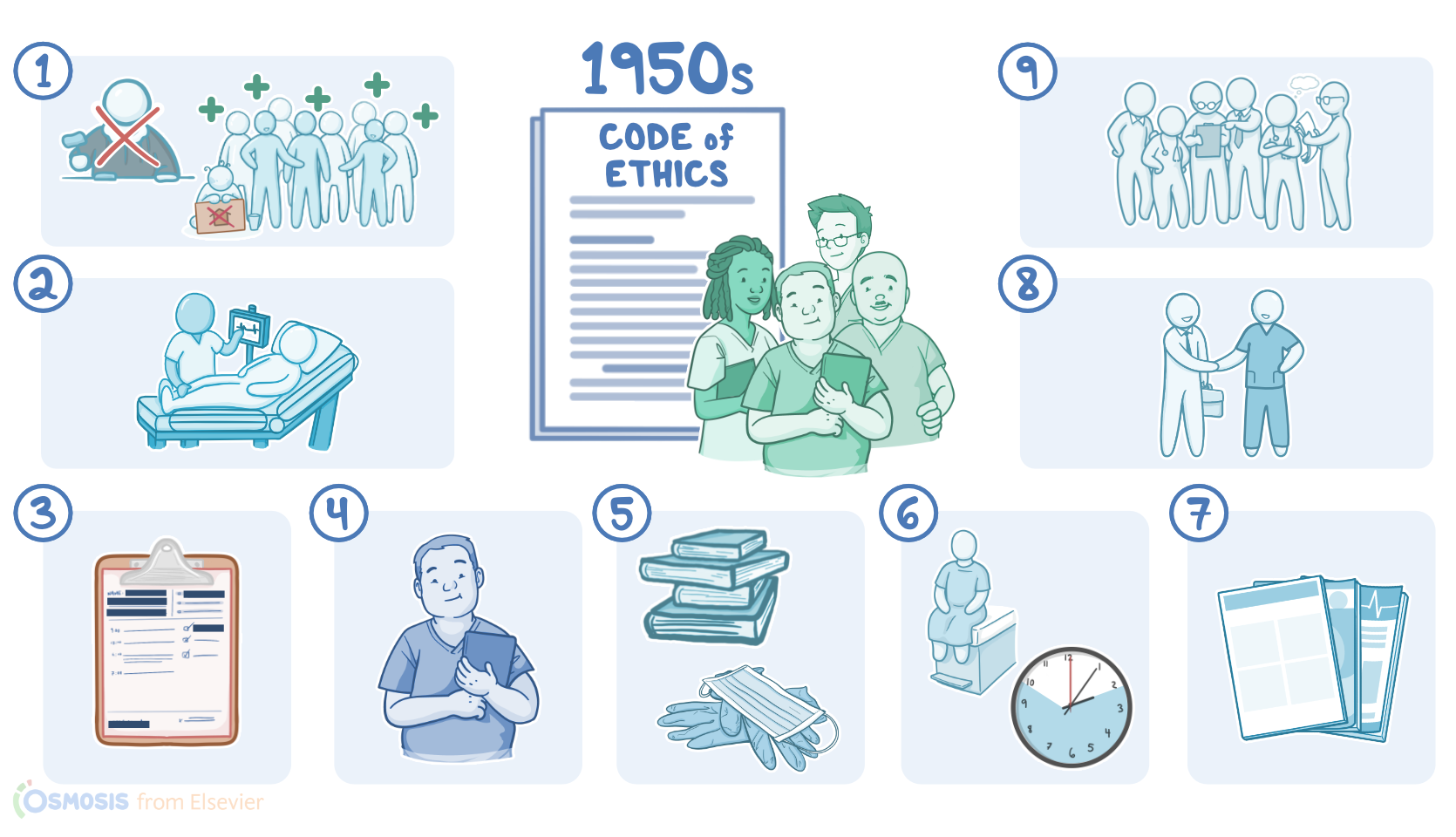
So the profession of nursing has its own code of ethics written by the American Nursing Association, or ANA. The Code of Ethics for Nurses was first published in the 1950s but it’s updated often to reflect changes in the nursing profession.
Some of the most recent changes discuss the ethical responsibility of protecting client privacy in a time of increased use of technology and the responsibility of providing client education to help clients make informed decisions for their care.Now, the ANA Nursing Code of Ethics for Nurses has nine provisions, or guiding principles, for ethical nursing care.
Let’s take a look at each provision.Number one. “The nurse practices with compassion and respect for the inherent dignity, worth, and unique attributes of every person.” This means the nurse will treat every client without prejudice or judgment and accept the values of each client even if it does not match their own personal beliefs.
Provisions2:11–9:22
This includes treating each client equitability no matter their income, race, or gender. An example of this provision in action is when a nurse is working at the triage desk in the emergency department, they would not delay the care of a client because of their race.
Instead, the nurse should treat each client equitably and only consider the severity of their symptoms when assigning a priority for care.Number two.
“The nurse’s primary commitment is to the patient, whether an individual, family, group, community, or population.” This means that client care is the nurse’s priority.
So, when the charge nurse has a busy shift, a schedule to make, supply orders to place, and a client requesting assistance, the greatest importance should be focused on client care.
This provision also includes reporting any conflict of interest you might have in caring for a client. For example, if your neighbor is admitted to the unit you work on and you have been assigned to care for them, that might be considered a conflict of interest since your personal relationship can potentially impact your judgment when delivering care.Number three.
“The nurse promotes, advocates for, and protects the rights, health, and safety of the patient.” This addresses the nurse’s role in client advocacy.
Advocacy can look different depending on your work setting, but might include supporting your client’s care decisions, reporting issues with safety at your institution, or working with political leaders to influence policies that affect nursing and client care.
This provision also includes the need to uphold client privacy. So as a nurse you should make sure the Health Insurance Portability and Accountability Act or HIPPA is upheld by safeguarding a client’s private health information.Number four.
“The nurse has authority, accountability, and responsibility for nursing practice; makes decisions; and takes action consistent with the obligations to promote health and provide optimal care.” So when you are working in your role as a nurse, you have an ethical responsibility to practice within your scope, make clinical decisions with consideration to the nursing process to improve the care and outcomes of your clients, and accept responsibility for the outcomes of your decisions.
For example, a nurse working the triage desk at the emergency department notices that a client who is waiting now appears to have signs of respiratory distress.
The nurse decides to assess further and discovers an Sp02 of 88%. The nurse acts by admitting the client immediately for medical treatment.Number five.
“The nurse owes the same duties to self as to others, including the responsibility to promote health and safety, preserve wholeness of character and integrity, maintain competence, and continue personal and professional growth.” This provision explains the importance of self-maintenance and the pursuit of continued growth.
This might include engaging in continuing education activities to keep your practice up to date, advocating for improved safety in the work environment like requesting more personal protective equipment when working with clients with infectious disease, or addressing mental health and compassion fatigue, sometimes referred to as “burn out”, among nurses in order to maintain the health and well-being of nursing professionals and clients.Number six.
“The nurse, through individual and collective effort, establishes, maintains, and improves the ethical environment of the work setting and conditions of employment that are conducive to safe, quality health care.” Now, this provision calls for the promotion of ethical behavior within the profession.
An example might be advocating for policies within your organization that exemplify ethical practice like the Emergency Medical Treatment & Labor Act (EMTALA) which requires that every client with an emergency must be assessed and treated and cannot be turned away.
Also this provision supports standards that promote a safe and fair environment for all clients and healthcare employees like staffing ratios or shift maximums.Number seven.
“The nurse, in all roles and settings, advances the profession through research and scholarly inquiry, professional standards development, and the policy generation of both nursing and health policy.” Contributing to research and scholarship helps to build what is known about the delivery of care and best practice.
This might include performing a literature review, participating in a pilot study on your floor, or participating in the dissemination, or sharing research findings with poster presentations at a local conference.Number eight.
“The nurse collaborates with other health professionals and the public to protect human rights, promote health diplomacy, and reduce health disparities.” This provision speaks to health and wellness as a human right.
It includes collaboration within the profession and with other health professionals to improve the delivery of care to all people through individual and community efforts.
An example might be helping to open a free community diabetes clinic to educate and treat the public.Number nine. “The profession of nursing, collectively through its professional organizations, must articulate nursing values, maintain the integrity of the profession, and integrate principles of social justice into nursing and health policy.” The last provision speaks to the importance of professional support.
This might be through larger professional groups like the ANA or smaller groups within organizations, like a hospital committee.
These groups should take responsibility for advancing the profession and informing the public of professional matters that affect the public while working to advocate for nursing and client rights.
An example might be ANA’s efforts to support legislation for safe nurse to client ratios.So let’s check back in with Nurse Jocelyn, who considers The Code of Ethics for Nurses before responding to her friend Sam.
Nurse Jocelyn decides that maintaining client confidentiality is an ethical duty that she must uphold. Therefore, she responds to Sam, “I understand your concern for your aunt and I’m so glad she has a niece that cares for her so much.
However, as a nurse, it is my responsibility to keep my clients’ health information confidential.” Sam replies, “I appreciate your dedication to the nursing profession!
I’ve got to go pick my son up from school but let’s find a time to meet for coffee soon!”Alright, as a quick recap… Ethics refers to moral principles that guide a person’s behavior and choices.
Ethics help us to figure out what is “right” and what is “wrong”. A formal written summary of the ethics that guides a particular profession is called a code of ethics.
The profession of nursing has its own code of ethics written by the American Nursing Association. The Code of Ethics for Nurses has nine provisions, or guiding principles, for ethical nursing practice.
gotta go pick up my son from school but let's find a time to meet for coffee soon All right As a quick recap ethics refers to moral principles that guide a person's behavior and choices Ethics helps us to figure out what is right and what is wrong A formal written summary of the ethics that guides a particular profession is called a code of ethics The profession of nursing has its own code of ethics written by the American Nursing Association The code of Ethics for nurses has nine provisions or
Review9:22–9:45
| CODE OF ETHICS | ||
| KEY POINTS | NOTES | |
| ETHICS |
| |
| THE CODE OF ETHICS |
| |
| PROVISIONS |
| |
No notes for this video yet
Try adding a note below