Core measures: Nursing

Core measures: Nursing

NSG1201

NSG1201

Leg ulcers: Clinical
Venous thromboembolism (VTE): Nursing process (ADPIE)
Wound healing
Peripheral venous disease (PVD): Nursing process (ADPIE)
Peripheral arterial disease (PAD): Nursing process (ADPIE)
Pharmacodynamics: Nursing pharmacology
Pharmacokinetics - Elimination: Nursing pharmacology
Vital signs - Pain: Nursing skills
Analgesics: Nursing pharmacology
Antacids: Nursing pharmacology
Antibiotics - Cephalosporins: Nursing pharmacology
Antibiotics - Cyclic lipopeptides: Nursing pharmacology
Antibiotics - Glycopeptides: Nursing pharmacology
Antibiotics - Lincosamides: Nursing pharmacology
Antibiotics - Macrolides: Nursing pharmacology
Antibiotics - Metronidazole: Nursing pharmacology
Antibiotics - Oxazolidinones: Nursing pharmacology
Antibiotics - Penicillins: Nursing pharmacology
Antibiotics - Polymyxins: Nursing pharmacology
Antibiotics - Tetracyclines and glycylcyclines: Nursing pharmacology
Antibiotics - Trimethoprim and sulfonamides: Nursing pharmacology
Anticoagulants - Direct thrombin and factor Xa inhibitors: Nursing pharmacology
Anticoagulants - Heparin: Nursing pharmacology
Anticoagulants - Warfarin: Nursing pharmacology
Antidepressants - SSRIs and SNRIs: Nursing pharmacology
Antidepressants - Tricyclic antidepressants (TCAs) and monoamine oxidase inhibitors (MAOIs): Nursing pharmacology
Antiemetics: Nursing pharmacology
Antiepileptics: Nursing pharmacology
Antihistamines: Nursing pharmacology
Antihyperlipidemics - Statins: Nursing pharmacology
Antimetabolites: Nursing pharmacology
Antiplatelet agents: Nursing pharmacology
Antipsychotics: Nursing pharmacology
Antirejection immunosuppressants: Nursing pharmacology
Antiretrovirals for HIV/AIDS - CCR5 antagonists, fusion inhibitors, and attachment inhibitors: Nursing pharmacology
Antiretrovirals for HIV/AIDS - Integrase strand transfer inhibitors: Nursing pharmacology
Antiretrovirals for HIV/AIDS - NRTIs and NNRTIs: Nursing pharmacology
Antiretrovirals for HIV/AIDS - Protease inhibitors: Nursing pharmacology
Antivirals for herpesviruses: Nursing pharmacology
Antivirals for influenza: Nursing pharmacology
Anxiolytics and sedative-hypnotics: Nursing pharmacology
Beta-adrenergic blockers: Nursing pharmacology
Biologic agents: Nursing pharmacology
Blood products: Nursing pharmacology
Calcium-channel blockers: Nursing pharmacology
Cardiac glycosides: Nursing pharmacology
Chloramphenicol: Nursing pharmacology
Debridement agents: Nursing pharmacology
Direct-acting vasodilators: Nursing pharmacology
Disease-modifying therapy for multiple sclerosis: Nursing pharmacology
Diuretics - Osmotic and carbonic anhydrase inhibitors: Nursing pharmacology
Diuretics - Thiazide, thiazide-like, loop, and potassium-sparing diuretics: Nursing pharmacology
Eye anesthetics: Nursing pharmacology
Gallstone-dissolving agents: Nursing pharmacology
Gastric mucosal protective agents: Nursing pharmacology
Glucocorticoids and mineralocorticoids: Nursing pharmacology
Hematopoietic growth factors: Nursing pharmacology
Hemostatics: Nursing pharmacology
Histamine H2 antagonists: Nursing pharmacology
Hormones and hormone modulators for cancer: Nursing pharmacology
Immunoglobulins: Nursing pharmacology
Immunomodulators: Nursing pharmacology
Immunosuppressants for autoimmune diseases: Nursing pharmacology
Corticosteroids - Inhaled: Nursing pharmacology
Insulin: Nursing pharmacology
Iron preparations: Nursing pharmacology
Keratolytics: Nursing pharmacology
Laxatives: Nursing pharmacology
Leukotriene modifiers: Nursing pharmacology
Lung surfactants and antenatal corticosteroids: Nursing pharmacology
Medications affecting the parathyroid glands: Nursing pharmacology
Medications for antidiuretic hormone (ADH) disorders: Nursing pharmacology
Medications for thyroid disorders: Nursing pharmacology
Medications to control airway secretions: Nursing pharmacology
Medications for Alzheimer disease: Nursing pharmacology
Medications for growth hormone disorders: Nursing pharmacology
Medications for acne vulgaris: Nursing pharmacology
Medications for hepatic encephalopathy: Nursing pharmacology
Medications for migraines: Nursing pharmacology
Mydriatics and cycloplegics: Nursing pharmacology
Nitrates: Nursing pharmacology
Non-biologic disease-modifying antirheumatic drug (DMARD) therapy: Nursing pharmacology
Non-insulin injectable antidiabetic drugs - GLP-1 agonists and amylinomimetics: Nursing pharmacology
Ophthalmic anti-inflammatories and anti-infectives: Nursing pharmacology
Oral antidiabetic medications - Alpha-glucosidase inhibitors: Nursing pharmacology
Oral antidiabetic medications - Biguanides and thiazolidinediones: Nursing pharmacology
Oral antidiabetic medications - DPP-4 inhibitors: Nursing pharmacology
Oral antidiabetic medications - Sodium-glucose co-transporter-2 (SGLT-2) inhibitors: Nursing pharmacology
Oral antidiabetic medications - Sulfonylureas and meglitinides: Nursing pharmacology
Other antineoplastics: Nursing pharmacology
Oxygen therapy: Nursing pharmacology
Oxytocin: Nursing pharmacology
Pancreatic enzyme replacements: Nursing pharmacology
Pharmacokinetics - Distribution: Nursing pharmacology
Pharmacokinetics - Metabolism: Nursing pharmacology
Phytonadione (Vitamin K1): Nursing pharmacology
Plant extracts for chemotherapy: Nursing pharmacology
Platinum-based agents: Nursing pharmacology
Prostaglandins: Nursing pharmacology
Proton pump inhibitors (PPIs): Nursing pharmacology
Respiratory stimulants: Nursing pharmacology
Rho(D) immune globulin: Nursing pharmacology
Sympathomimetic medications: Nursing pharmacology
Thrombolytics: Nursing pharmacology
Tocolytics: Nursing pharmacology
Antibiotics - Topical: Nursing pharmacology
Antifungals - Topical: Nursing pharmacology
Corticosteroids - Topical: Nursing pharmacology
Treatment for Helicobacter pylori: Nursing pharmacology
Antispasmodics (GU): Nursing pharmacology
Cholinergic therapy (GU): Nursing pharmacology
Vaccines: Nursing pharmacology
Pharmacokinetics - Absorption: Nursing pharmacology
Pressure injury: Nursing process (ADPIE)
Emergency care: Falls
Diabetic ketoacidosis (DKA): Nursing process (ADPIE)
Inflammatory process: Nursing
Nutrition - Oral: Nursing skills
Core measures: Nursing
Standards and methods of documentation: Nursing
Physical assessment - Abdomen: Nursing
Physical assessment - Overview: Nursing
Vital signs - Blood pressure (BP): Nursing skills
Vital signs - Oxygen saturation (SpO2): Nursing skills
Vital signs - Respirations: Nursing skills
Vital signs - Pulse: Nursing skills
Vital Signs - Temperature: Nursing skills
Comprehensive Assessment
Mobility - Ambulation: Nursing skills

Notes

CORE MEASURES

KEY POINTS
NOTES
DEFINITION
  • National standards for common conditions like diabetes 
  • Also include heart failure and hypertension treatment 
  • Include tobacco screening and childhood immunizations 
  • Based on best available clinical evidence 
  • Designed by 
    • The Joint Commission (TJC)
    • Centers for Medicare and Medicaid Services (CMS)
  • Components 
    • Vary depending on the specific condition 
    • Include medication prescribing and administration 
    • Include disease assessment and treatment 
    • Include patient and family education

ASSESSING AND MONITORING CORE MEASURES
  • All healthcare facilities must report core measure compliance 
  • Reports go to TJC and CMS for review 
  • Facilities track performance using electronic health records 
  • TJC and CMS rate care quality using this data 
  • Core measures are updated with new research and evidence 
  • Noncompliance may affect CMS reimbursement and TJC status

SIGNIFICANCE OF CORE MEASURES
  • Benefits
    • Reduce illness complications and readmissions 
    • Improve patient outcomes and care quality
    • High scores show best practice compliance 
    • Public can view and compare facility scores 
    • Helps patients choose high-performing facilities 
  • Standardization and collaboration 
    • Decrease variation in care processes 
    • Increase teamwork across healthcare providers 
    • Ensure consistent care across different facilities 

THE NURSE'S ROLE IN CORE MEASURES
  • Nurses support 4 key areas of core measures 
    • Implementation 
    • Documentation 
    • Patient education 
    • Identifying compliance issues
  • Implementation and documentation 
    • Administer medication
    • Document medication given within correct time frame 
  • Patient education 
    • Teach patients about medications and care 
  • Identifying compliance issues 
    • Nurses help spot missing or incorrect documentation 
  • Team collaboration 
    • Nurses work with informatics to improve records 

Transcript

Watch video only

Nurse Selena works in the emergency department and is reviewing the discharge policy for clients diagnosed with heart failure with the Nurse Educator, Liam. Nurse Selena says to Nurse Liam, “I noticed that our facility’s discharge policy doesn’t align with the core measures for heart failure.” Nurse Liam notes that discharge paperwork for clients diagnosed with heart failure should include instructions for activity level, diet, discharge medications, follow-up appointments, weight monitoring, and what to do if symptoms worsen. However, information about follow-up appointments and weight monitoring is missing from the facility’s electronic discharge template. Nurse Liam says, “You’re right. Let’s work together to make our hospital compliant with these core measures.” Nurse Selena and Nurse Liam will use what they know about core measures to improve discharge care for clients diagnosed with heart failure.

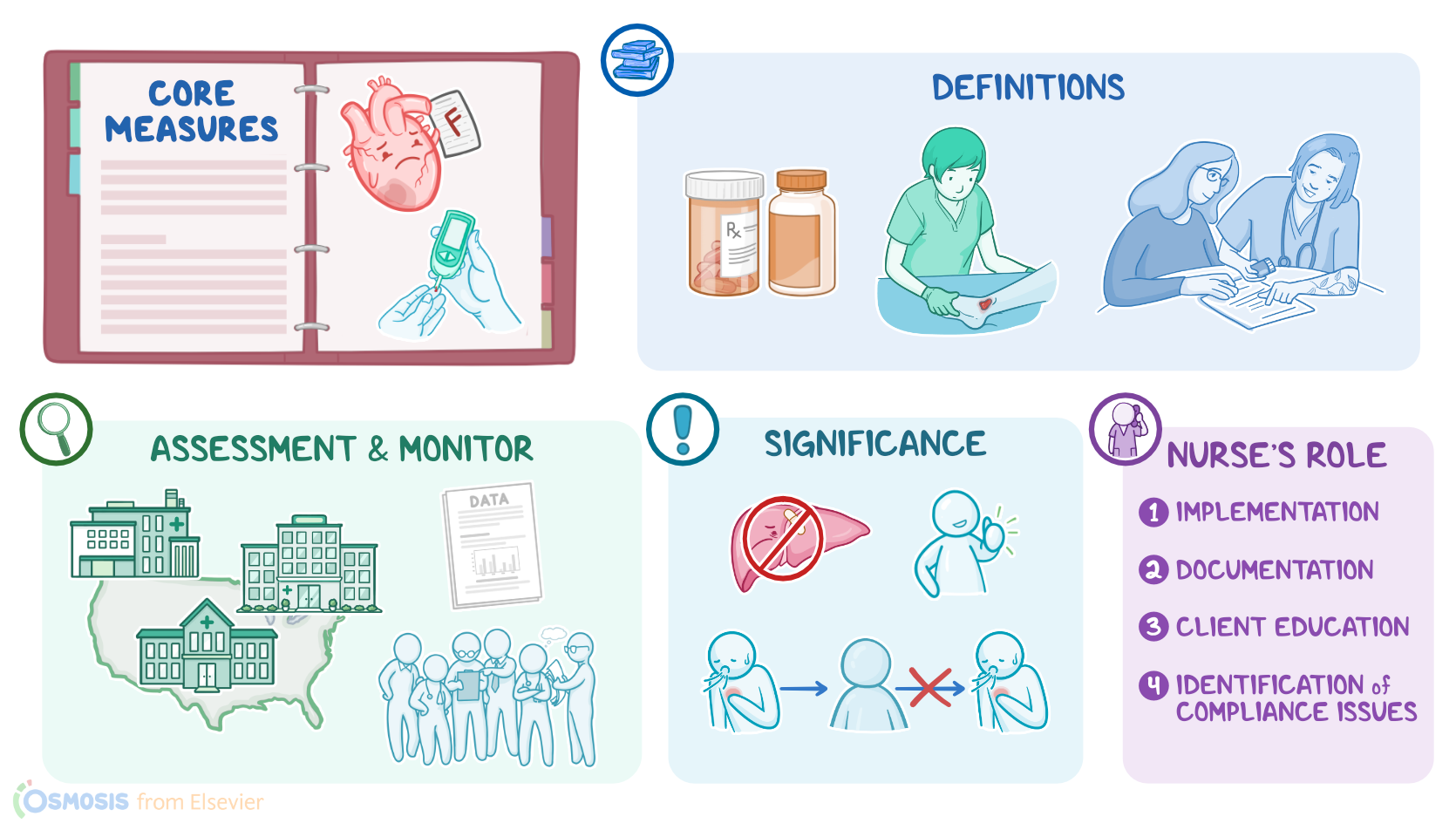
So, core measures are national standards of care for common conditions like diabetes and heart failure. Additional examples of core measures include instructions for tobacco screening and cessation, treatment of hypertension, and the scheduling of childhood immunizations. These standards are based on the best available evidence and are designed by The Joint Commission, or TJC, and the Centers for Medicare and Medicaid Services, or CMS. Although core measures differ depending on the condition, they usually include recommendations for prescribing and administering medications, assessment and treatment of disease, as well as client and family teaching.

Okay, so now that you know what core measures are, let’s learn how they are assessed and monitored. All healthcare facilities in the United States must report their compliance with core measures to healthcare accreditation organizations like TJC and CMS. Healthcare facilities generally track their core measure performance by examining documentation in the electronic healthcare record. TJC and CMS compile this information to measure and rate the quality of care provided to clients. Periodically, TJC and CMS will update core measures based on the most current research and evidence. Importantly, if a healthcare facility is not compliant with core measures, it may impact their CMS financial reimbursement and TJC accreditation.

Now, core measures can reduce complications of illness, help prevent recurrences or readmissions, and lead to better client outcomes. Higher core measure performance scores means that the healthcare facility is following the best practices to care for clients. The information is released to the public, so clients and their families can view the core measurement performance of a healthcare institution, compare it to other facilities, and find the healthcare facility with the highest compliance scores and seek care there. In addition, core measures are designed to decrease variation in care processes and increase collaboration across healthcare teams. So, if the client with heart failure moves from one healthcare facility to another, the standards of care performed by the client’s new healthcare team should be very similar to the previous one. Now that you understand why core measures are important, it’s time to discuss the role of the nurse in providing care while using core measures.