Crisis intervention: Nursing
Introduction0:00–0:16
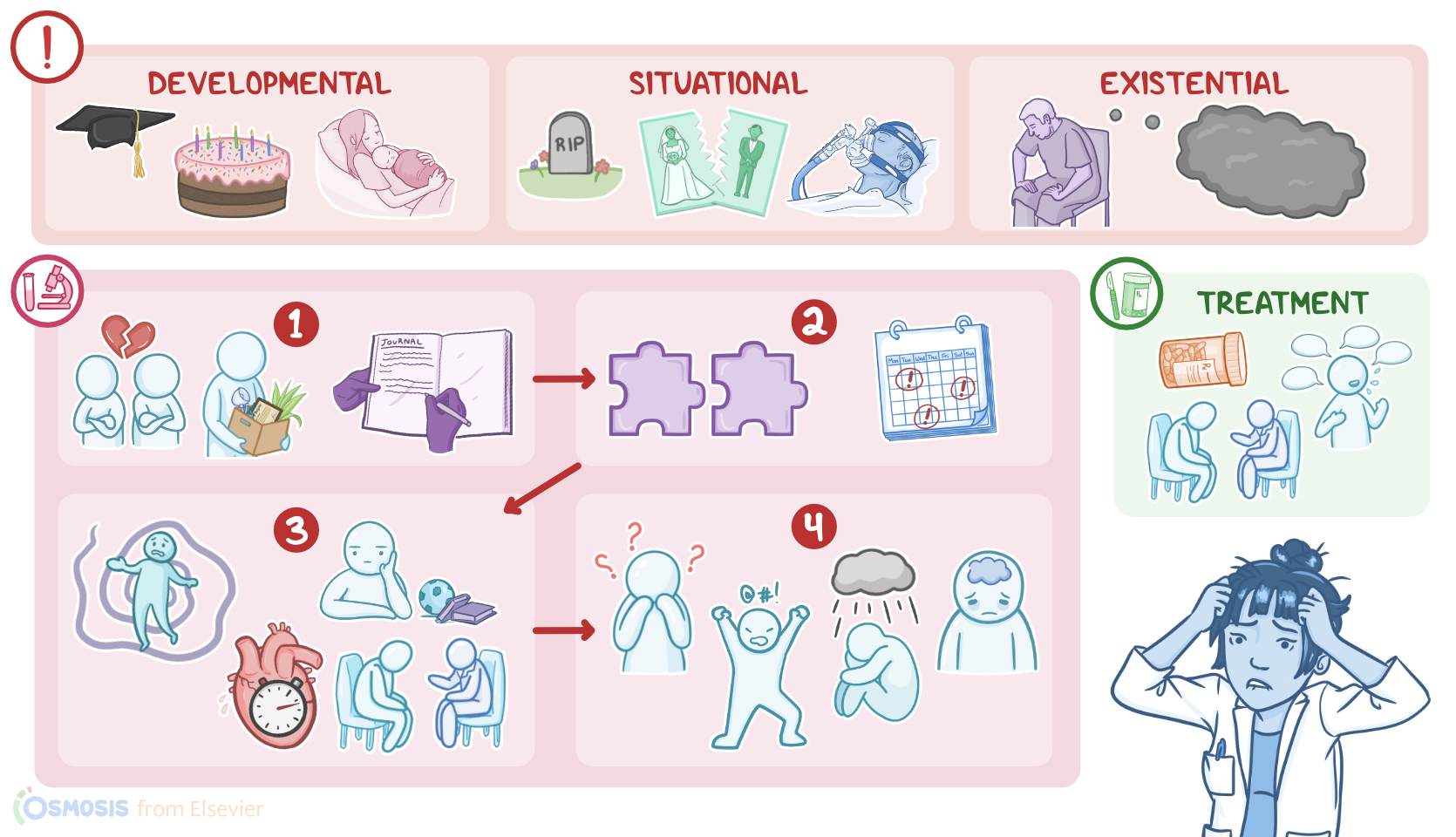
A crisis is a sudden, temporary, overwhelming emotional reaction caused by a stressful event perceived as a threat. Crisis intervention is a short-term management method used by health professionals in clients who are experiencing a crisis.Now, there are three main types of crises: developmental, situational, and existential crises.
Types of crises0:16–1:02
Developmental crises are predictable and expected occurrences during life. Common examples of developmental crises include graduation, new job, marriage, the birth of a child, and retirement.
Situational crises are unpredictable random and unexpected events. Common examples of situational crises include severe illness, job loss, unwanted pregnancy, divorce, and the death of a loved one.
Finally, existential crises are usually related to one’s life's meaning, purpose, and freedom. One common example of existential crisis occurs when an older person reflects on their life and accomplishments only to feel unfulfilled and dissatisfied.Now, regardless of the type of crisis, there are typically four main phases.
Phases of crisis1:02–2:36
During the first phase, the client encounters a stressful situation or a precipitating event that disrupts their psychological balance and causes discomfort and anxiety.
As a result, the client activates problem-solving and coping mechanisms to resolve the crisis. If the client fails to resolve the crisis, they enter the second phase.
During the second phase, discomfort and anxiety continue to rise, and the client starts perceiving this stressful situation as a threat, resulting in it affecting their daily function and quality of life.
Since problem-solving and coping mechanisms have failed, the client switches to a trial and error method, which uses various mechanisms in an attempt to resolve the crisis.
But, if the trial and error method fails, the client enters the third phase, which is associated with further negative impact on their daily function, severe panic, and even physical symptoms, such as sweating, shaking, and increased heart rate.
As a result, the client might make compromises in their life by reevaluating their needs and readjusting priorities. Some might reach out to external help and medical professionals, like nurses, psychologists, or psychiatrists.
If all previous coping mechanisms fail, the client enters the fourth phase and develops severe personality dysfunction, confusion, depression, or even violence against others.
During this phase, the client can even develop suicidal thoughts and present with suicidal behavior, such as self-harm.Now, clinical manifestations during crises vary from person to person.
Clinical manifestations2:36–3:13
Some clients can be angry, easily agitated and offended, and present with aggressive behavior, like yelling and shouting.
Treatment3:13–3:39
Non-pharmacological treatment includes counseling, expression and validation of feelings, improvement of the current life situation, and development of new problem-solving and coping mechanisms.
On the other hand, pharmacological treatment usually includes the administration of selective serotonin reuptake inhibitors, which can help relieve symptoms of panic attacks.Now let’s move onto the nursing care you will provide for a client during a crisis.
Management of Care3:39–6:07
Your priority goals are to maintain safety, assist in resolving the crisis, and promote return to pre-crisis functioning.First, take steps to maintain your client’s safety.
Assess their mood and observe their behavior, and determine if there is a risk of your client’s self-harm or harm to others.
Immediately report to the healthcare provider if your client expresses suicidal ideation, has attempted suicide, or expresses the intent to harm others.
Follow your facility procedures to address suicidality and promote safety, and continue to monitor your client’s mood and behavior.
Then, assist your client in resolving the current crisis. Begin by establishing a rapport with your client.
Speak to them calmly in a low-toned voice, listen actively, and use supportive body language to show them that you are concerned about their feelings.
Be sure to convey acceptance and support, and reassure them that they are in a safe place. Next, help them to define the problem.
Ask them about the crisis, including when the problem started, what happened, if there were any precipitating factors, and who else was affected.
Once you understand the problem, ask them about coping mechanisms they have used in the past when experiencing difficult situations.
Determine if those mechanisms were effective in other situations, help them to identify the strengths and limitations of their past coping mechanisms, and reinforce adaptive coping mechanisms they have used.
Also suggest other positive coping strategies they may not have tried, such as physical activity, journaling, or meditation, and encourage them to use existing support systems, such as family, friends, or a spiritual advisor.
Be sure to work together to develop a plan for coping adaptively with the crisis. Help them identify goals and assist them in creating a coping plan.Finally, follow up with them to determine if their plan was effective in reducing anxiety, and talk to them about how they can use these strategies should future crises occur.
Then, refer them to resources for ongoing support.Now, moving onto client and family teaching. Remind your client to use the successful coping mechanisms they’ve identified, as well as resources such as counseling to help resolve future crises.
General client and family teaching6:07–6:29
If they continue to have difficulty managing their crises or experience suicidal ideation, stress the importance of immediately seeking mental health care.
Review6:29–7:55
All right, as a quick recap… A crisis is a sudden, temporary, overwhelming emotional reaction caused by a stressful event.
Crisis intervention is the management method used by healthcare providers for clients who are experiencing a crisis. The three types of crisis are developmental, which are expected to occur during someone’s life; situational, which are unpredictable life events such as losing a job or divorce; and existential, which are usually related to the meaning of life.
A crisis usually has four phases. In phase one, the client is able to use problem solving skills and coping mechanisms.
When those strategies do not work, the client progresses into the second crisis stage where the client moves to a trial and error method.
The final phase happens when all previous coping mechanisms and strategies have failed and they experience severe depression, confusion, or even violence and suicidality.
Finally, education during a crisis intervention involves learning to use effective coping mechanisms and when to seek care.
| CRISIS INTERVENTION | ||
| KEY POINTS | NOTES | |
| DEFINITION |
| |
| TYPES OF CRISES |
| |
| PHASES OF CRISES |
| |
| SIGNS AND SYMPTOMS |
| |
| TREATMENT |
| |
| MANAGEMENT OF CARE |
| |
| PATIENT AND FAMILY TEACHING |
| |
No notes for this video yet
Try adding a note below