Evidence-based practice (EBP): Nursing
Introduction0:00–0:49
Nurse Jamaal works at a long-term care facility and has noticed that the average number of catheter-associated urinary tract infections, or CAUTIs, has been increasing each month.
Nurse Jamaal speaks to Nurse Jenny, another staff nurse, about the increased incidence of CAUTIs and asks about the facility policy for catheter care.
Nurse Jenny replies, “We clean urinary catheters once per day here. It’s how we’ve always done it.” Nurse Jamaal knows that CAUTIs can negatively affect client health and be very costly to healthcare institutions so he wonders if a more frequent cleaning schedule, such as twice per shift, would be more effective than once per shift over the span of one month.
In order to address this question, Nurse Jamaal decides to implement evidence-based practice, called EBP. EBP is a process which addresses a clinical problem by using the best evidence available to implement practice changes.
Definition of EBP and Research0:49–1:27
The goal of EBP is to improve client outcomes and overall quality of care. The foundation of EBP in healthcare is research, which is a systematic process of validating, refining and generating knowledge.
Research and EBP work hand in hand to guide nurses in making effective and appropriate decisions using clinical judgment.
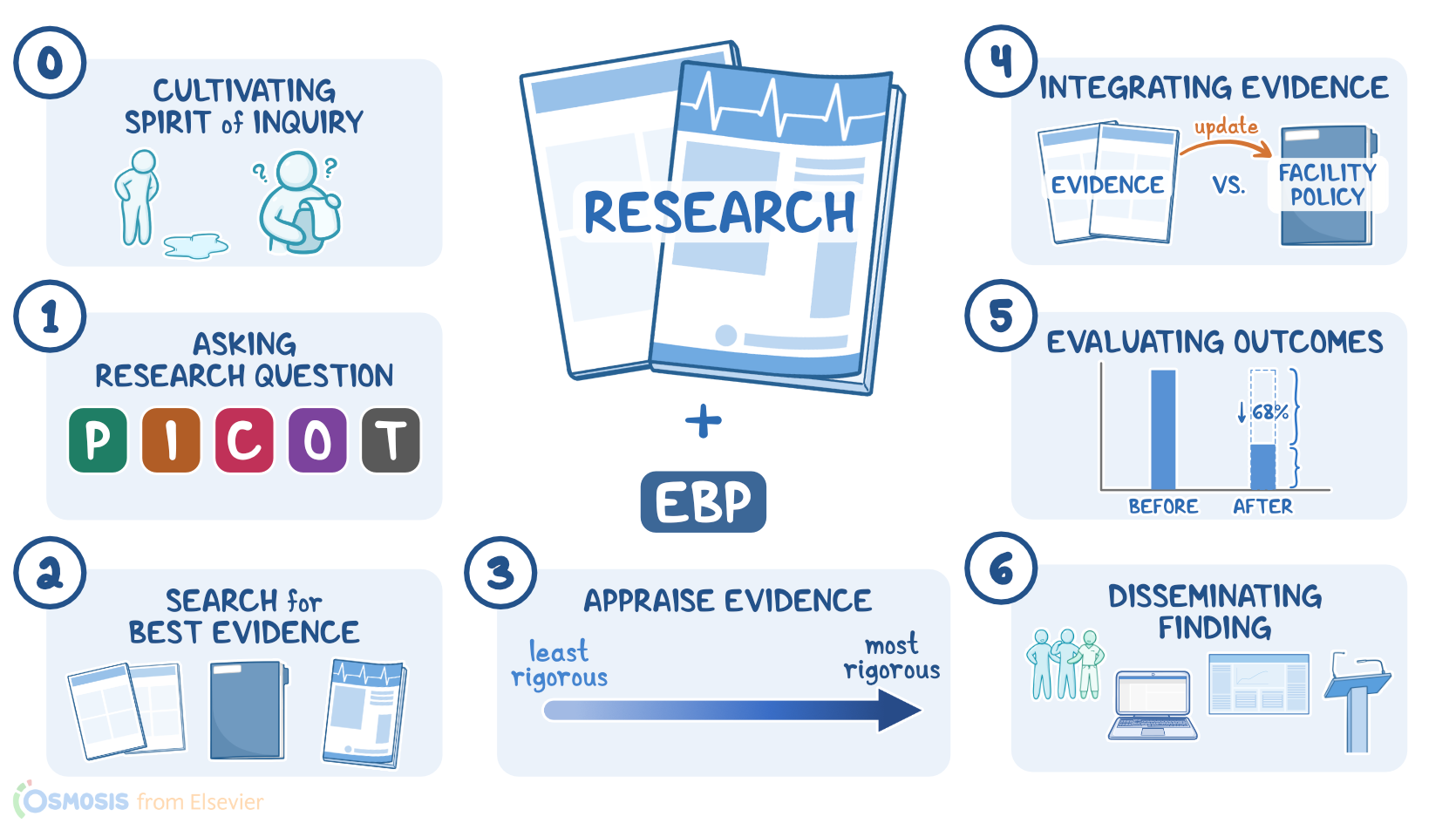
In order to try to find a solution to decrease the rate of CAUTIs within the facility, Nurse Jamaal should use EBP. EBP is a systematic process which includes seven steps, which are numbered zero to six: Cultivating a spirit of inquiry, asking the question, searching and collecting evidence, appraising the evidence, integrating the evidence, evaluating the outcomes, and disseminating the outcomes.
The Process of EBP1:27–7:15
Following this step-by-step approach ensures that you obtain the strongest available information to improve client care.
Step Zero is cultivating a spirit of inquiry. You can do this by noticing the potential for improvements in safety or care, and always questioning clinical practice instead of accepting what you have been taught or the ways things have always been done.
Nurse Jamaal exhibits a spirit of inquiry by asking questions regarding CAUTIs and catheter care. For a healthcare facility to be successful at implementing EBP, there must be a culture that promotes and supports inquiry.
Using these question components helps you to clarify and develop the key concepts related to your question.Nurse Jamaal’s PICOT question is, “In long-term care clients with an indwelling urinary catheter, how does cleaning the catheter twice per day compared to once per day affect catheter-associated urinary tract infections over a one month period?”After the research question is created, you are ready for step 2, which is to search for the best evidence.
This can be done by searching databases for journal articles, gathering facility policies and procedures, and reading quality improvement data.
Nurse Jamaal has access to journal databases through this workplace and searches for evidence using the key terms from his PICOT question which are: long-term care client, indwelling urinary catheter, cleaning or care, and catheter-associated urinary tract infections or CAUTI.
He finds 5 journal articles which help to answer his PICOT question.Step 3 is to appraise the evidence you have found. During this step, you will determine the level of evidence, meaning how rigorous the source of information is.
Generally, systematic reviews and meta-analyses are the most rigorous. Next, are experimental studies, especially those with randomized and controlled trials.
Finally, qualitative studies, opinion pieces, and committee reports are the least rigorous. Nurse Jamal appraises the journal articles he has found.
He determines that one article is an opinion piece written by a nurse about urinary catheter care, another is a qualitative study describing clients’ experience receiving urinary catheter care, one is a large randomized controlled trial that showed CAUTI rates comparing two cleaning methods, and two articles were systematic reviews of randomized controlled trials comparing CAUTI rates for different cleaning frequencies.
Nurse Jamal appraises that the systematic review articles are a high level of evidence that can be used when making evidence-based decisions.Step 4 is integrating evidence into clinical practice.
You can integrate evidence on a small-scale, such as using an intervention with one client, or on a large-scale, like creating a new facility-wide policy.
Since several clients have experienced CAUTIs, Nurse Jamaal decides that the evidence he has found should be compared to the facility’s policy on indwelling urinary catheter care.
After completing the comparison, Nurse Jamaal sees that the policy is not supported by the current evidence based literature.The evidence supports completing indwelling urinary catheter care twice per day instead of once.
This means that it is time for the facility to update their policy to support the evidence of cleaning urinary catheters twice per day instead of once.
The updated urinary catheter cleaning schedule will be integrated in the long-term care facility for one month to see if it is successful.
Step 5 of EBP is evaluating outcomes. This is when you assess whether the intervention was successful, partially successful, or not successful and decide if any modifications to the plan are needed.
Nurse Jamaal and the Nurse Educator Rhonda decide to evaluate if the increase in urinary catheter cleaning frequency is successful by comparing CAUTI rates before and after implementation.
Therefore, they initiate additional teaching and urinary catheter care practice sessions. Finally, the sixth step of EBP is disseminating findings, where you communicate the outcomes of the EBP to others.
This information can be shared through nursing huddles, emails, poster presentations, conferences, or through publication in a peer-reviewed journal.
Nurse Jamaal and the Nurse Educator Rhonda share the findings throughout the facility by attending huddles to help educate other staff about the catheter care policy.
They also create a poster presentation and share their experience at a regional nursing conference. Okay, so now that you know how to use EBP in everyday practice, the next step is to help promote EBP where you work.
One of the most important ways you can promote EBP is by always questioning why things are done a certain way.Then, use trust-worthy resources, like nursing and medical references and procedure manuals, to see if there is a better or safer way.
Integration of EBP into Nursing Practice7:15–8:25
There are several strategies you can use to promote EBP where you work. One strategy is becoming familiar with EBP activities available within your healthcare facility.
This includes reaching out to a nurse researcher or administrator to inquire about grants or existing research opportunities.
Another strategy is to join an EBP team, such as a unit practice council, or UPC. This is a team of clinicians who work to implement EBP within their healthcare institution.
You can also partner with a mentor who has experience with research to further develop your EBP skills. Possible mentors may include advanced practice nurses, or APNs, nurse researchers, or nursing professors.Alright, as a quick recap… EBP is a process which addresses a clinical problem by looking for the best evidence available.
The goal of EBP is to implement practice changes to improve client outcomes. Research helps to inform EBP, however, it is different from EBP since research is not always aimed at improving client outcomes.
There are seven steps in the process of EBP, which include cultivating a spirit of inquiry, asking a clinical question in PICOT format, searching for the best evidence, critically appraising the evidence, integrating the best evidence, evaluating the outcomes of practice changes, and communicating the outcomes of EBP findings.
Summary8:25–9:21
In addition, there are strategies nurses can use to integrate EBP into their organization and practice. One example is joining an EBP committee with other clinicians.
process of EDP, which include cultivating, a spirit of inquiry asking a clinical question in the peacoat format searching for the best evidence.
Critically, appraising the evidence integrating the best evidence evaluating the outcomes of practice changes and communicating the outcomes of EDP findings.
In addition. There are strategies nurses can use to integrate EVP into their organization and practice.
One example is joining Andy VP committee with other clinicians.
| EVIDENCE-BASED PRACTICE (EBP) | ||
| KEY POINTS | NOTES | |
| INTRODUCTION |
| |
| DEFINITIONS |
| |
| EBP PROCESS |
| |
| INTEGRATION INTO NURSING PRACTICE |
| |
No notes for this video yet
Try adding a note below