Folliculitis, carbuncles, and furuncles: Nursing
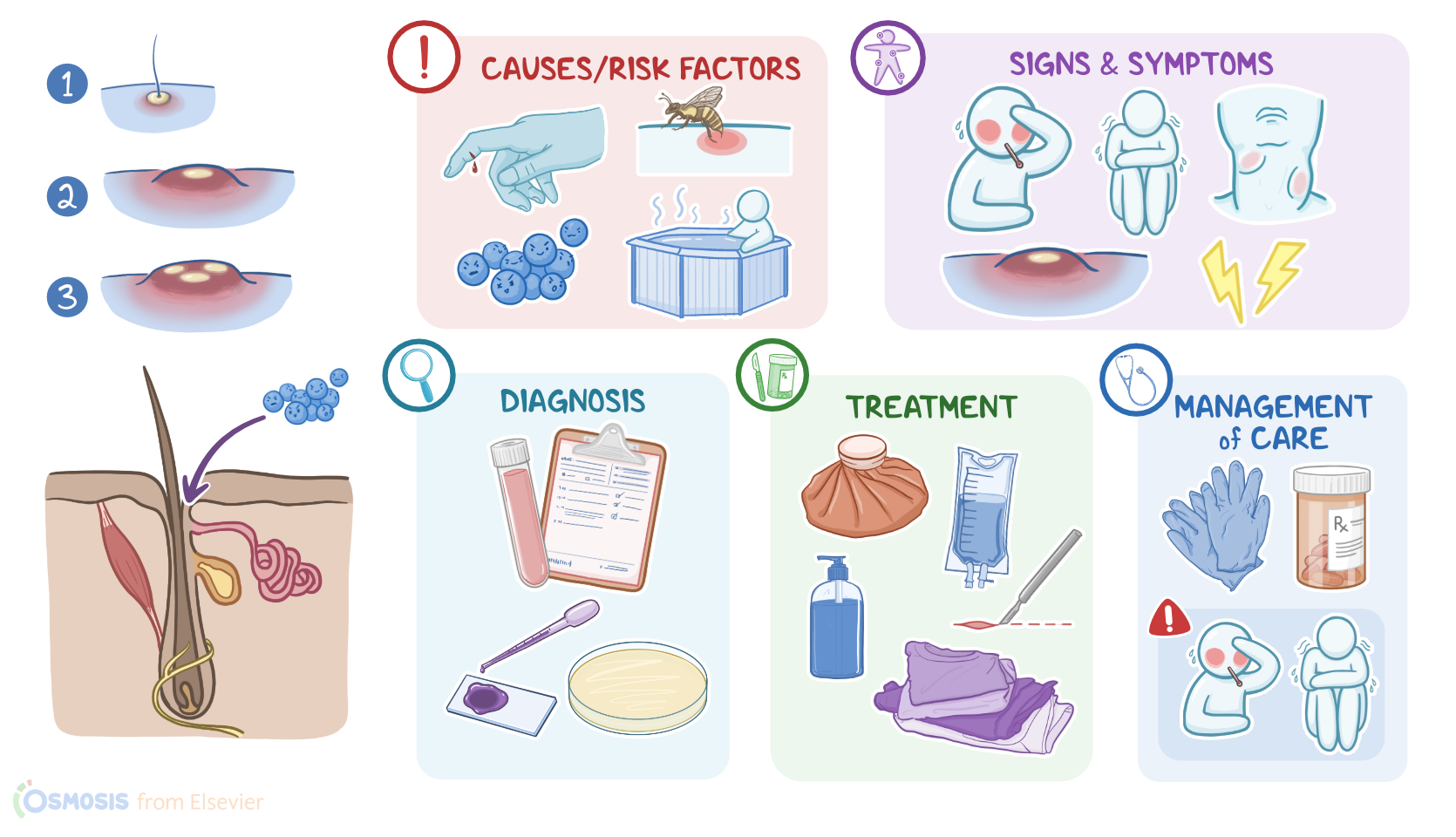
Folliculitis is a superficial bacterial infection of the hair follicles, while furuncles, or boils, are deeper infections of the hair follicles and the surrounding tissue, and carbuncles are groups of two or more furuncles.
They are usually caused by bacteria, but viruses, fungi, and parasites may also cause the infection.Okay, let’s go over some physiology.
Normally, the skin is divided into three layers, the epidermis, dermis, and hypodermis. The epidermis is the thin outermost layer of skin, the dermis is the thicker layer that lies below that, and the hypodermis is the lowest layer that’s made of fat and connective tissue and anchors the skin to the underlying muscle.Now, hair, along with nails and skin glands, are considered skin appendages that help with regulating body temperature and protection from the environment.
Hair is found on nearly every part of skin except the palms of the hands, soles of the feet, and the lips. Every strand of hair is composed of the shaft, root, and bulb that sits in a pouch-like structure called the hair follicle.
Next is the epidermal tissue that dips down into the dermis, and is associated with other structures like apocrine glands, sebaceous glands, the arrector pili muscle, and nerve receptors.
Inside the bulb lies the hair matrix which serves as the active site of hair growth and gives hair its color.Now, normally, the skin surface is colonized by a huge number of microorganisms that make up the normal skin flora.
This flora consists mostly of bacteria, such as Staphylococcus epidermidis, as well as certain fungi, such as Candida albicans.
The normal skin flora is typically non-pathogenic, meaning that these microorganisms don’t cause any disease. In fact, they are often beneficial, since they serve as a physical and competitive barrier that helps prevent pathogenic microorganisms from invading and infecting the skin and its appendages.Now, folliculitis, furuncles and carbuncles are all typically caused by Gram positive pathogenic bacteria, with the most common one being Staphylococcus aureus.
Less commonly, Gram negative pathogenic bacteria can also be involved, like Pseudomonas aeruginosa which loves humid or wet conditions, like hot tubs, and can cause a condition called hot tub folliculitis.
Risk factors that can allow these microorganisms to invade the skin appendages include having previous damage due to insect bites, minor trauma, abrasions, skin conditions like eczema, previous skin infections like impetigo or cellulitis; as well as using hot tubs or public pools.
Additional risk factors include prolonged use of oral antibiotics; obesity, diabetes mellitus, or being immunocompromised.Now, folliculitis occurs when pathogenic bacteria find a way to invade the hair follicle and cause infection of the superficial part of the follicle.
On the other hand, furuncles occur when bacteria manage to affect the deeper part of the hair follicles and the surrounding tissue, while a carbuncle are groups of furuncles that develop in the same area.In severe cases, these infections may cause complications, such as the formation of abscesses, as well as extensive tissue damage and necrosis, which can result in the formation of scars or dark spots in the skin.
Another complication is the destruction of the hair follicles, which can lead to permanent hair loss. Lastly, if the infection spreads to the blood, it may result in sepsis.Okay, moving onto clinical manifestations.
Folliculitis develops anywhere there’s hair, but it's more common in the scalp, arm pit, or groin area, which are areas prone to friction and moisture.
It typically presents as a tender or painless pustule with the hair shaft in its center. Other symptoms include minimal erythema, pruritus or tenderness.
Eventually, the pustules tend to heal without any scarring or follicle loss. It is important to distinguish folliculitis from pseudofolliculitis, which is an inflammation of an ingrown hair usually on the face due to shaving and it’s also known as “razor burn”.On the other hand, furuncles and carbuncles most commonly manifest on the lower abdomen, buttocks, and legs.
Furuncles typically present as a deep-seated, firm, tender, erythematous perifollicular nodule. They are typically indurated, with central necrosis, and there can be draining pus.
Constitutional symptoms are typically absent. In contrast, carbuncles present as clusters of painful, swollen and draining pustules, are often accompanied by fever, chills, and lymphadenopathy.Now, the diagnosis of folliculitis, furuncles and carbuncles primarily involves the client’s history and physical assessment.
There are no specific laboratory tests, but a complete blood count may reveal leukocytosis, as well as increased inflammatory markers like ESR and CRP.
For furuncles and carbuncles, a gram stain and culture of the purulent exudate can be also performed to identify the causative organism.Treatment of folliculitis, furuncles and carbuncles is chosen based on the severity of the infection, as well as the efficacy and response to treatment.
Mild folliculitis with few pustules often resolves spontaneously. If there are numerous papules or pustules involving a large body area then topical antibiotic therapy like clindamycin 1% lotion or solution can be used twice a day.
Severe cases of folliculitis can be treated with systemic antibiotics, such as dicloxacillin or cephalexin for a week, whereas chronic recurrent folliculitis may require daily application of a benzoyl peroxide 5% gel or wash.
Treatment of furuncles and carbuncles includes warm moist compresses, along with regular bathing with antimicrobial soaps containing chlorhexidine, and wearing loose-fitting clothing.
Drainage of the lesions with a small incision may also help. Finally, when lesions are numerous, IV antibiotics like cloxacillin or cefazolin are recommended.Alright, now let’s look at the nursing care you’ll provide for a client with a furuncle.
Your priority nursing goals are to prevent spread of infection, provide supportive care, and assist with eliminating the infection.
To begin, implement contact precautions to prevent spreading the infection. Then, assess and document the quantity, size, and location of any pustules; and note the presence of erythema or drainage.
Next, apply a warm compress to facilitate drainage. If your client requires an incision and drainage, administer the prescribed analgesics, and assist with the procedure as needed.
Then be sure to obtain cultures of any drainage to help identify the causative organism, and administer antimicrobials as prescribed to treat the infection.
Report to the healthcare provider if your client has a fever, chills, or malaise; and continue to monitor your client closely.
Okay, moving on to client and family teaching. First, explain that a furuncle is caused by an infection of the hair follicle.
Review the plan of care, including their prescribed medications, and instruct them to take them exactly as prescribed to resolve their infection and prevent complications.
Also be sure to remind them to keep all of their follow-up visits for continued monitoring and care.Next, teach your client how to take care of their incision at home.
If they had an incision and drainage, teach them to keep their wound dressing clean and dry. Instruct them to notify their healthcare provider if they develop fever, chills, or fatigue, or if their infection spreads.Finally, talk to your client about how to prevent future infections.
Emphasize the importance of keeping their skin clean and dry. Instruct them to cleanse the skin with an antimicrobial soap before shaving; to use a clean razor; to use shaving cream to help prevent breaks in the skin; and to apply a moisturizer afterwards to help maintain skin integrity.
In addition, teach them to avoid sharing personal care items like razors and towels. Then, suggest wearing non-constrictive clothing whenever possible, promote air flow and reduce friction.
Finally, recommend avoiding places that may harbor pathogens like hot tubs and public pools.Alright, as a quick recap… Folliculitis is a superficial infection of the hair follicles; furuncles are deeper infections of the hair follicles; and carbuncles are groups of two or more furuncles.
Risk factors include any break in the skin that can allow entry of microorganisms; exposure to hot tubs and public pools; prolonged use of oral antibiotics; and conditions like obesity, diabetes mellitus, or being immunocompromised.
Folliculitis occurs when bacteria invade the superficial part of the hair follicle; and presents as a pustule with the hair shaft in the center, that may involve other symptoms like erythema, tenderness, or pruritus.
Furuncles occur when bacteria infect deeper parts of the follicle and surrounding tissue, and typically present as a deep-seated, firm, tender, erythematous perifollicular nodule, they are often indurated and can have draining pus.
Carbuncles are often accompanied by fever, chills, and lymphadenopathy. Complications include abscess formation, tissue damage, and sepsis.
Diagnosis starts with a history and physical assessment, in addition to lab tests to identify the causative organism. Treatment depends on the severity of the infection, and includes the use of antimicrobials, incision and drainage, and supportive measures.
Nursing management focuses on preventing spread of infection, providing supportive care, and assisting with eliminating the infection.
Client and family teaching emphasizes treatment adherence, self care at home, strategies to reduce the risk of infection, and when to seek medical attention.
| FOLLICULITIS, CARBUNCLES, AND FURUNCLES | ||
| KEY POINTS | NOTES | |
| DEFINITION |
| |
| PHYSIOLOGY |
| |
| CAUSES AND RISK FACTORS |
| |
| PATHOPHYSIOLOGY |
| |
| SIGNS AND SYMPTOMS |
| |
| DIAGNOSIS |
| |
| TREATMENT |
| |
| MANAGEMENT OF CARE |
| |
| PATIENT AND FAMILY TEACHING |
| |
No notes for this video yet
Try adding a note below