Frostbite: Nursing process (ADPIE)
Client Report0:00–0:36
Christine Lee is a 46-year-old woman who presents to your emergency department after changing a flat tire in the cold with her bare hands.
The temperature outside was around 29 °F or -1.7 °C. Miss Lee is concerned about her hands and fingers.
She says that her fingers feel numb and tingly. Her fingertips are pale and cool, while her knuckles are red, warm, and swollen.
Pathology0:36–5:15
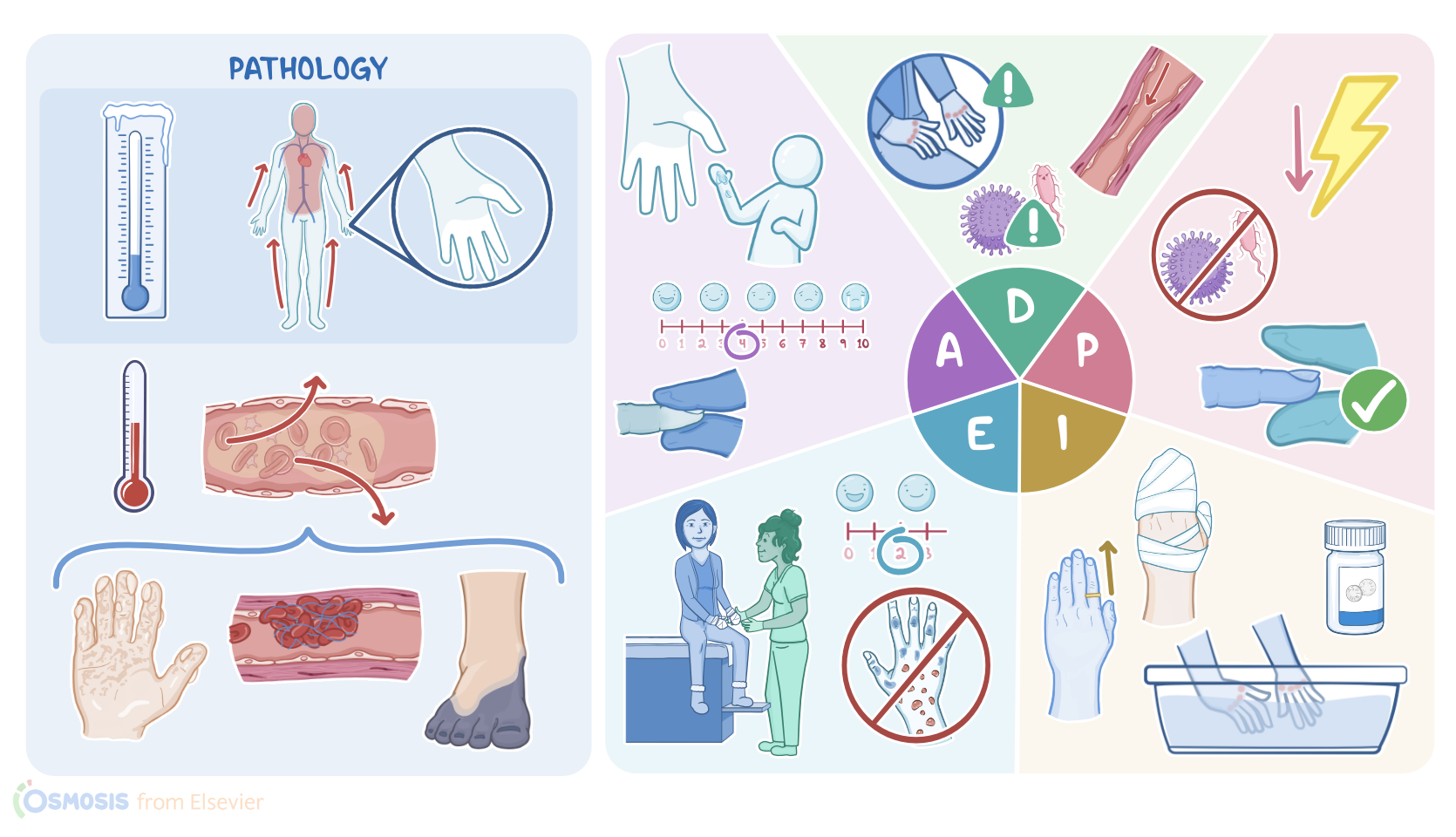
It typically occurs within 30 minutes where the skin is exposed to low temperatures and windy weather. Normally, our body responds to low temperatures by constricting small blood vessels close to the skin.
This way, it prevents loss of heat by shifting the warm blood from the extremities to internal organs. As a result, the exposed skin becomes pale, cold, and numb, and a person starts to experience a tingling and aching sensation.
Next, low temperatures cause intracellular and extracellular fluids to freeze and form small ice crystals that give the tissue a firm, solid feel.
Furthermore, these ice crystals directly damage the surrounding tissue and vascular endothelial cells. And if the exposure to low temperatures continues, blood vessels can lose their vascular tone, eventually causing the pooling of blood and changing the skin color from pale to purplish.
Now when the affected part of the body is rewarmed, the blood flow is restored and reperfusion injury occurs. In reperfusion injury, damaged blood vessels leak fluid into surrounding tissue, eventually causing edema.
At this point, the skin develops a blotchy appearance. The blotchy skin can be followed by fluid-filled blisters, which most commonly occurs in the next 24 to 48 hours.
At the same time, damaged blood vessels initiate platelet aggregation, eventually causing thrombosis and further reduction of the blood flow.
In severe cases, tissue destruction can progress to skin necrosis, which typically presents as a blue-gray discoloration of the skin.
So the diagnosis of frostbite is based on the detection of these changes on the skin during a physical exam. Additionally, we can check whether or not the person has peripheral pulses in the affected extremity.
The first group includes environmental factors like low temperature, the duration of exposure, high altitude, wind, and wet clothes.
Next, we have individual risk factors such as age, gender, and race. For example, infants and the elderly have limited thermoregulation abilities, so they have a harder time producing and retaining body heat.
The third group includes health risk factors such as exhaustion and dehydration, which can further decrease the ability of the body to adapt to low temperatures.
Additionally, the use of vasoconstrictive substances such as beta blockers and nicotine from smoking increases the risk of freezing because they narrow small blood vessels in the hands and feet.
Finally, we have behavioral risk factors such as alcohol and substance abuse, which can all lead to an altered mental status that prevents the person from seeking shelter.
Now it's important to note that frostbite can lead to some serious complications. First, it can progress to hypothermia, which is a condition when a person's core body temperature drops below 95 °F or 35 °C.
Next, damaged skin offers little protection against pathogens, so there's an increased risk of infection. Moreover, bacterial infection can progress to gangrene, which is a condition associated with severe tissue destruction that might require the amputation of the affected extremity.
Treatment of frostbite requires rewarming of the affected part using warm water that ranges from 98.6 to 102.2 °F or 37 to 39 °C.
Additionally, clients should take non-steroidal anti-inflammatory drugs to relieve pain and thrombolytics to reduce the risk of thrombosis and reperfusion injury.
Finally, severe frostbites associated with necrosis require wound care and removal of dead tissue. Let's get back to assess Miss Lee and see how she's doing.
Assessment5:15–6:16
As you assess Miss Lee's hands, you notice that her fingertips are pale. Her knuckles look flushed and slightly swollen, forming a reddened border around her mottled fingers.
She has no visible blistering or necrosis, but has a small amount of peeling skin along her fingers. The capillary refill in her fingertips is delayed around 4 seconds, but she has normal pulses in both radial arteries.
Her vital signs are oral temperature 97.5 °F or 36.4 °C, heart rate 70 BPM and regular, respiratory rate 18 breaths per minute with clear lungs on auscultation, and her SPO2 is 99% on room air.
She states that her pain is 4 out of 10 and describes a burning sensation in her fingers that has worsened since she has been inside.
You document your assessment findings, share the information with the physician, and begin to develop a care plan for Ms.
Lee. Based on the assessment data you collected, your nursing diagnoses include ineffective peripheral tissue perfusion related to decreased blood flow, acute pain related to rewarming, and risk for infection related to impaired skin integrity.
Diagnosis6:16–6:31
Planning6:31–6:56
Now that you have established some nursing diagnoses, it's time to collaborate with Ms. Lee and the physician to plan some goals of care.
By the time Ms. Lee is discharged from the ED, she will have increased perfusion to her fingertips, as evidenced by improved color, temperature, and capillary refill.
She will experience less pain as evidenced by her stated tolerable pain rating of 3 out of 10, and there will be no evidence of infection.
Implementation6:56–8:03
Next, you review the physician's orders and implement your plan of care. You start by removing a class ring from Ms.
Lee's ring finger, explaining that as her hands are rewarmed, they will likely swell, causing the ring to feel tight and constrict blood flow to that finger.
Next, you administer the ordered analgesic and antiplatelet medication, aspirin, and begin rewarming Miss Lee's hands in a circulating warm water bath.
After 30 minutes you dry her hands, patting gently with a towel, and apply antibiotic ointment and a loose, non-adherent dressing, explaining that it is important to avoid compressing the skin since it may blister or swell in the coming hours.
Next, you administer the ordered tetanus prophylaxis before discharge. You stress the need to seek medical attention if she notices any signs of infection, especially pustules on the skin or areas of red streaks near a blister or open area of skin.
The physician writes an order for Ms. Lee's discharge home, including a close follow-up with her primary care provider.
Evaluation8:03–8:39
Let's check back and evaluate how Ms. Lee is doing so far.
Her hands are now warm, and her capillary refill is less than 3 seconds in both hands. Her skin is slightly swollen and red, but no longer pale or mottled.
The areas of peeling have remained the same but have not gotten worse, and she has not developed blisters or lesions. No signs of infection are present at this time.
Ms. Lee states that her pain is 2 out of 10 and she is beginning to have more sensation in her fingertips.
All right, as a quick recap, your assigned client, Christine Lee, presented to the ED with signs and symptoms of frostbite, an injury caused when the skin freezes.
Summary8:39–9:26
Your assessment revealed pale, mottled fingers, peeling skin, and delayed capillary refill. Your nursing diagnoses were ineffective peripheral tissue perfusion, acute pain, and risk for infection.
The goals you identified when planning included increasing circulation and profusion to the fingers, decreasing pain, and preventing infection.
You implemented your plan by safely rewarming Miss Lee's hands, treating her pain, and dressing her hands appropriately.
You explained to Miss Lee the importance of follow-up with her primary care provider and evaluated the effectiveness of her plan of care.
| FROSTBITE | ||
| KEY POINTS | NOTES | |
| PATIENT REPORT |
| |
| PATHOPHYSIOLOGY |
| |
| DIAGNOSIS AND TREATMENT |
| |
| ASSESSMENT |
| |
| NURSING DIAGNOSES |
| |
| PLANNING |
| |
| IMPLEMENTATION |
| |
| EVALUATION |
| |
- "Ackley and Ladwig’s Nursing Diagnosis Handbook: An Evidence-Based Guide to Planning Care, 13th edition" Mosby (2022)
- "Frostbite: Current status and advancements in therapeutics" J Therm Biol (2020)
- "Interventions for frostbite injuries" Cochrane Database Syst Rev (2020)
- "Harrison’s Principles of Internal Medicine, 21st edition" McGraw Hill / Medical (2022)
- "Long-Term Sequelae of Frostbite-A Scoping Review" Int J Environ Res Public Health (2021)
- "Diagnosis and Treatment of Frostbite" N Engl J Med (2022)
- "Practical Review of the Current Management of Frostbite Injuries" Plast Reconstr Surg Glob Open (2022)
No notes for this video yet
Try adding a note below