Growth and development - School-age: Nursing
The school-age period begins when children start elementary school, at 6 years old, and lasts until they have finished primary education at around 12 years of age. This stage is characterized by slow physical growth and accelerated social development, compared to earlier stages. As they become more independent, school-age children start to participate in various sports and social activities, and are now able to socialize with people other than family members, such as teachers, peers, and coaches.
Now, developmental psychologists involved in studying development during the preschool period include Jean Piaget, Erik Erikson, and Lawrence Kohlberg.
Now let’s quickly take a look at two important terms here, which are growth and development. Growth refers to physical changes in height, weight, and the appearance of the body; whereas development refers to the acquisition of complex motor, cognitive, and social skills, such as walking, speaking, turning a page in a book, or smiling at familiar faces.
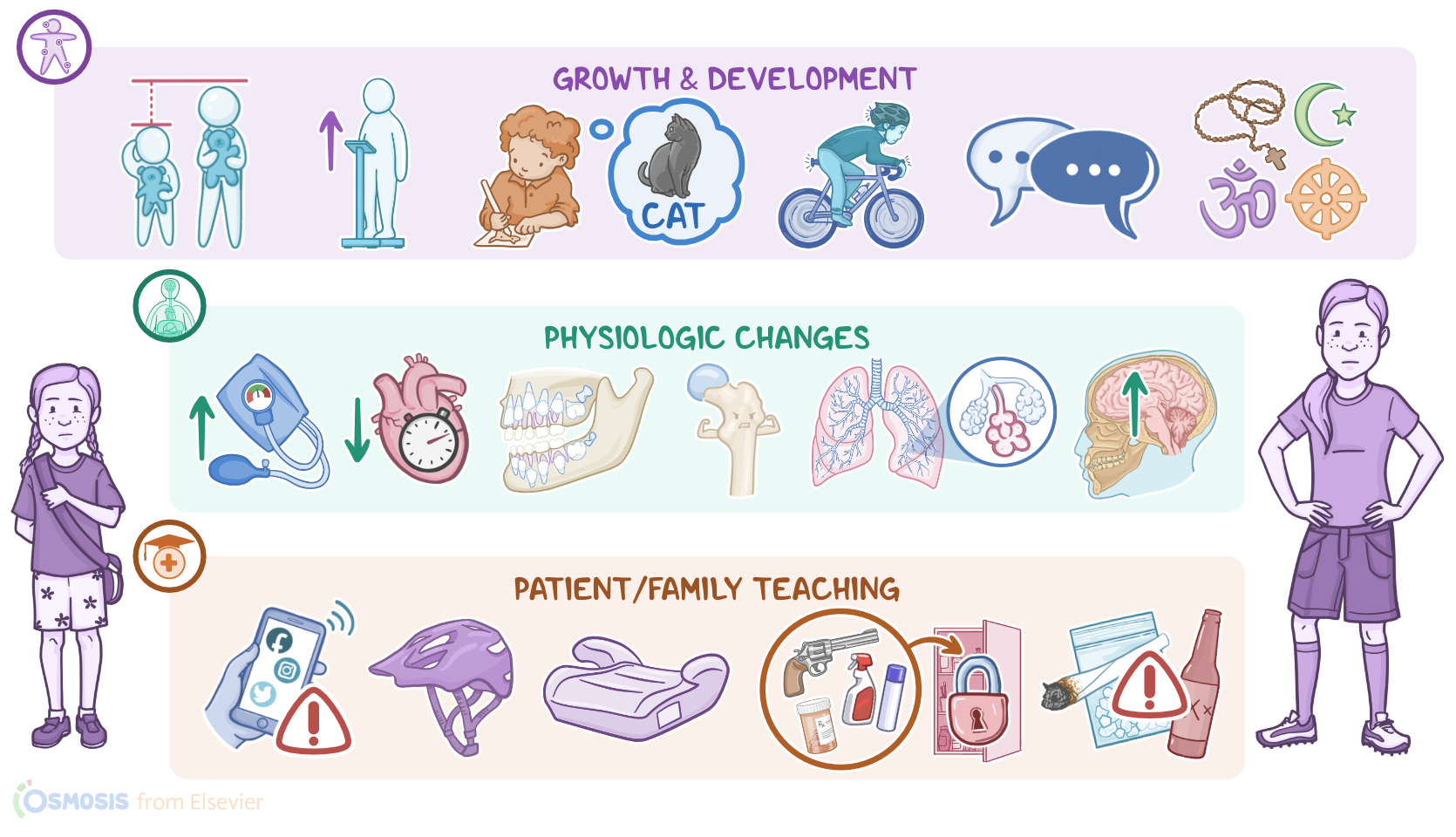
Alright, when it comes to growth, school-age children tend to get taller at a slower pace, growing about 6 to 7 centimeters each year, with an expected increase of 3 to 3.5 kg per year in weight. It’s important to note that children of the same age are frequently at different points in their growth during childhood. This is also a time where kids start to have feelings about how they look and how they’re growing, so it’s not uncommon that they become more interested in stepping on the scale or standing by a tape measure.
Alright, now let’s switch gears and look at the motor, cognitive, psychosocial, moral, and spiritual development of a school-age child. Starting with motor development, this is a period where children refine fine motor skills, hand-eye coordination, and they become more skilled at things like writing, drawing, and playing a musical instrument. During school-age years, coordination, balance, and rhythm improve as well, allowing children to learn new activities, such as riding a two-wheel bike, dancing, and participating in a variety of sports.
For cognitive development, school-age children are in the concrete operational stage, according to Piaget. This is when children begin to understand their world in terms of words and images. They develop the ability to arrange things according to their common or different characteristics, a process known as seriation; and they begin to collect things like rocks and other objects. They also develop a sense of conservation, meaning that they understand that objects or quantities can remain the same, even if their physical appearance changes.
Moving on to psychosocial development. Erikson explains that school-aged children face the task of industry vs inferiority where they become eager to increase their knowledge about the world around them in home and school. As they interact with family members and peers, they learn new social skills. When the child is supported in learning these new skills, they will develop a sense of accomplishment, competence, and industry. If they are not supported, or unsuccessful in developing new skills, they may develop a sense of inadequacy and inferiority.
In terms of moral and spiritual development, school-age children are in the conventional stage of moral development, according to Kohlberg. They begin accepting social rules about what is right and wrong, and they have a desire to be “good” in order to win other people’s approval.
School-age children thrive on learning the music, language, traditions, holidays, values, and other aspects of their culture, and they may develop a desire to understand more about their religion and cultural beliefs.
This age group tends to imitate parents, family members, and other important figures, like teachers or coaches, so role modeling is very important to shape their sense of right and wrong. By the end of the school-age years, children can understand the concept of the “golden rule” which helps to guide them to treat others as they'd like to be treated.
Finally, let’s look at the physiologic changes that take place during the school years, starting with the nervous system. The brain and skull grow very slowly during the school-age years, and brain growth is complete by the time a child reaches 10 years old.
The respiratory system also continues to mature with the development of the lungs and alveoli, resulting in fewer respiratory infections. Respiratory rate decreases, and respirations become more diaphragmatic.
Next, changes in the cardiovascular system involve an increase in blood pressure and a decrease in heart rate. During this stage, the growth of the heart as an organ slows down, and is smaller in size in relation to the rest of the body than at any other developmental stage. Musculoskeletal growth leads to increased strength and coordination. Bones continue to ossify throughout childhood, but mineralization is not complete.
| GROWTH AND DEVELOPMENT - SCHOOL-AGE | ||
| KEY POINTS | NOTES | |
| DEFINITION |
| |
| GROWTH |
| |
| DEVELOPMENT |
| |
| PHYSIOLOGIC CHANGES |
| |
| PATIENT AND FAMILY TEACHING |
| |
No notes for this video yet
Try adding a note below