Growth and development theories: Nursing
Introduction0:00–0:55
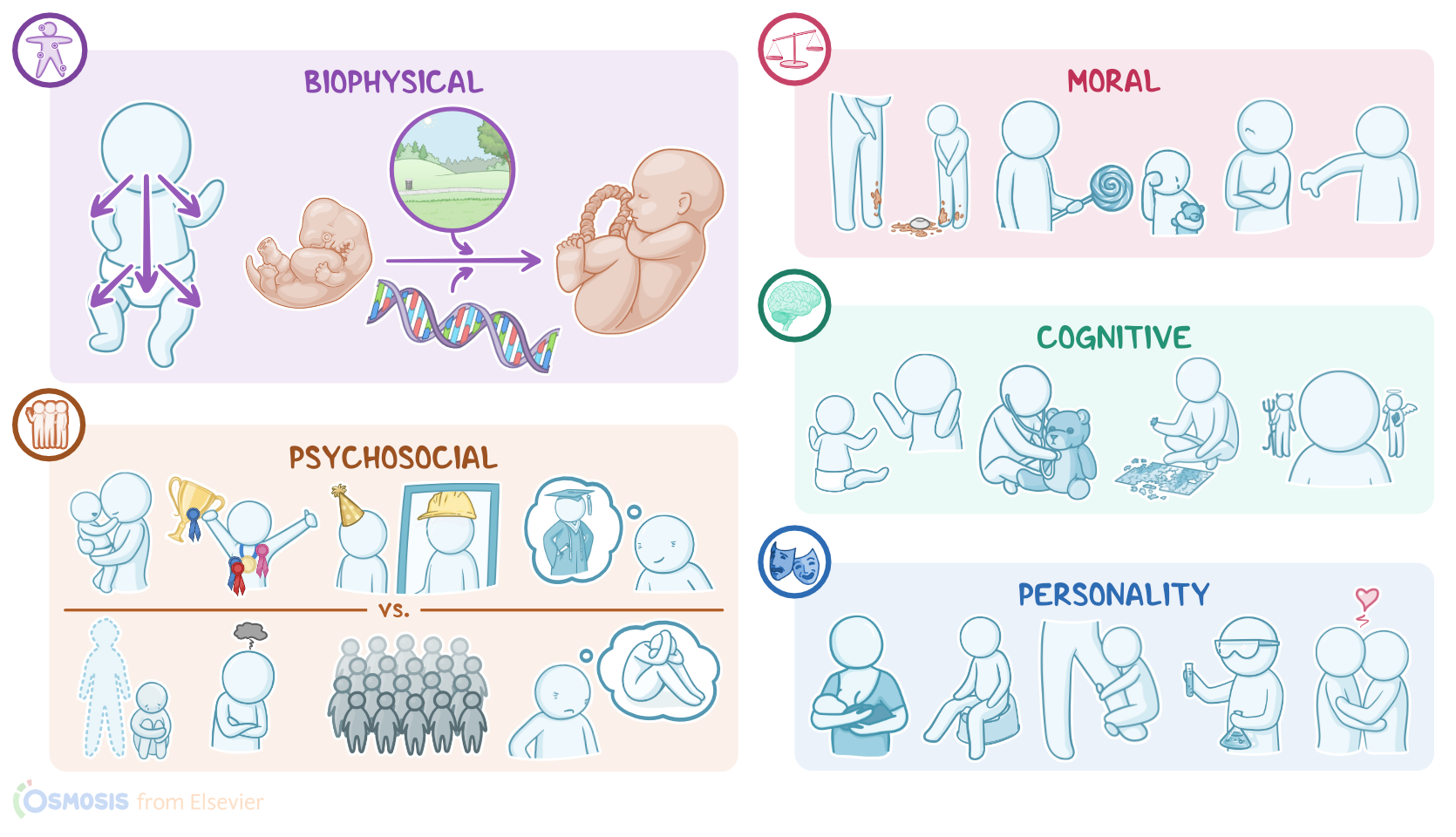
Growth and development start from the time of conception and progress until a person dies. Growth and development theories provide a framework to understand this wide array of changes, and they help healthcare providers plan individualized care for clients based on their stage of development, and to provide anticipatory guidance for parents and caregivers.Major growth and development theories include biophysical developmental theory by Gesell, psychosocial development theory by Erikson; cognitive development theory by Piaget; moral development theory by Kohlberg; and finally, the psychoanalytic development theory by Freud.OK, let’s start with Gesell's theory of biophysical development, which focuses on physical growth, and promotes the idea that every child has unique growth patterns that are influenced by an interaction between genes and the environment.
Gesell theory of biophysical development0:55–1:36
It also states that even from early prenatal life, growth occurs in a cephalocaudal and proximodistal manner. Cephalocaudal growth means that the head and brain develop first and then progress towards the feet, while proximodistal growth means that the central body parts, like the heart, develop before distal parts like arms and legs.
Erikson's theory of psychosocial development focuses on the psychosocial aspects of human development, such as personality, thinking, and behavior.
Erikson theory of psychosocial development1:36–6:05
Erikson described eight stages of psychosocial development, from infancy to adulthood, during each of which a client experiences opposing conflicts that need to be resolved in order for development to be successful.The first stage occurs from birth until one year of age, and is characterized as trust vs mistrust.
During this stage, the infant needs physical comfort and a reliable and sensitive caregiver in order to establish a sense of trust in the world around them, and to feel the world is a safe, predictable place.
On the other hand, the infant will experience anxiety and develop mistrust if they are mistreated or if their needs are not reliably met.The second stage, autonomy vs shame and doubt, occurs from 1 to 3 years of age.
During this stage, toddlers start exploring their world and learn some independent and self-care activities such as walking, feeding, playing, and toileting as they develop a sense of independence and autonomy.
So, allowing a child to choose what shirt to wear or if they want to eat a piece of cheese or some peanut butter can promote independence and autonomy.
At the same time, not allowing them to make choices can cause them to doubt their abilities and inhibit autonomy, ultimately resulting in them developing a sense of shame and doubt.
The third stage, initiative vs guilt, occurs between 3 to 6 years. During this period, preschoolers experience a desire to assert control over their environment and interactions with others.
As they learn to initiate activities, plan goals, and successfully master tasks, they develop self-confidence and a sense of initiative.
On the other hand, a lack of praise for the child’s efforts, harsh control, or being overly critical of mistakes or messiness can impair the development of initiative, resulting in a sense of guilt.
The fourth stage takes place in school-age children from 6 to 12 years, where children face the task of industry vs inferiority.
During this stage, children are eager to increase their knowledge about the world in school and learn social skills as they learn to interact with their peers.
When they are supported in learning new skills, the child will develop a sense of accomplishment, competence, and industry.
If they are not supported, are unsuccessful in the development of new skills, or are unable to keep up with their peers, they can develop a sense of inadequacy and inferiority.
Next, there is the fifth stage, identity vs role confusion, which occurs between the ages of 12 and 18 years. During this stage, adolescents strive to answer the question, “Who am I?” They tend to be preoccupied with their appearance and seek to discover their personal identity by exploring roles, personal beliefs, values, and goals for adulthood.
Adolescents who are not encouraged to discover their individual selves can become uncertain and confused regarding their place in society.The sixth stage takes place during young adulthood, between the ages of 18 to 40 years, and is about intimacy vs isolation.
It’s characterized by a search for meaningful, intimate and long-term relationships with others. Failure to develop significant relationships and connectedness with others can result in isolation.The seventh stage, generativity vs self-absorption and stagnation, takes place during middle adulthood between the ages of 40 to 65 years.
During this stage, contributing to future generations through work, child rearing, mentoring, and becoming involved in different communities and organizations produces a sense of caring for future generations.
Failure to contribute to society in a meaningful way can result in a lack of accomplishment and lead to self-absorption and a feeling of stagnation.
Finally, there is the eighth stage which takes place during late adulthood, starting from the age of 65 years until death, and is about integrity vs despair.
During this stage, older adults contemplate their life’s achievements. Looking back with contentment and happiness leads to a feeling of integrity.
On the other hand, failing to achieve goals or looking back with disappointment and regret can result in feelings of bitterness and despair.Alright, now let’s move to Piaget’s theory of cognitive development, which looks at how children develop their thinking and make sense of their world.
Piaget cognitive development6:05–8:17
According to Piaget, children's cognitive development occurs in four distinct stages. The first stage is the sensorimotor stage, which starts from birth and ends at 2 years of age.
During this stage infants learn about their world through senses like hearing and seeing along with motor activity. They develop certain cognitive skills such as object permanence, which is the ability to understand that objects can still exist even if they are not seen.
The second stage, called preoperational stage, takes place between the ages of 2 to 7 years. During this stage, children tend to use symbols to represent words and ideas, which is why they engage in symbolic or pretend play, imagining a broom is a dinosaur or a cardboard tube is a telescope.
One major characteristic of this stage is that children experience egocentrism, meaning that they don't distinguish between their own point of view and the perspectives of others.
Another major characteristic is animism, meaning they believe that objects have life-like qualities like feelings, thoughts, and the ability to act.Next, there is the concrete operational stage that occurs between the ages of 7 to 11 years, is when children begin to understand the world in terms of words and images.
Children begin to use logic to understand principles like cause and effect, size, and difference. They can arrange things according to their common or different characteristics, what’s known as seriation.
During this stage, they also develop a sense of conservation, which means they can understand that objects or quantities might remain the same even if their physical appearance may change.
Fourth and last, there is the formal operational stage, which takes place from the age of 11 years through adulthood. During this stage, people develop the ability to understand abstract concepts such as success, morality, and truth.
This stage is also characterized by idealism and logical thinking.Alright, now, let’s move to the next theory, called Kohlberg's theory of moral development, which refers to the process of learning and accepting the values and rules of society.
Kohlberg theory of moral development8:17–9:50
Kohlberg believes that there are three levels of moral development. There is level one, called pre-conventional morality, which is characterized by the lack of a moral code, and behaviors are only guided by reward and punishment.
This means that action that leads to punishment is considered bad, while an action that leads to a reward must be good. At first, an infant lacks awareness of right or wrong, but later they learn to follow the rules as a way to avoid punishments, while trying not to displease those in power such as the teacher, or parents.
Next, there is level two, called conventional morality. It is characterized by the acceptance of social rules about right and wrong and internalizing the moral standards of valued adult role models.
During this stage, children want to be good in order to win other people’s approval, and later, they begin to understand norms of the society around them and are concerned with obeying rules and doing what's right.Finally, there is level 3, also known as post-conventional morality, during which people understand moral-ethical principles and ideals.
During this stage, there's an understanding of shared values in society, but that different groups may also have different values.
Later, ethical principles are self-chosen, and actions are defended because they are viewed as moral and just.Finally, there is Freud’s model of personality development.
Freud psychoanalytical model of personality development9:50–12:03
Freud proposed 5 stages of psychosexual development, each of which is characterized by sexual pleasure in parts of the body.
First, there is the oral stage, which occurs between birth and about 1 year of age. During this stage, an infant finds pleasure and satisfaction in sucking, biting, and breastfeeding.
Also during this stage, the child begins to recognize their parent or caregiver as separate from themselves, and any disruption in the availability of the parent or caregiver could impair the child’s development.Next is the anal stage, from about 1 year to 3 years of age.
During this stage, the child’s primary focus is with attainment of bowel control. Through the process of toilet training, children learn to delay gratification, so that they can meet expectations of parents and society.
According to Freud, a child’s personality is impacted by the caregiver’s reaction to the toilet-training process.Third, there is the phallic or oedipal stage, which occurs between the ages of 3 to 6 years.
During this stage, children become aware of the presence or absence of a penis. Those without a penis experience penis envy, according to Freud.
This is also a time when an Oedipus or Electra complex could occur, when the child becomes enamored with the parent of the opposite sex.
Successful resolution of this phase occurs when the child begins to identify with the parent of the same sex. Next comes the latency stage, between the ages of 6 to 12 years.
During this stage, libido becomes dormant, and children channel their energy into socially acceptable and productive activities such as school work, hobbies, and friendships.
Finally, there is the genital stage, which starts at adolescence and lasts through adulthood. During this stage, sexual urges are reawakened and are directed outside the family.
It’s also characterized by sexual experimentation in adolescence, and having mature sexual relationships in adulthood.Alright, as a quick recap….
Review12:03–12:46
There are five major growth and developmental theories. First is Gesell's theory of biophysical development that describes cephalocaudal and proximodistal development.
Next, there is Erikson's theory of psychosocial development, which describes 8 developmental stages, and that each stage must be successfully mastered before starting next.
There is also Piaget’s cognitive development theory, which describes four stages of cognitive development. The fourth theory is Kohlberg's theory of moral development, where moral development occurs in three levels.
Finally, there is Freud’s theory of psychoanalytic theory of personality development, which proposed 5 stages of psychosexual development.
| GROWTH AND DEVELOPMENT THEORIES | ||
| KEY POINTS | NOTES | |
| DEFINITION |
| |
| GESELL'S THEORY OF BIOPHYSICAL DEVELOPMENT |
| |
| ERIKSON'S THEORY OF PSYCHOSOCIAL DEVELOPMENT |
| |
| PIAGET'S THEORY OF COGNITIVE DEVELOPMENT |
| |
| KOHLBERG'S THEORY OF MORAL DEVELOPMENT |
| |
| FREUD'S PSYCHOANALYTICAL MODEL OF PERSONALITY DEVELOPMENT |
| |
No notes for this video yet
Try adding a note below