Hygiene - Urinary catheter care: Nursing skills
A urinary catheter is a tube that goes into the bladder that drains urine. This is commonly used in a variety of situations, such as before, during, or after an operation, in order to keep the bladder empty. It’s also used to accurately measure the amount of urine produced by critically ill clients or clients receiving IV therapy, inclients with wounds or pressure ulcers that need to be protected from contact with urine, in clients with urinary obstruction or retention, or to collect sterile urine samples. Catheter care is essential for preventing catheter-associated urinary tract infections, called CAUTIs, because an indwelling catheter is a pathway for bacteria to move up from the perineum into the bladder. This is important because, during normal urination, the urine flow acts as a natural way to “flush” bacteria out of the urinary tract.
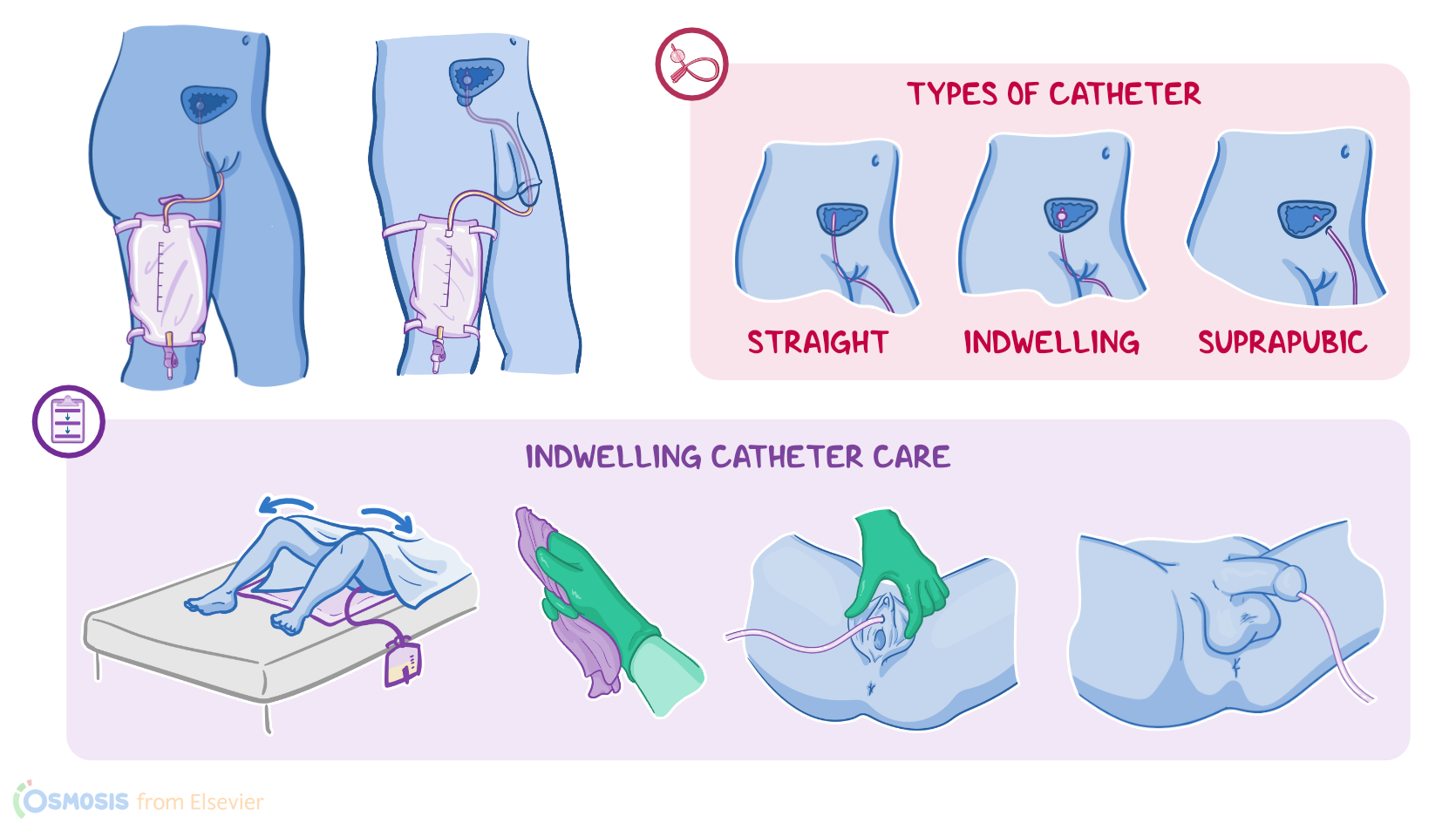
Now, the most common types of urine catheters are straight, indwelling, and suprapubic catheters. Both straight and indwelling catheters are inserted into the bladder through the urethra, but the difference is that a straight catheter is removed once the urine is drained, while an indwelling urinary catheter, also called Foley catheter or retention catheter, remains in the bladder and lets the urine drain continuously into a drainage bag. With the suprapubic catheter, “supra-” means above and “pubic” refers to the pubic bone, so it is inserted into the bladder through a surgical incision made above the pubic bone.
Let’s focus on the indwelling catheter. This consists of a soft balloon that is inflated inside the bladder to keep the catheter from slipping out and a length of tubing, which connects the catheter with a drainage bag for collecting urine. Indwelling catheters may have two or three lumens. In double-lumen indwelling catheters, one is for urine drainage and the other one is used to inflate the balloon. In triple-lumen indwelling catheters, the additional lumen is used to regularly deliver irrigation fluid into the bladder. This can help prevent blood clots from forming, which is important in certain cases, like after a prostate surgery.
Before we talk about how to provide the best catheter care, here are some general considerations. Remember to close the room’s door and bedside curtain and respect the client’s privacy. Before beginning the procedure, unclip the catheter tubing from the bed linens. When caring for a client, make sure you do not pull or tug on the catheter. When you are finished, secure the catheter tubing again and make sure that it doesn’t have any kinks and that the client is not lying on top of it. You also need to make sure that the drainage bag is placed below the level of the bladder to prevent the urine from flowing back into the bladder. Okay, for routine indwelling catheter care, start by making sure that the wheels on the bed are locked and the side railings on the working side are down. Inform the client about the procedure before beginning and answer any questions related to the procedure. Lower the head of the bed so that the bed is flat. Fill the wash basin with water and check that the temperature is comfortably warm. Cover the over-bed table with paper towels and use it to place the basin together with soap, towels, and washcloths. Next, put your gloves on, position a waterproof bed pad under the client’s buttocks to protect the bed linens, and cover them with a bath blanket, exposing only the genital area. Ask them to open their legs and bend their knees, if they can; if not, help them to do so. Wrap a washcloth around one hand, wet it with warm water, and apply soap.
Now, if the client has a vagina, use your other hand to separate the labia. Next, move the washcloth downwards from the top of the vulva towards the anus. Remember to use a different part of the washcloth with each swipe and repeat until the area is clean. Then make sure to rinse and dry the washed areas rigorously.
| HYGIENE - URINARY CATHETER CARE | ||
| KEY POINTS | NOTES | |
| DEFINITION |
| |
| TYPES OF CATHETERS |
| |
| PARTS OF AN INDWELLING CATHETER |
| |
| COMMON CARE TIPS |
| |
| ROUTINE INDWELLING CATHETER CARE |
| |
| EMPTYING A URINE DRAINAGE BAG |
| |
| REPORTING AND DOCUMENTATION |
| |
No notes for this video yet
Try adding a note below