Immune response - Adaptive: Nursing
Definitions & Key takeaways
The adaptive immune response is a complex network of cells and molecules that work together to protect the body from infection. This response is "adaptive" because it adjusts its tactics as needed to fight off different pathogens. The immune system also produces Memory B cells and Memory T cells, which remember how to fight a particular pathogen if it ever comes back.
Nurses are essential members of the healthcare team who help patients through every stage of their illness. They provide care, education, and support to patients and their families, and work with other healthcare professionals to ensure that patients receive the best possible care.
Introduction0:00–1:04
Now, the immune system consists of two main branches: innate immunity and adaptive immunity. Innate immunity is the first line of immunity, that we are born with; it is fast, meaning that it responds within several minutes to hours; it’s non-specific, therefore it does not differentiate one pathogen from another; and finally, it’s short-lived, meaning it does not retain the memory of previous infections.
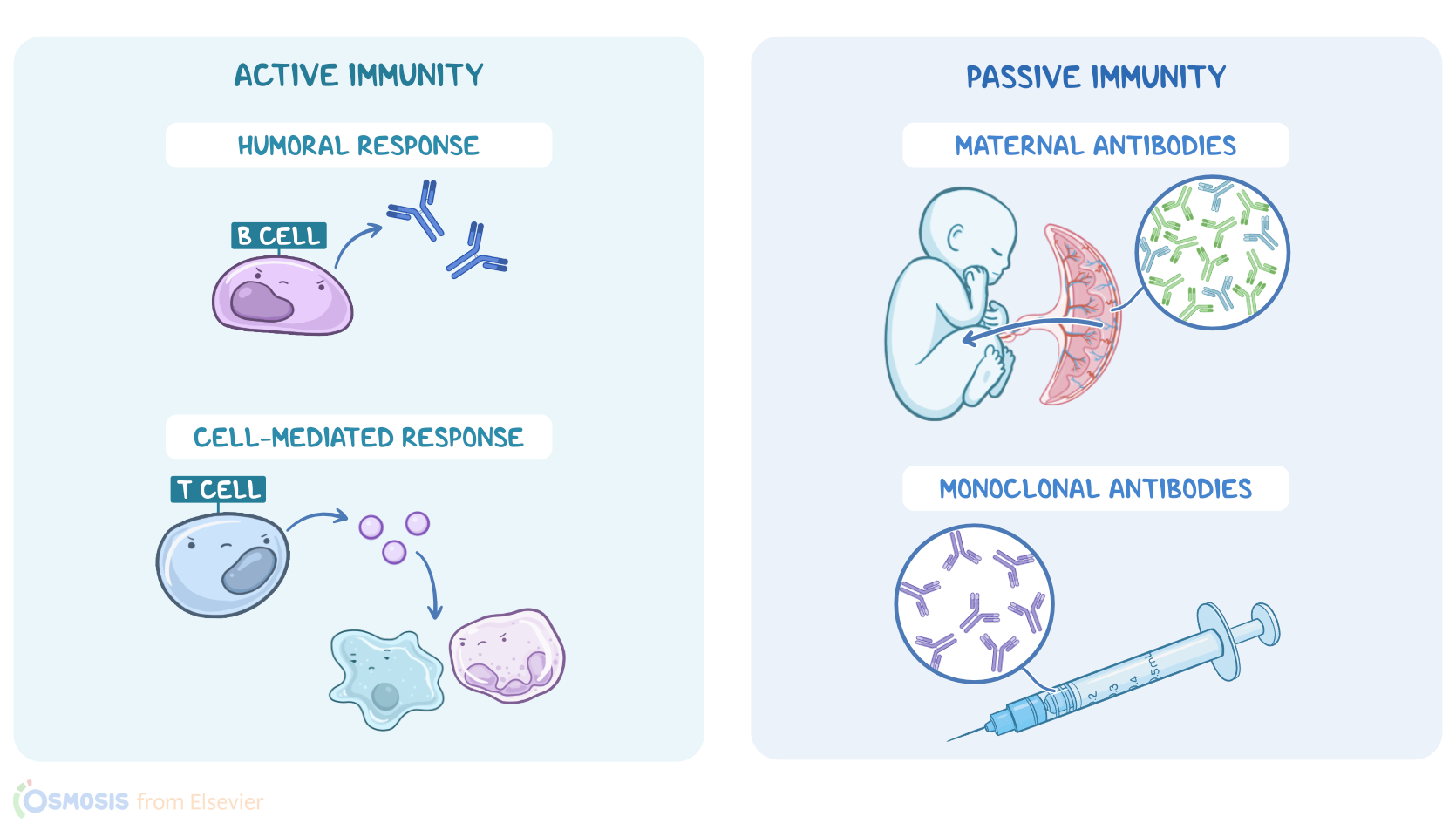
On the flip side, adaptive immunity is the second line of defense, that is acquired throughout life; it is slower and takes time to respond; but it’s also specific, so it recognizes different pathogens; and long-term, so it doesn’t forget a previous exposure to a pathogen.Now, let's cover the physiology of the adaptive immune response, which can be further subdivided into active and passive adaptive immunity.In the active adaptive immune response, antibodies are produced by the client’s own immune system, following exposure to a particular antigen.
Active adaptive immune response1:04–5:16
In this case, two mechanisms can be employed: the humoral response, where antibodies are secreted by B cells; and the cell-mediated response which is carried out by T cells.
Both B and T cells are a type of white blood cell called lymphocytes, and they’re produced in the bone marrow. B cells are called “B” cells because they mature in the bone marrow, while T cells are called “T” cells because they mature in the thymus.
Now, when mature B cells leave the bone marrow they’re still naive, meaning they haven’t been exposed to an antigen yet; so they usually circulate around in the blood or find their way to the lymph nodes or spleen.
Once they encounter an antigen, they become memory B cells, or plasma cells, which secrete specific antibodies against the antigen.
Now T cells usually mature and differentiate into either helper T cells, or cytotoxic T cells in the thymus. A particular subset of T helper cells, called regulatory T cells, live up to their name by regulating the immune response.
This means they can inhibit or suppress the immune response as needed, such as at the end of an infection and they reduce the risk of autoimmune diseases by helping distinguish between self and non-self antigens.
These naive T cells are then released into the blood and end up in the same places as the B cells. All these types of cells interact tightly with each other to ensure an adequate and specific immune response.Now, the key element in the adaptive immune response is specificity.
This includes macrophages, dendritic cells, and even naive B cells. These APCs will engulf and digest the pathogen and the fragments are then presented on the APC’s surface via proteins called major histocompatibility complex class II, or MHC II.
Now these fragments serve as antigens, which are anything that could trigger an immune response, and they can be presented to T helper cells.
Now, once the APC presents its antigen to T helper cells, it causes the T helper cells that recognize the antigen to activate and proliferate; this results in an army of T helper cells that release cytokines, which are signalling molecules that attract other immune cells to the site of inflammation.
These can be part of the adaptive immune system, like cytotoxic T cells, or killer T cells; or innate immune cells, like neutrophils and natural killer, or NK cells.
Cytotoxic T cells can recognize the pathogen just like the helper T cells, so it will go directly to the pathogen and release perforin to make pores in its membrane; and then inject a cytotoxin directly into the invader, inducing apoptosis, or programmed cellular death.T helper cells can also make the naive B cells rapidly multiply and differentiate into plasma cells, which secrete antibodies or immunoglobulins, which can bind to a specific antigen, and neutralize it.
Macrophages and other immune cells will also be attracted to antibody bound pathogens, making them a priority target for phagocytosis.
Once the infection has subsided, most cytotoxic T cells die off, but a small portion of them, called short memory T cells, stick around for a few weeks to months, just in case an infection with the same pathogen happens again.
Of these, a few become long-term memory T cells that can remain in the body for years. Plasma cells also stick around for a long time, and along with memory T cells, they can activate a quicker adaptive immune response to that antigen, if they see it in the future.Finally, passive adaptive immunity is when ready-made antibodies reach a person who doesn’t have their own antibodies.
Passive adaptive immunity5:16–5:46
One example is an infant who has not been exposed to an antigen but the mother’s antibodies cross the placenta to reach the fetus during pregnancy.
This will give the infant some level of protection when they’re born. Lab made antibodies against a specific pathogen, called monoclonal antibodies, can also be given to treat a specific infection like COVID 19; or even certain types of cancer cells.Alright, as a quick recap the active immune system is the specific and slower response to a foreign pathogen that consists of T and B lymphocytes.
Review5:46–6:54
Active immunity contains the humoral response, which consists of B cells secreting antibodies, and the cell-mediated response, where T cells interact with other cells of the immune system.
Both B and T cells are produced in the bone marrow. B cells also mature in the bone marrow, and enter the circulation as naive B cells.
When naive B cells encounter an antigen, they become plasma cells that secrete antibodies against that specific antigen.
T cells, on the other hand, mature in the thymus, and they can differentiate into either T helper cells, which can recognize antigens presented by APCs, and also make B cells rapidly multiply and differentiate into plasma cells; or cytotoxic T cells, that directly destroy infected cells.
A particular subset of T helper cells, called regulatory T cells, helps regulate the immune response. Finally, passive adaptive immunity is when ready-made antibodies reach a person who doesn’t have their own antibodies.
| IMMUNE RESPONSE - ADAPTIVE | ||
| KEY POINTS | NOTES | |
| DEFINITION |
| |
| ACTIVE ADAPTIVE IMMUNE RESPONSE |
| |
| PASSIVE ADAPTIVE IMMUNE RESPONSE |
| |
- "Lewis’s medical-surgical nursing: Assessment and management of clinical problems" Elsevier (2020)
- "Passive Immunization" Plotkin's Vaccines (2018)
- "Saunders comprehensive review for the NCLEX-RN examination" Elsevier (2017)
- "Response to the Letter-to-the Editor by Cohen et al. concerning our eNeurologicalSci article, Melamed-Gal, et al. Physicochemical, biological, functional and toxicological characterization of the European follow-on glatiramer acetate product as compared with Copaxone. eNeurologicalSci 2018;12:19–30.https://doi.org/10.1016/j.ensci.2018.05.006" eNeurologicalSci (2018)
- "Innate-adaptive immunity interplay and redox regulation in immune response" Redox Biology (2020)
- "The Neutrophil’s Role During Health and Disease" Physiological Reviews (2019)
No notes for this video yet
Try adding a note below