Immune response - Innate: Nursing
Introduction0:00–0:52
Now, the immune system consists of two main branches: innate immunity and adaptive immunity. Innate immunity is the first line of immunity, that we are born with; it is fast, meaning that it responds within several minutes to hours; it’s non-specific, therefore it does not differentiate one pathogen from another; and finally, it’s short-lived, meaning it does not retain the memory of previous infections.
On the flip side, adaptive immunity is the second line of defense that is acquired throughout life; it is slower and takes time to respond; but it’s also specific, so it recognizes different pathogens; and long-term, so it doesn’t forget a previous exposure to a pathogen.Now, let's cover the physiology of the innate immune system, which can be further subdivided into anatomic, physiologic, and cellular components.
Physiology0:52–1:41
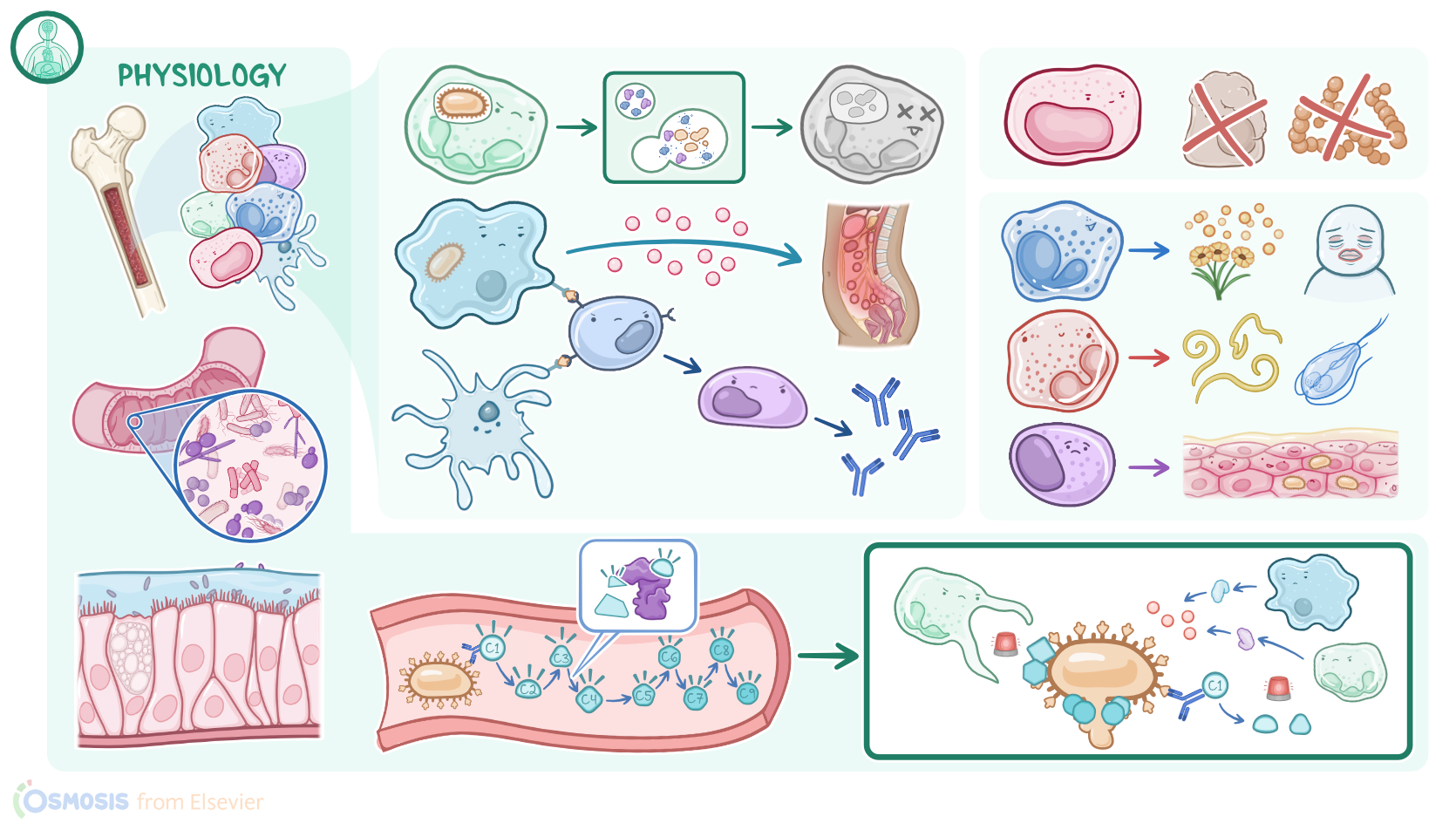
Anatomic components include physical barriers, like skin and mucous membranes, while physiologic components include additional mechanisms like the microflora found in different parts of the body, like the skin, gut and reproductive organs; or the low stomach pH.
The cellular components of innate immunity include several types of white blood cells, all of which are produced in the bone marrow from hematopoietic stem cells which give rise to all blood cells.
First up, there’s phagocytes, like neutrophils, macrophages and dendritic cells, and these are immune cells that digest pathogens in a process called phagocytosis.
There are some key differences between them. First up, neutrophils are circulating immune cells, so they are normally found in the blood.
Neutrophils1:41–3:21
In fact, they’re the most numerous type of white blood cell in the blood! Microscopically, they also have a multi-lobed nucleus, which is why they’re also called polymorphonuclear neutrophils, or PMN for short.
They’re also granulocytes, meaning they have vesicles that store enzymes or proinflammatory compounds. Now, since neutrophils are floating around in the blood, they’re the first immune cells to reach the site of an injury or infection in response to chemical signals, called cytokines, that are produced during acute inflammation.
Now, once they reach the site of injury, neutrophils swallow the pathogen in a process called phagocytosis. Inside the neutrophil, the pathogen is trapped in a phagosome, which combines with lysosomes which are vesicles that contain antimicrobial enzymes.
This creates a phagolysosome that breaks down the pathogen. Some of these enzymes are responsible for the “respiratory burst” where reactive oxygen species like superoxide and hydrogen peroxide are produced.
These are highly effective at destroying pathogens, but also damage the neutrophil, causing it to die in the process. Since neutrophils utilize respiratory burst more than other immune cells, they have a very short lifespan, of just a few days.
Neutrophils can also degranulate, meaning they release their enzymes outside the cell to damage extracellular pathogens.
However, this also damages themselves and nearby tissue. In addition, they can also release their own proinflammatory molecules like cytokines to attract more immune cells to the area.
Macrophages3:21–7:05
Macrophages, on the other hand, are mostly stationary immune cells, so they stay and guard various tissues in the body; they actually derive from circulating white blood cells called monocytes, which travel through the blood and eventually set up shop in one tissue or another.
Both monocytes and macrophages are agranulocytes, which means that their cytoplasm doesn’t contain granules. They also have different names depending on their home.
So for example, in the lung they’re called alveolar macrophages, while in the liver they’re called Kupffer cells. Now, macrophages also swallow pathogens, dead tissue, and debris by phagocytosis.
However, they utilize oxidative burst less than neutrophils, so they can last for months instead of just days. Because of this, macrophages are mostly responsible for chronic inflammation.
Also, like neutrophils, macrophages can release proinflammatory molecules which will amplify the immune response. What sets macrophages apart is their ability to act as professional antigen presenting cells, or APCs.
The other important APC of the innate immune system are the dendritic cells, which live in areas that come in direct contact with the outside environment like the skin, GI tract, and lungs.
APCs phagocytize pathogens and break them down into small fragments, called antigens. They then present them on their surface with major histocompatibility complex class II molecules or MHC II.
They can then use these antigens to activate T cells and B cells in the adaptive immune system, causing a specific immune response, that only targets the specific pathogen.Alright!
Now, the innate immune response also relies on natural killer cells, or NK cells for short, that directly destroy pathogens.
Interestingly, NK cells are a type of lymphocyte; but unlike T cells, they don’t require activation to destroy infected cells.
They also play an antitumor role, by destroying cells with mutations that could progress to cancer. Other cellular components of innate immunity include white blood cells like basophils, eosinophils, and mast cells.
All three are granulocytes; however, they typically don’t participate in phagocytosis. Their granules contain molecules like histamine and heparin, which are mainly released during allergic reactions.
Additionally, eosinophils also play a role in defense against parasites, while basophils can participate in the immune response against a virus.
Another difference is that basophils and eosinophils are circulating cells, like neutrophils; so they migrate from the blood to the site of inflammation in response to cellular signals; while mast cells are stationary cells, like macrophages, so they respond when inflammation is happening in their home tissue.Finally, innate immunity also includes the complement system, which is a family of 9 small proteins called C1 through C9, that act as a cascade.
This means that one complement protein helps activate the next one in sequence by helping enzymes cleave them to functional fragments.
So first, C1 attaches to the antibody on the bacteria and activates other complements. Some of these complements also act as chemotaxins, meaning they bind to the pathogen and attract macrophages and neutrophils to the area, and these cells release enzymes that create oxygen free radicals that’s harmful to the bacteria.
Others can act like opsonins, meaning they attach to the pathogen and mark it as a target for the macrophages to phagocytose.
The rest will form membrane attack complexes, or MAC, on the bacteria’s surface which then creates a hole that lets surrounding fluid leak into the cell and intracellular content leak out, causing the cell to die.
All right, as a quick recap… Innate immunity is fast, non-specific, and short-lived, and consists of several anatomic, physiologic, and cellular components.
Review7:05–8:19
The main cellular components are phagocytes, like macrophages, neutrophils and dendritic cells; as well as natural killer, or NK cells; and basophils, eosinophils and mast cells.
Phagocytes employ phagocytosis to directly swallow the pathogen and destroy it intracellularly. Neutrophils are circulating granulocytes, and they’re usually the first ones to reach the site of inflammation, so they’re responsible for acute inflammation.
Macrophages, on the other hand, are agranulocytes, and they’re stationary cells that have different names depending on the tissue they reside in.
Macrophages have a long lifespan, so they’re mostly responsible for chronic inflammation. Macrophages and dendritic cells are also antigen presenting cells, or APCs, so they present antigens to B and T cells, which are cells that mount a specific, adaptive immune response.
Next, NK cells directly destroy pathogens, and also play an antitumor role. Finally, basophils, eosinophils, and mast cells are all granulocytes, but they’re mostly involved in allergic reactions.
| IMMUNE RESPONSE - INNATE | ||
| KEY POINTS | NOTES | |
| DEFINITION |
| |
| PHYSIOLOGY |
| |
No notes for this video yet
Try adding a note below