Mobility - Ambulation: Nursing skills

1,206views

Mobility - Ambulation: Nursing skills

Clinical Nursing Skills & Technique

Clinical Nursing Skills & Technique

Hygiene - Urinary catheter care: Nursing skills
Vital signs - Blood pressure (BP): Nursing skills
Vital signs - Pulse: Nursing skills
Nutrition - Oral: Nursing skills
Nutrition - Enteral: Nursing skills
Nutrition - Parenteral: Nursing skills
Infection prevention and control - Precautions and personal protective equipment (PPE): Nursing skills
Medical asepsis: Nursing skills
Surgical asepsis and sterile technique: Nursing skills
Hygiene - Bathing: Nursing skills
Hygiene - Oral care: Nursing skills
Hygiene - Ostomy care: Nursing skills
Hygiene - Perineal care: Nursing skills
Hygiene - Gastric and intestinal tube care: Nursing skills
Immobility - Positioning and alignment: Nursing skills
Mobility - Assistive devices: Nursing skills
Mobility - Ambulation: Nursing skills
Vital Signs - Temperature: Nursing skills
Vital signs - Pain: Nursing skills
Care of an intubated client: Nursing skills
Oxygenation - Oxygen therapy: Nursing skills
Vital signs - Oxygen saturation (SpO2): Nursing skills
Vital signs - Respirations: Nursing skills
Chronic disease: Nursing
Code of ethics: Nursing
Core measures: Nursing
Genomics - DNA mutations: Nursing
Genomics - DNA structure: Nursing
Genomics - Ethical, legal, and social implications (ELSI): Nursing
Genomics - Mendelian genetics: Nursing
Genomics - Pharmacogenomics: Nursing
Health and illness models: Nursing
Health literacy: Nursing
Healthcare costs: Nursing
Health promotion and illness prevention: Nursing
Integrative and alternative therapies: Nursing
Quality management: Nursing
Standards and methods of documentation: Nursing
Health history: Nursing
Physical assessment - Overview: Nursing
Physical assessment - Comprehensive: Nursing
Physical assessment - Heart and neck vessels: Nursing
Physical assessment - Peripheral vascular system: Nursing
Physical assessment - Thorax and lungs: Nursing
Physical assessment - Neurological system: Nursing
Physical assessment - Mental status: Nursing
Physical assessment - Cranial nerves: Nursing
Physical assessment - Abdomen: Nursing
Physical assessment - Anus, rectum, and prostate: Nursing
Physical assessment - Musculoskeletal system: Nursing
Physical assessment - Lymphatic system: Nursing
Physical assessment - Skin, hair, and nails: Nursing
Physical assessment - Nose, mouth, and throat: Nursing
Physical assessment - Ears: Nursing
Physical assessment - Eyes: Nursing
Physical assessment - Female reproductive system: Nursing
Physical assessment - Male reproductive system: Nursing
Blood pressure: Clinical skills notes
Pulse: Clinical skills notes
Administering an enema: Clinical skills notes
Routine ostomy care: Clinical skills notes
Collecting a stool specimen: Clinical skills notes
Collecting a urine specimen: Clinical skills notes
Performing urine testing: Clinical skills notes
Hand hygiene: Clinical skills notes
Condom catheters: Clinical skills notes
Removing indwelling catheters: Clinical skills notes
Types of personal protective equipment: Clinical skills notes
Laxatives: Nursing pharmacology
Antacids: Nursing pharmacology
Antihistamines: Nursing pharmacology
Antiemetics: Nursing pharmacology
Thrombolytics: Nursing pharmacology
Mood stabilizers: Nursing pharmacology
Antiarrhythmics: Nursing pharmacology
Analgesics: Nursing pharmacology
Antifungals - Topical: Nursing pharmacology
Antiplatelet agents: Nursing pharmacology
Antipsychotics: Nursing pharmacology

Notes

MOBILITY - AMBULATION

KEY POINTS
NOTES
DEFINITION
  • Ambulation
    • Walking

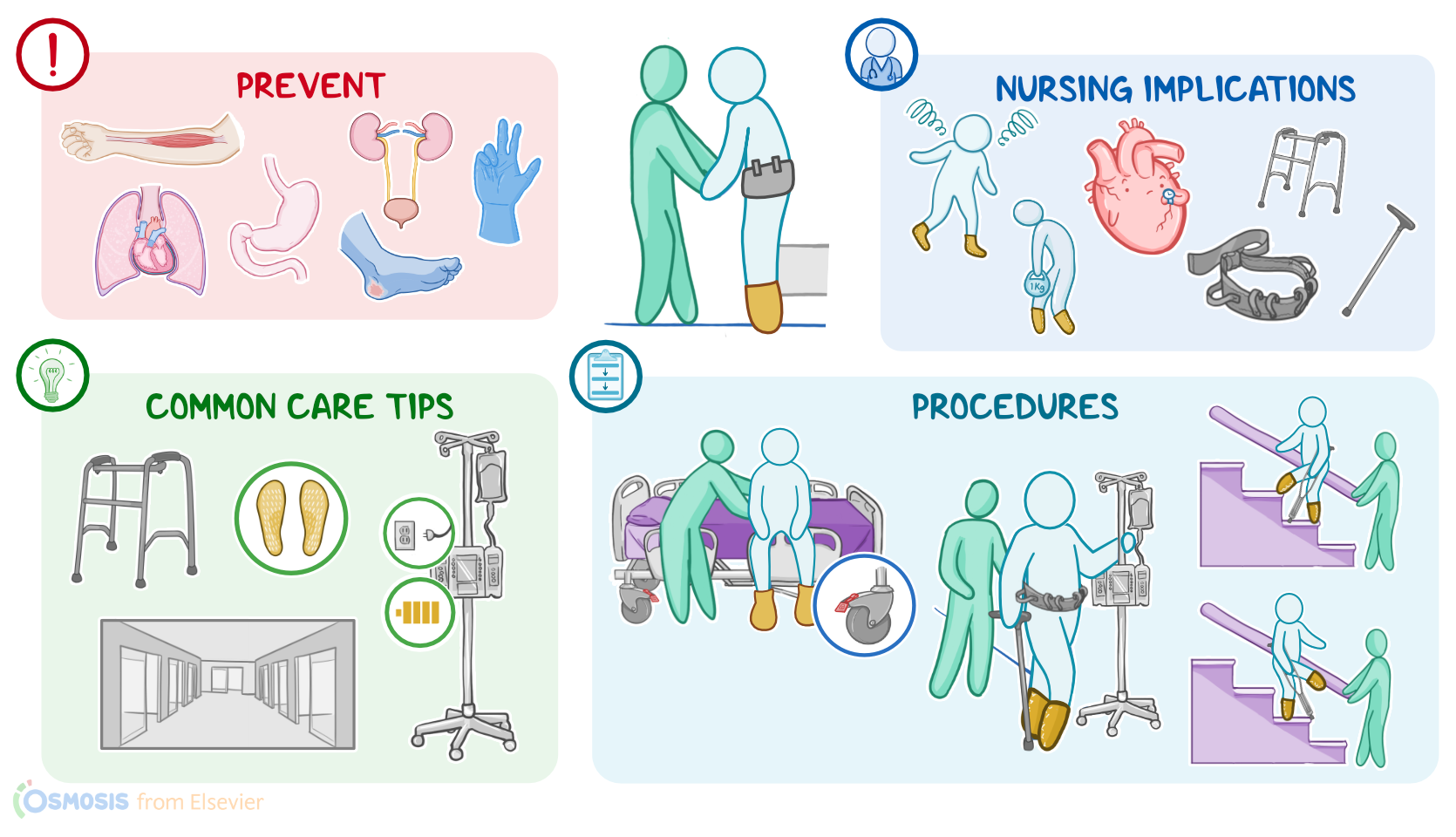
COMMON CARE TIPS
  • Check patient chart for information on most recent ambulation
    • Tolerance
    • Difficulties
    • Assistive devices
    • History of falls
  • Review medication list
  • Explain how far and how you'll assist
  • Check assistive device for functionality
  • Ensure route is not slippery and is free from obstacles
  • Ensure IV lines and poles are free from tangles and IV pump is unplugged from the wall 
  • Ensure proper dress and non-skid footwear
  • Encourage normal walking without shuffling or sliding
  • Use an additional assistant as needed
  • Do not leave patient's side 

DANGLING POSITION
  • Before ambulation
  • Sit erect with feet dangling off side of bed
    • Protects against falls
  • Ensure bed wheels locked and side rails down
  • Assist to lateral position with knees bent
  • Ask to push up into upright position 
    • Assist as needed
  • Replace in supine position for dizziness or lightheadedness
  • Allow time to rest in dangle position 
  • Apply gait or transfer belt as indicated
  • Ensure feet are flat on the ground
  • Hold edge of bed
  • Reach under arms and support back
  • Push off bed
  • Once standing, check for dizziness or lightheadedness as well as balance, weakness, and pain
  • Grab assistive device as needed
  • Walk behind patient and towards stronger side
  • Patient should hold onto IV pole with stronger side if able
  • Check frequently if rest is needed
  • If necessary, ease onto closest available chair or bed

NURSING IMPLICATIONS
  • Report any dizziness, lightheadedness, balance problems, weakness, pain, chest pain, breathing problems, or abnormal heart beats to health care provider
  • Document distance, assistive device, tolerance, and any incidents

Transcript

Watch video only

Ambulation means “walking,” and your client might need to ambulate to get to places or may need to do it to prevent atrophy, which is when muscles waste away from prolonged bed rest.

Other health problems from long-term immobility include decreased cardiovascular and pulmonary functions, poor digestion, pressure injuries, contractures, urinary problems, and many others. So, even if they require assistance, clients are encouraged to ambulate frequently.

Before we talk about ambulation assistance, here are some general considerations. Start by checking the client’s chart for information on their most recent ambulation. This will let you know if the client tolerated the activity, if they had any difficulty, if an assistive device like a walker or cane was needed, or if they have a history of falls.

It can also be helpful to review the client’s medication list to see if they are taking medications that might make them a higher risk for falls, like pain medications which can cause lethargy or blood pressure reducing medications which can cause dizziness.

Next explain to the client how far you’ll be walking and how you will assist them. If an ambulatory device is needed, check to see if it’s functional. Make sure the route is not slippery and that there are no obstacles. Make sure IV lines and poles are free from tangles and that the IV pump is unplugged from the wall and has enough battery to last during ambulation. Make sure they’re properly dressed and wearing non-skid footwear.

During ambulation, encourage them to walk normally without shuffling or sliding. You might need an additional assistant if the person’s unbalanced, weak, or not cooperative. Finally, and most importantly, be sure not to leave the client’s side at any time during the process.

Now, before getting a resting person to stand and walk, you need to get them into a sitting, or “dangling,” position, where they sit erect with their feet dangling off the side of the bed. The main reason for this is to protect against falling. One common cause of falls is orthostatic hypotension, where blood rushes into the legs as the person shifts into an upright position, causing a drop in blood pressure and decreased blood flow to the brain. It can result in dizziness or even fainting, especially in the elderly. If you have the person stand in this condition, it could lead to falls, so having them sit in the dangling position will help their body adjust without the risk.