Mobility - Assistive devices: Nursing skills

1,002views

Mobility - Assistive devices: Nursing skills

Watch later

Watch later

Stages of labor
Uterine stimulants and relaxants
Uterine disorders: Pathology review
Postpartum hemorrhage
Pregnancy
Anatomy and physiology of the female reproductive system
Breastfeeding
Menopause
Estrogen and progesterone
Oxytocin and prolactin
Nephrotic syndrome: Nursing
Anatomy of the female reproductive organs of the pelvis
Anatomy of the perineum
Arterial blood gas (ABG) - Overview: Nursing
Acid-base disturbances: Pathology review
Arterial blood gas (ABG) - Metabolic acidosis: Nursing
Crohn disease
Irritable bowel syndrome: Clinical sciences
The nursing process
Urinary tract infections (UTIs): Nursing process (ADPIE)
Celiac disease: Nursing process (ADPIE)
Left-sided heart failure: Nursing process (ADPIE)
Introduction to vital signs
Assessment of Vital Signs
Vital signs - Pain: Nursing skills
Vital signs - Respirations: Nursing skills
Vital signs - Blood pressure (BP): Nursing skills
Vital signs - Pulse: Nursing skills
Immobility, basic positions and alignment
Physical assessment - Overview
Comprehensive Assessment
Physical assessment - Comprehensive: Nursing
Workplace safety: Body mechanics
Transferring clients
Transferring clients: Clinical skills notes
Mobility - Assistive devices: Nursing skills
Assisting clients with ambulation: Clinical skills notes
Introduction to the cranial nerves
Cranial nerve pathways
Anatomy of the trigeminal nerve (CN V)
Anatomy of the facial nerve (CN VII)
Anatomy of the glossopharyngeal nerve (CN IX)
Anatomy of the vagus nerve (CN X)
Anatomy of the spinal accessory (CN XI) and hypoglossal (CN XII) nerves
Anatomy clinical correlates: Trigeminal nerve (CN V)
Anatomy clinical correlates: Facial (CN VII) and vestibulocochlear (CN VIII) nerves
Anatomy clinical correlates: Glossopharyngeal (CN IX), vagus (X), spinal accessory (CN XI) and hypoglossal (CN XII) nerves
Anatomy of the cranial base
Anatomy of the external and middle ear
Anatomy of the infratemporal fossa
Anatomy of the nose and paranasal sinuses
Anatomy of the pterygopalatine (sphenopalatine) fossa
Anatomy of the temporomandibular joint and muscles of mastication
Anatomy of the tongue
Bones of the cranium
Blood and nerve supply of the oral cavity
Muscles of the face and scalp
Nerves and vessels of the face and scalp
Anatomy clinical correlates: Skull, face and scalp
Anatomy clinical correlates: Temporal regions, oral cavity and nose
Anatomy of the larynx and trachea
Anatomy of the lymphatics of the neck
Anatomy of the pharynx and esophagus
Anatomy of the thyroid and parathyroid glands
Bones of the neck
Deep structures of the neck: Prevertebral muscles
Deep structures of the neck: Root of the neck
Fascia and spaces of the neck
Superficial structures of the neck: Anterior triangle
Superficial structures of the neck: Cervical plexus
Superficial structures of the neck: Posterior triangle
Anatomy clinical correlates: Bones, fascia and muscles of the neck
Anatomy clinical correlates: Vessels, nerves and lymphatics of the neck
Anatomy clinical correlates: Viscera of the neck
Periodontal attachment
Anatomy of the oral cavity
Anatomy of the oral cavity (dentistry)
Anatomy of the salivary glands
Range of motion exercises
Restraints
Cardiovascular: Applying antiembolic stockings and sequential compression devices (for nursing assistant training)
Insulin
Insulins
Antidiabetic Therapy - Insulin
Diabetes mellitus
Antepartum care (third trimester): Clinical sciences
Antepartum care (second trimester): Clinical sciences
Cushing syndrome and Cushing disease: Clinical sciences
Workplace safety: Hazards
Emergency care: Falls
Integumentary: Applying dressings and bandages (for nursing assistant training)
Assessment of Thorax and Lungs
Prions (Spongiform encephalopathy)
Neisseria meningitidis
Respiratory: Incentive spirometry
Introduction to the immune system
Tracheostomy
Respiratory: Tracheostomy suctioning
Nutrition - Enteral: Nursing skills
GI/GU: Other ways of providing fluids and nutrition
Genitourinary: Urinary catheters and routine indwelling catheter care (for nursing assistant training)
Upper respiratory tract infections: Clinical sciences
Approach to postoperative respiratory distress: Clinical sciences
Renal system anatomy and physiology
Laxatives: Nursing pharmacology
Azoles
Renal failure: Pathology review
Osmotic diuretics
Diuretics
Loop diuretics
Dialysis
Kidney stones: Pathology review
Benign prostatic hyperplasia
Genitourinary: Urinary catheters and routine indwelling catheter care
Nephrotic syndromes: Pathology review
Gastroesophageal reflux disease (GERD)
Bladder tumors: Nursing
Urinary tract infections: Pathology review
Glomerulonephritis: Nursing
Chronic kidney disease
Huntington disease
Amyotrophic lateral sclerosis (ALS): Nursing
Parkinson disease
Multiple sclerosis
Myasthenia gravis
Alzheimer disease
Guillain-Barré syndrome: Nursing
Meningitis
HIV and AIDS: Pathology review
HIV (AIDS)
Brain herniation
Adult brain tumors
Spinal cord injury (SCI): Nursing
Spinal cord disorders: Pathology review
Spinal Cord Injury and Spinal Cord Tumors
Anatomy of the descending spinal cord pathways
Anatomy of the ascending spinal cord pathways
Normal pressure hydrocephalus
Pain: Heat and cold applications
Approach to hypercalcemia: Clinical sciences
Approach to hypernatremia: Clinical sciences
Approach to hyponatremia (pediatrics): Clinical sciences
Approach to hypokalemia: Clinical sciences
Approach to hypoglycemia: Clinical sciences
Approach to hypothyroidism: Clinical sciences
Approach to shock: Clinical sciences
Approach to dyspnea: Clinical sciences
Approach to dysuria: Clinical sciences
Approach to aphasia: Clinical sciences
Approach to diplopia: Clinical sciences
Approach to hypertension: Clinical sciences
Approach to ascites: Clinical sciences
Approach to leukemia: Clinical sciences
Approach to tachycardia: Clinical sciences
Approach to dysmenorrhea: Clinical sciences
Approach to hyperkalemia: Clinical sciences
Approach to bradycardia: Clinical sciences
Approach to a red eye: Clinical sciences
Approach to hypercoagulable disorders: Clinical sciences
Alcohol withdrawal: Clinical sciences
Approach to complications of prematurity (late): Clinical sciences
Multiple endocrine neoplasia: Clinical sciences
Nephrolithiasis: Clinical sciences
Chronic kidney disease: Clinical sciences
Pyloric stenosis: Clinical sciences
Small bowel obstruction: Clinical sciences
Ileus: Clinical sciences
Mitosis and meiosis
Mental health and illness

Notes

MOBILITY - ASSISTIVE DEVICES

KEY POINTS
NOTES
DEFINITION
  • Assistive devices
    • Tools used to aid walking
    • Walkers
    • Canes
    • Crutches
    • Other
      • Mechanical lift

WALKER
  • Movable, lightweight 
  • Metal frame, 2 hand grips, 4 legs
  • Ideal for people who can bear weight but have weakness or balance issues
  • Proper fit
    • Hand grips at waist
    • Legs with non-slip tips
  • Use
    • Stand straight
    • Hold hand grips
    • Lift up and move 6-10 inches 
    • Set down
    • Ensure any brakes are locked as needed
    • Move one leg forward at a time

CANES
  • Movable, lightweight
  • Handle, shaft, and legs
    • Single, triple, or quadruple leg
  • For those that can bear weight but have weakness
  • Proper fit
    • Handle at hip level
    • Non-slip tips
  • Use
    • Hold on strong side
    • Rest cane tip flat on ground
    • Lift up and move forward 6-10 inches
    • Place flatly on ground
    • Step forward with weaker side first
    • Use cane as support

CRUTCHES
  • Single or paired
  • For those that cannot bear weight on one or both legs
  • Underarm
    • Better balance
    • More upper arm strength 
    • Temporary
  • Forearm
    • Shorter
    • Allows use of hands
  • Proper fit
    • Underarm
      • 2-3 finger widths between top of crutch and axilla
      • Reach handles with elbows slightly flexed
    • Forearm
      • Hand grip at hand levels
      • Cuff at elbow level
  • Check bolts for tightness 
  • Non-slip tips
  • Use
    • Squeeze between chest and arms
    • Shoulder-width apart
    • 4-point gait
    • 3-point gait
    • 2-point gait
    • Swing-to gait

MECHANICAL LIFTS
  • Unable to bear weight or have poor upper body strength
  • Ceiling mounted, hydraulic floor, power-driven
  • Use
    • Collect supplies
    • Ensure an additional clinician 
    • Ensure patient is comfortable, secure, and does not bump into furniture or equipment
    • Inform about transfer
    • Answer questions
    • Bring lift over bedside
    • Lock brakes
    • Position patient
    • Lower side rail and head of bed
    • Raise bed to comfortable height
    • Roll patient onto side 
    • Align harness
    • Secure closures
    • Raise had of bed
    • Lower lift bar to patient level
    • Attach harness
    • Instruct patient how to position
    • Operate lift slowly 
    • Guide patient 
    • Slowly lower until comfortably seated
    • Unhook harness and remove from under patient 

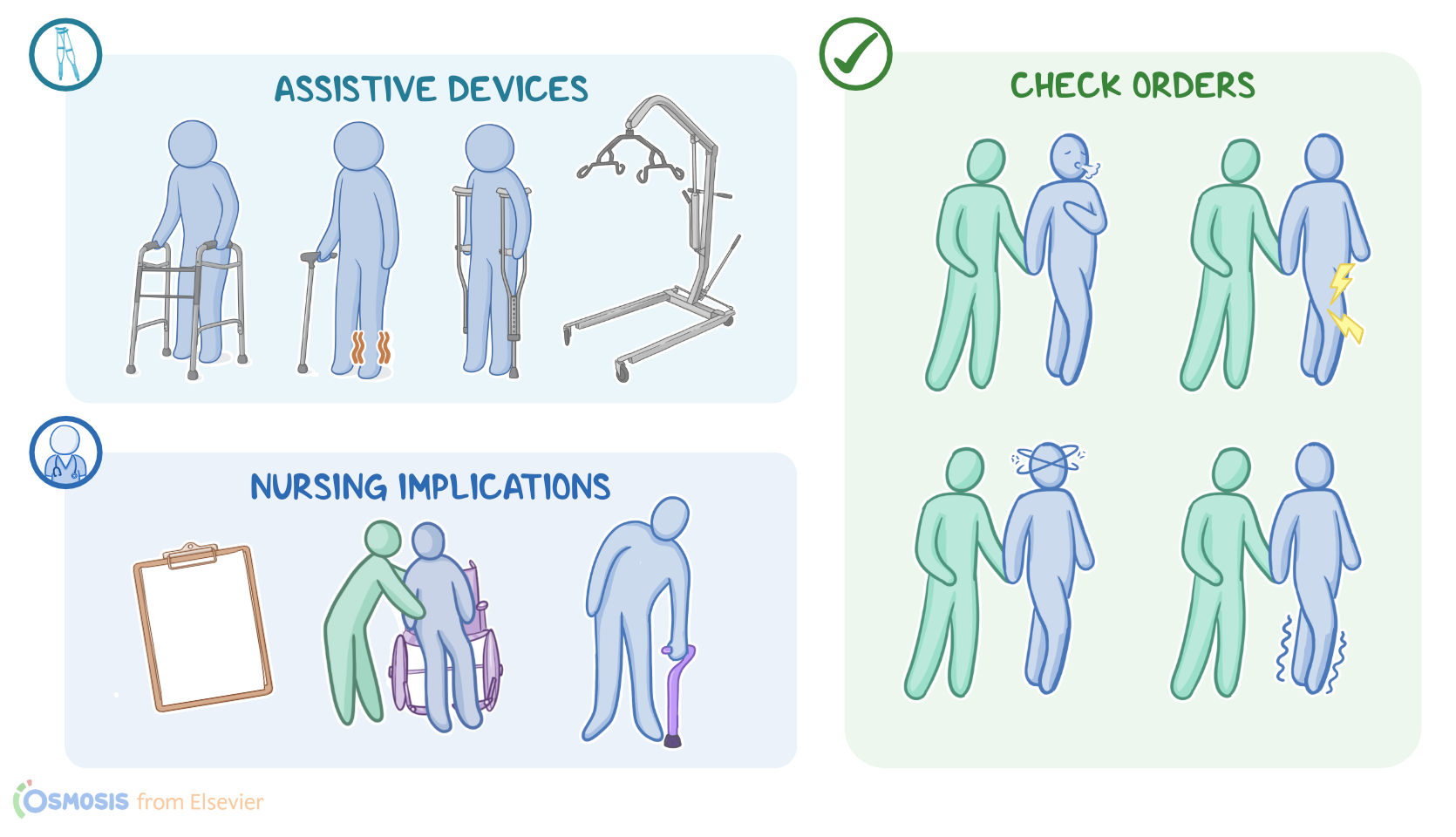
NURSING IMPLICATIONS
  • Check orders for activity level
  • Perform ongoing assessment during ambulation or transfer
  • Document efforts and any complications 

Transcript

Watch video only

Assistive devices for ambulation, or just ambulation devices, are tools used to aid in walking. The most common types include walkers, canes, and crutches. As the nurse, you need to know when each of these are appropriate and assess if the client is using them correctly. Remember that a client’s ambulation device is specially ordered and fits them specifically, kind of like glasses, so they should not be shared with other clients. Some devices like mechanical lift, are used by clients who aren’t able to ambulate independently and need assistance to move from one location to another. Nurses often use mechanical lifts to make sure the client is safe during transfer. Let’s start by looking at walkers. These are movable, lightweight devices that consist of a metal frame, 2 hand grips, and 4 legs. Walkers provide great stability due to their wide base, so they are great for people who can bear weight on their feet but have trouble walking due to weakness of the legs or balance issues. When assessing the proper fit of a client’s walker, make sure that the hand grips are at the client’s waist level. Check the legs because they should have non-slip tips like a rubber cover.

To use a walker, the client should stand straight while holding the hand grips. When moving forward, they lift it up and move it another 6-10 inches in front of them and set it down. Because many clients have difficulty lifting a walker, many models now have wheels on the front legs. However, these are prone to rolling forward, so brakes are usually built in. So, when the client is going to stand for a while, make sure the brakes are locked. Using the walker as support, they should move one leg forward and then the other. Once balance is reestablished, repeat the process. Next up, we have canes. These are also movable, lightweight devices made of a strong material like wood or metal. Canes consist of a handle, a shaft, and legs. There are single leg, triple leg or quad leg canes, and the ones with multiple legs provide more stability but are also more cumbersome. Canes are used by clients who could bear weight but have weakness in one of their legs, like a client who had a stroke or those with paralysis in one leg.

Crutches and walkers are better for people with two weak legs. A properly fitted cane should have the handle at the client’s hip level. The tips should also be non-slip. When using a cane, hold it on the strong side, or the side without weakness. The cane tip should rest flat on the ground at the start and then lifted and moved forward 6-10 inches before being placed flatly on the ground again. Step forward with the weaker leg first, using the cane for support. After balance is established, move the stronger leg forward. The most vulnerable point is when only the weak leg and the cane are on the ground. Crutches are the last kind of common ambulation device. They are either single or paired and are used by people who cannot bear weight on one or both legs. There are two common types of crutches: underarm, or axillary, and forearm crutches. Axillary crutches stretch from the armpits, or axilla, to the ground. They provide better balance but require more upper body strength to use. They are often used temporarily, like when someone is recovering from leg injuries.

Forearm crutches are shorter, reaching from the elbow level to the ground. They have a hand grip and a cuff for the arm. The cuff lets the crutch stay attached to the arm when the person needs to use their hands for other tasks. This is one of the reasons that this type is preferred for people with permanent leg weakness. For proper fit, axillary crutches should leave 2-3 finger widths between the top of the crutch and the arm pit. This prevents compressing the nerves found in the axilla. The person should be able to reach the handle with their elbows slightly flexed. Forearm crutches are often adjustable. With the arms relaxed and slightly flexed, the hand grip should be at the level of the hand, and the cuff should be at the level of the elbow. Check the bolts on the crutches to make sure they’re tight, that the non-slip tip is intact, and that there are no cracks or other deficits. The proper usage of crutches should be taught to the client by a nurse or a physical therapist, but here are some general considerations. Crutches should be squeezed between the arms and chest. They should be about shoulder-width apart when they reach the ground. There are four different types of gait. In a 4 point gait, the left crutch moves forward, followed by the right leg. Then the right crutch moves forward, followed by the left leg. In a 3 point gait, both crutches move forwards, followed by the strong leg and then the weak leg.

In the 2 point gait, the left foot and right crutch moves forward together, followed by the right foot and left crutch. Finally, for the swing-to gait, both crutches move forward, then using them as support, both legs are lifted and swing to the crutches position. Now, for clients who are unable to bear weight or have poor upper body strength, common ambulatory devices like canes, walkers, or crutches might not be a safe option. For these clients, mechanical lifts can be used for client transfer. There are a few kinds of mechanical lifts like ceiling mounted lifts, hydraulic floor lifts, or power-driven lifts, each of these devices will have slightly different instructions based on the manufacturer's specifications, so make sure you are familiar with the lift you are using before transferring a client. Now, when using a hydraulic floor lift, start by collecting your supplies. Also make sure you have at least one additional nurse or nursing assistant to help with the transfer, and to ensure the client is comfortable, secure, and does not bump into furniture or equipment during transfer.