Musculoskeletal injuries: Nursing process (ADPIE)
Client Report0:00–0:30
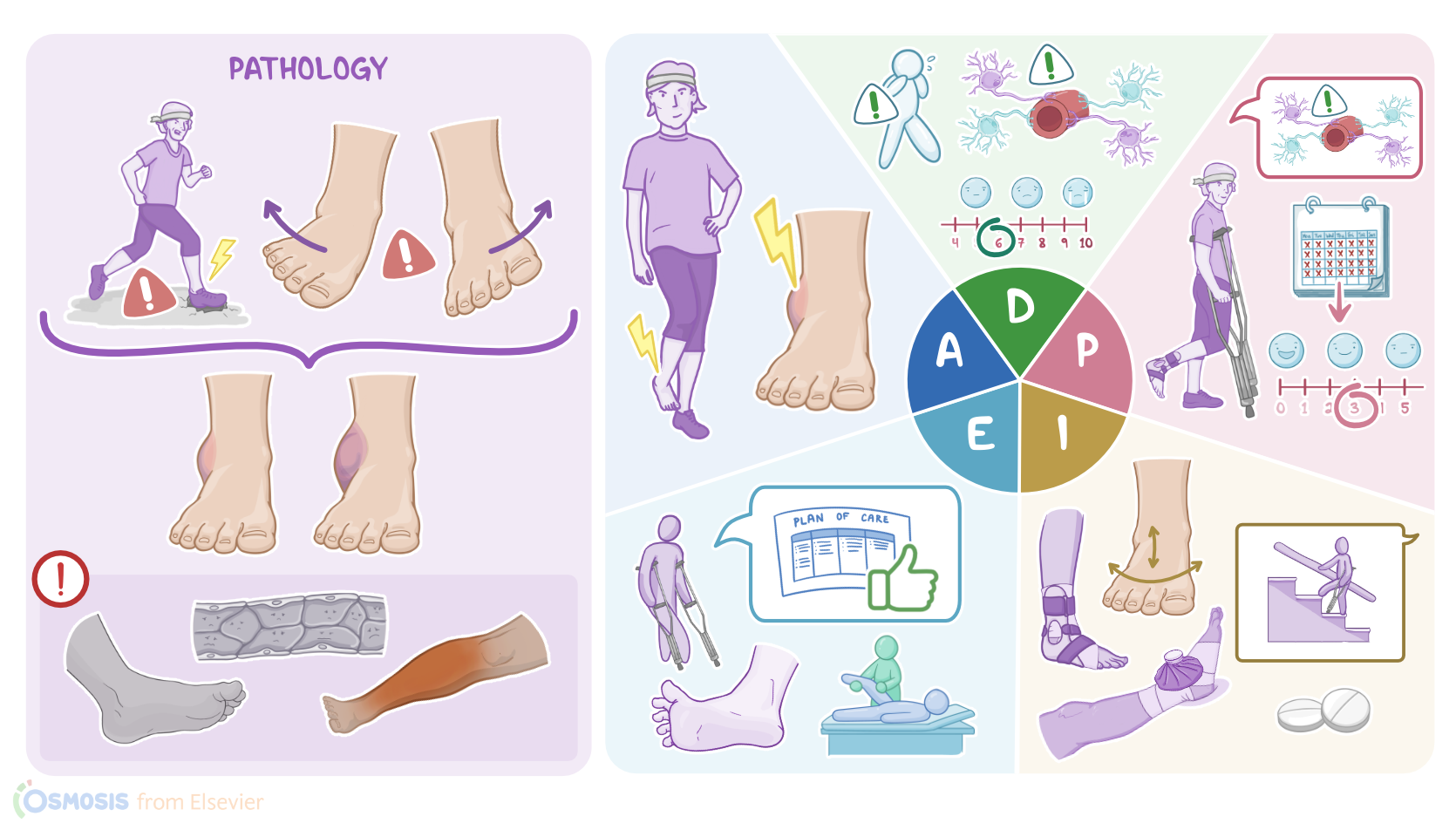
Liam Warner is a 24-year-old male who is dropped off at the urgent care clinic with right ankle pain and swelling. This morning Liam was running in a 10K run when his foot landed on an uneven surface, injuring his ankle.
He says “My foot didn’t land right and I could feel it rolling inward. I wasn’t able to finish because I could barely walk.” While in the clinic, an ankle X-ray series rules out a bone fracture, and a grade 2 sprain is suspected.
Local musculoskeletal injuries mainly include conditions that affect bones, joints, muscles, and ligaments. The most common ones include bone fractures; joint dislocations; muscle or tendon strains; and finally, ligament sprains.
Pathology0:30–4:32
Now, sprains typically occur when the physical force applied to the joint exceeds the elasticity of the surrounding ligaments.
And this is particularly common in ankle injuries, when there’s incorrect positioning of the foot at landing, like when a person is walking or running on an uneven surface; or they fall and twist their ankle; another frequent scenario involves jumping and awkwardly landing on their foot; or being stepped on during a sports game.Now, there are two main types of ankle sprains.
Alright, there are some factors that can put a person at risk for ankle sprains. Modifiable risk factors include wearing inappropriate footwear, having poor athletic condition, not warming up before training, and fatigue from overtraining or intense physical activity.
On the other hand, non-modifiable risk factors include being male between the ages of 15 to 24, or being female over the age of 30, as well as previous history of ankle sprains; balance problems; and conditions associated with foot misalignment, such as pes cavovarus, often referred to as overarched foot.Depending on how severe the injury is, ankle sprains can be classified into one of three grades.
Grade one ankle sprains refers to mild stretching of the ligament, and it’s typically associated with mild pain and swelling.
Grade two ankle sprains involve a partial rupture of the ligaments and present with moderate pain and swelling, as well as bruising.
There is mild to moderate joint instability, with some restriction in ankle motion, and both walking and weight bearing are painful.
Finally, grade three ankle sprains involve complete ligament tears, and present with severe pain, swelling, and bruising; as well as significant joint instability with loss of function and weight bearing.
Now, most ankle sprains heal without causing any complications. Rarely though, some clients may develop acute complications from associated muscle or blood vessel injuries, such as acute compartment syndrome.
On the other hand, long-term complications may occur years after the injury. The most common ones include joint instability or stiffness, as well as osteoarthritis, all of which can ultimately result in impaired range of motion.In most cases, diagnosis is based on history and physical examination.
If a fracture is suspected, it can be confirmed by performing an X-ray. An MRI can be done to evaluate the condition of the surrounding soft tissue or detect a hidden fracture.
Treatment of ankle sprains is usually symptomatic and includes the PRICE method, which stands for protection and rest, by immobilizing the ankle with a brace or controlled ankle motion boot or CAM boot; as well as ice, compression, and elevation of the affected ankle to reduce the swelling.
Additionally, below-knee casts can be used to reduce the length of the recovery period; while pain and inflammation can be managed with acetaminophen or NSAIDs like ibuprofen.
This is followed by mobilization of the ankle with physical therapy and gradual exercises to recover the full mobility and strength of the ankle.
Fortunately, surgery is rarely needed for ankle sprains.After introducing yourself as his nurse you begin your assessment.
Assessment4:32–5:38
Liam’s vital signs are oral temperature 98.2° F or 36.8° C; heart rate 62 beats per minute, respiratory rate 16 breaths per minute, blood pressure 115/70 mmHg, SpO2 100% on room air and pain 6/10.
Liam’s right foot and ankle are edematous with ecchymosis on the lateral side of his foot. The ankle is warm and tender to palpation around the lateral malleolus.
Capillary refill in less than 3 seconds, he can wiggle his toes, and you palpate strong posterior tibial and dorsalis pedis pulses.
He is able to bear toe-touch weight and take 5 limping steps. Next, you elevate Liam’s ankle above the level of his heart and apply an ice pack.
After documenting your assessment findings, you let Liam know the physician assistant, or PA, will be in to examine him shortly.
The nursing diagnoses that you identify for Liam are: risk for peripheral neurovascular dysfunction related to edema; impaired physical mobility related to musculoskeletal injury; and acute pain related to tissue injury.
Diagnosis5:38–5:52
Next you collaborate with the healthcare team and plan goals for Liam. Before Liam leaves the clinic, he will verbalize the signs of neurovascular complications and demonstrate safe mobilization.
Planning5:52–6:14
Over the next 4 weeks, Liam will return to his baseline activity level, and his pain will be managed at 3/10, a level he identifies as tolerable.Now it’s time to implement Liam’s plan of care.
The PA has diagnosed Liam with a grade 2 ankle sprain. You administer the ordered NSAID, ibuprofen.
Implementation6:14–8:55
Next, you teach him about the signs and symptoms of neurovascular compromise, including numbness or tingling below his ankle, severe pain or swelling, inability to move his foot or wiggle his toes, or if his toes become pale, blue, or feel cold.
You instruct Liam to seek immediate medical attention if he experiences any of these. Then, you explain the PRICE method, beginning by wrapping his foot and ankle with an elastic bandage.
Over the bandage, you show Liam how to apply a brace to provide support and light compression, adjusting the brace to fit the heel and aligning the pads with each side of the ankle.
You then demonstrate how to secure the brace, ensuring that it is snug, but not too tight. You instruct Liam to wear this brace whenever he is up and moving around.
Next, you remind Liam to avoid activities that cause discomfort. However, to prevent joint stiffness, you emphasize the importance of removing the brace a few times each day to perform range-of-motion exercises, moving the foot side-to-side and back and forth.
While sleeping or resting, instruct Liam to elevate his right ankle above the level of his heart. For pain and swelling, encourage Liam to ice his ankle for 15 to 20 minutes several times per day for the next few days.
You also let Liam know the PA recommends he continue to take ibuprofen for pain and to reduce inflammation. Next, you provide Liam with crutches, teaching him to use them by moving both crutches forward at the same time, then advancing his right foot, followed by his left.
When using the stairs at home, instruct him to hold his crutches under his left arm and hold the handrail with his right hand.
When going upstairs, teach him to lead with his left leg, followed by the crutches and right leg. When going down the stairs, he will move his right leg and crutches first, followed by his left leg.
To help Liam remember all your teaching, you provide printed instructions summarizing his treatment plan. Finally, you encourage Liam to attend the ordered physical therapy to improve the stability and strength in his ankle, and you recommend he call his primary care provider to make a follow-up appointment.
Before he leaves, you remind Liam to seek medical attention if his pain and swelling don’t improve over the next 72 hours, if he notices any worrisome signs or symptoms that indicate neurovascular complications, or if weight bearing is still difficult after 4 days.Before Liam’s friend arrives to drive him home, you evaluate the effectiveness of your interventions.
Liam rates his current pain level as 3/10. His foot has normal warmth and circulation, and he can wiggle his toes.
Liam correctly summarizes the teaching you provided. He is able to verbalize the signs of neurovascular complications and agrees to seek immediate medical attention if he experiences any of them.
He tells you he will call his primary care provider to schedule a follow-up appointment and that he will take advantage of physical therapy sessions.
Evaluation8:55–9:34
Then, Liam correctly demonstrates using the crutches, telling you that he feels comfortable walking with them.##SummaryAlright, as a quick recap...
your client Liam presented to the urgent care clinic with an ankle sprain. Sprains are a common ankle injury that are usually caused by the sole of the foot rotating abnormally medially or laterally, injuring the ligaments around the joint.
Your assessment of Liam revealed swelling, bruising, pain and impaired mobility. Your nursing diagnoses for Liam were risk for peripheral neurovascular dysfunction, impaired mobility, and acute pain.
You planned goals for Liam to promote understanding of the signs of neurovascular compromise, how to safely mobilize, to return to baseline activity, and manage pain.
Summary9:34–10:22
You implemented strategies to reach these goals, and evaluated that these goals were partially met by the time of discharge from the urgent care clinic.
the joint, your assessment of land, reveal the swelling, bruising pain and impaired mobility. Your nursing diagnosis for Leo, or risk for peripheral neurovascular, dysfunction impaired, mobility, and acute pain.
You plan goals, for Liam, it to promote, understanding of the signs of neurovascular compromise. How to say if we mobilize to return to a baseline activity and managed pain?
You implemented strategies to reach these goals and evaluate it. That he's goals were partially mad by the time of discharge from the Urgent Care Clinic.
| MUSCULOSKELETAL INJURIES | ||
| KEY POINTS | NOTES | |
| PATIENT REPORT |
| |
| PATHOPHYSIOLOGY |
| |
| DIAGNOSIS AND TREATMENT |
| |
| ASSESSMENT |
| |
| NURSING DIAGNOSES |
| |
| PLANNING |
| |
| IMPLEMENTATION |
| |
| EVALUATION |
| |
No notes for this video yet
Try adding a note below