Neurological assessment - Neonate: Nursing
Introduction0:00–0:20
Newborn neurological assessment is a part of the thorough evaluation of the newborn that’s performed within 24 hours after birth.
The goal is to confirm normal neurological status and early detection of treatable conditions and conditions that might affect their development.Begin your assessment by observing the infant's posture and muscle tone.
General survey0:20–0:53
A healthy term infant will be flexed and have good muscle tone; the cry will be strong; and the motor activity will be spontaneous and symmetrical.
Problems such as prematurity; birth injury; exposure to opioids; or problems like hypoglycemia or sepsis are associated with abnormal assessments that include limp, floppy muscle tone; asymmetrical motor activity; jitteriness; or a weak, high-pitched cry.Let’s start with normal newborn reflexes.
Normal Newborn Reflexes0:53–4:08
If they persist beyond that age, it could indicate a neurological issue that requires further investigation. First, let’s focus on the Babinski reflex.
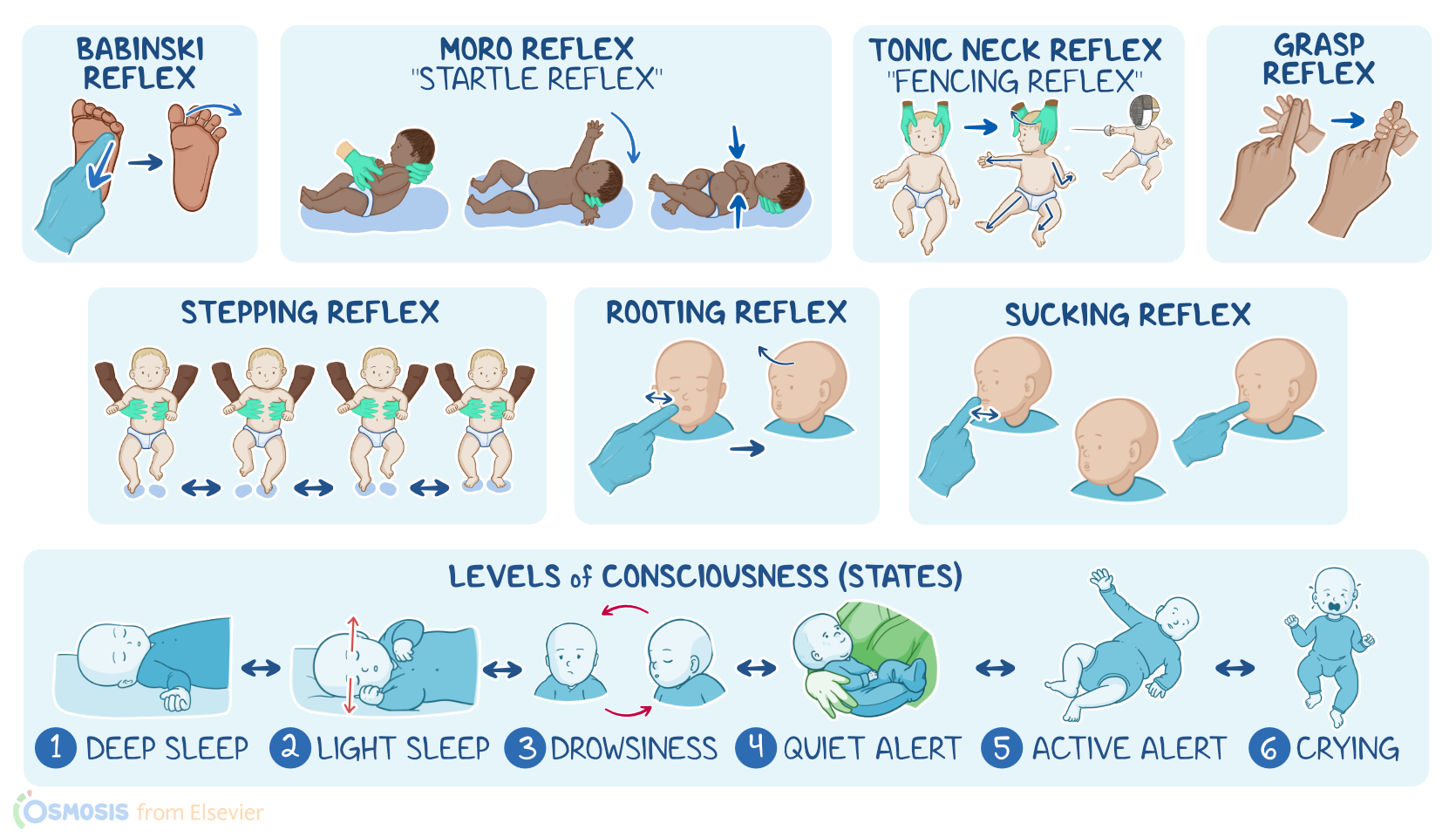
The Babinski reflex is induced by lightly stroking the lateral aspect of the sole of the foot. Normally, the infant responds by hyperextending the big toe back and upwards while spreading the other toes.
Normally, the Babinski reflex disappears eight to nine months after delivery. Moving on to the Moro reflex.
This reflex is sometimes called the startle reflex, because it is often seen in response to a loud noise. When assessing the Moro reflex, lift the infant up a few inches, and then suddenly lower them.
Alternatively, you can withdraw the hand that’s supporting the head, allowing the head to fall back into your hand. Normally, the infant responds by extending their arms outward and opening their hands.
There may also be a slight extension of the neck. This is followed by flexion of the knees and adduction of the arms as well as closing of the fists.
At the same time, the infant will often cry. The Moro reflex usually disappears after 5 to 6 months of life.
Switching gears and moving on to the tonic neck reflex. Testing for this reflex requires placing an infant in the supine position and gently turning their head to one side.
Normally, the infant responds by bending the arm and leg on the opposite side of the body while extending the arm and the leg on the same side of the body.
And since this position looks like the infant is engaged in a fencing match, this reflex is often called the fencing reflex.
Normally, the tonic neck reflex disappears after 4 months of life.Next up is the stepping reflex. Begin by holding the infant upright with the soles of their feet touching a solid surface, such as a bed.
Normally, the infant will make stepping movements, as if walking. Normally, the stepping reflex disappears after 3 to 4 months.Now, the rooting reflex helps the infant to get ready to suck.
The infant should respond by opening their mouth and making sucking movements. Then place your gloved finger in the infant’s mouth to evaluate the strength and coordination of the suck.
Normally, the infant responds by sucking your finger. The sucking reflex disappears after 12 months of life.Finally, to test for the grasp reflex, stroke the palm of the infant’s hand.
This causes them to close their fingers in a grasp. This reflex normally lasts for about 5 to 6 months.
A similar reflex in the toes lasts until 9 to 12 months.Now, let’s switch gears and move on to looking at normal newborn behaviors, where the infant’s ability to adapt and respond to the environment is assessed.
Newborn Behaviors4:08–6:14
Behaviors include the infant’s organization, by observing how well the infant is able to regulate different levels of consciousness, referred to as states.
Newborn states include deep sleep, characterized by no motor activity except for periodic sucking movements, along with regular breathing; and the infant will be difficult to awaken from this state.
Light sleep includes low levels of motor activity, though an occasional startle might be seen; eye movements are often observed under the eyelids.
Drowsiness is a state where the infant moves from sleep to awake or awake to asleep; and the infant’s eyes may open and close during this state.
The quiet alert state is where the infant’s eyes are open wide and focused on outside stimuli; this is the best time for them to interact and learn from their environment.
Next, the active alert state is characterized by increased motor activity and periods of fussiness. Lastly crying is where there’s increased motor activity that accompanies the cry.
Normally, an organized infant can move smoothly between these states, and they should demonstrate the ability to gradually stop responding to stimuli, a response called habituation, which helps the infant preserve energy for physiologic needs.
Finally, let’s focus on the infant’s interactive processes. Normally infant behavior includes focusing on faces and bright objects and turning their heads to follow the object movement.
Next, auditory stimuli cause the infant to try to locate the source of the sound. Lastly is consolability, where the infant can engage in self-quieting activities like bringing their hands to their mouth, sucking, watching their surroundings, and listening to voices.Alright, as a quick recap… Newborn neurological assessment is done within the first 24 hours of life to confirm normal neurological status and early detection of treatable conditions and conditions that might affect their development.
Review6:14–6:54
There’s a general survey focused on observing the infant and looking at muscle tone and motor activity. Next, the various reflexes should be checked for strength and symmetry.
Some reflexes should disappear by a certain age and if they persist, it could indicate a neurological condition. Finally, the newborn’s behavior should be assessed which involves checking their consciousness and their interactive processes.
| NEUROLOGICAL ASSESSMENT - NEONATE | ||
| KEY POINTS | NOTES | |
| DEFINITION |
| |
| GENERAL SURVEY |
| |
| NORMAL NEWBORN REFLEXES |
| |
| NEWBORN BEHAVIORS |
| |
No notes for this video yet
Try adding a note below