Parkinson disease: Nursing process (ADPIE)
Client Report0:00–0:16
Michael Desante is a 67 year old male with a history of Parkinson disease. His daughter has been his primary caregiver since his diagnosis, however, as Michael’s disease progressed, Michael moved into a long-term care center for further support.Parkinson disease, or PD for short, is a progressive neurological disease that affects movement.
Pathology0:16–4:19
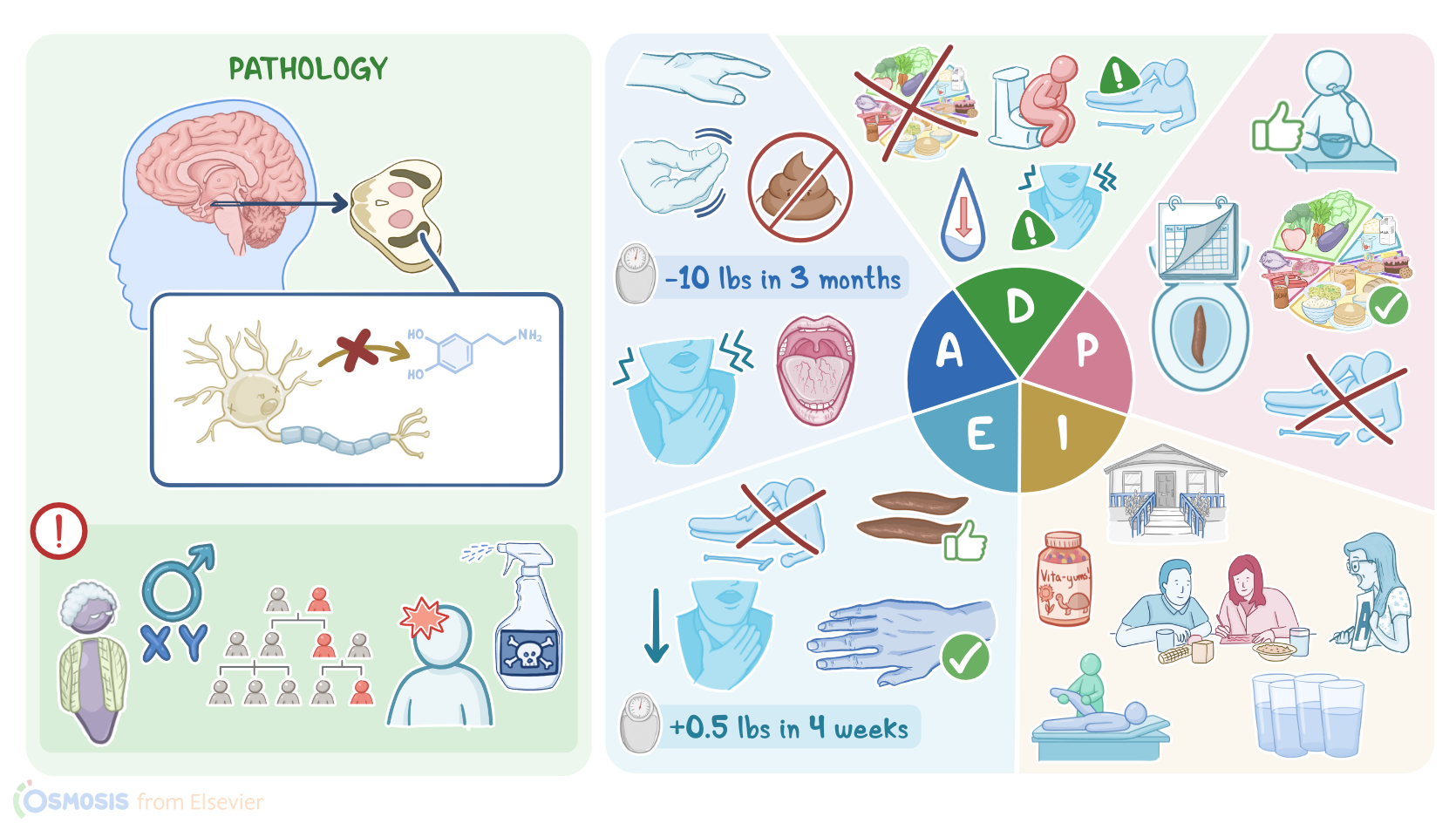
Most often, the cause of PD is unknown, but there are some factors that can increase the risk. Non-modifiable risk factors include increasing age, with a mean age of onset of 57 years; as well as male sex; and having a family history of PD.
On the other hand, modifiable risk factors include exposure to toxins like pesticides, and a history of head trauma. Now, in PD there’s degeneration of the dopamine-producing neurons in the substantia nigra of the basal ganglia.
Normally, the substantia nigra helps initiate movements, but also fine tunes the way that movements happen. When these neurons die, the first symptom is a resting tremor, which is an involuntary shaking that presents at rest and decreases with movement.
Most often, resting tremor affects the hands, which is called a “pill-rolling” tremor because it looks like someone is rolling a pill between their thumb and index finger.Over time, resting tremor can also involve the feet, tongue, and jaw.
In addition, the client can experience bradykinesia, or slowness of voluntary movement. A more severe form of bradykinesia is akinesia, which is when they become unable to initiate a voluntary movement.
For instance, the client may feel like their legs freeze up when trying to walk. Another typical symptom is “cogwheel” rigidity, which is a type of stiffness characterized by a series of catches or stalls as a person’s arms or legs are passively moved by someone else.
And because of rigidity of facial muscles, some clients with PD may have a mask-like facial expression, as well as difficulty speaking, chewing, and swallowing.
As a result, food, fluid, or saliva may enter the lungs, causing aspiration pneumonia. Decreased intake can put the client at risk for nutritional problems.
Additionally, clients may acquire a stooped posture, and a late feature of the disease is postural instability, which causes problems with maintaining balance and can lead to falls.
Now, PD can also cause non-motor symptoms, like urinary incontinence and constipation. Finally, some clients may develop sleep disturbances, apathy, depression, dementia, and an impaired sense of smell.
Okay, now diagnosis of PD mainly relies on physical examination and the presence of bradykinesia in addition to at least one of either akinesia, tremor, rigidity, or postural instability.
Ruling out other potential causes is also required. Sometimes, the diagnosis can be confirmed by administering L-dopa, which is a precursor of dopamine.
If the client’s symptoms improve, the diagnosis is confirmed. Another diagnostic test that can be used to confirm diagnosis is the DaT scan, which is an imaging technique that helps visualize the dopamine levels in the brain.
Unfortunately, there’s no cure for PD, but there are medications that can help with its symptoms by increasing the amount of dopamine in the brain.
Sometimes these drugs are given in combination with a catechol-O-methyltransferase, or COMT inhibitor, called entacapone, that prevents the breakdown of levodopa by the enzyme COMT.
Very similarly, clients can be given MAO-B inhibitors like selegiline, which prevents the breakdown of dopamine by the enzyme monoamine oxidase B.
Finally, the dopamine agonist amantadine acts by increasing dopamine production. If medications fail to control symptoms or the client develops serious adverse effects, they can be treated with deep-brain stimulation.
This involves an implantable device that sends electrical signals to the brain that counteract the motor symptoms of PD.
Okay, let’s get back and assess your client Michael. After reviewing his chart, you enter his room, introduce yourself to Michael and his daughter, wash your hands, and confirm his identity.
Assessment4:19–6:22
Michael is sitting in an armchair in a forward leaning posture. You ask Michael how he is feeling today, and he replies “OK.” You note that he has a flat affect and is slow to respond to questions.
You ask Michael to ambulate to the bed so you can check limb strength. He takes small, shuffling steps to the bed in a stooped position.
When he lies down on the bed, you note rigidity as you passively move his limbs. You ask him how often he gets up to move around to which he states he only gets up to go to the bathroom.
His mucous membranes appear tacky and dry. You palpate his skin turgor and note skin tenting is present.
He thinks his last bowel movement was four days ago. He appears thin and while reviewing his chart you note he has lost ten pounds in the last three months.
His current weight is 117 pounds, and his height is 5 foot 7 inches. His vital signs are temporal temperature 98.4 F or 36.9 C, heart rate 85 beats per minute and regular, respiratory rate 16 breaths per minute with clear lung sounds bilaterally, blood pressure 115/70 mmHg, and SpO2 98% on room air.
Throughout your assessment Michael remains oriented to person, place, and time. His lunch tray is brought to him, and you use this opportunity to assess his eating and swallowing.You note he eats very slowly and he appears to have difficulty chewing.
Food falls from his mouth at times and he occasionally coughs and gags. He consumes less than half his meal.
After removing the lunch tray and assisting Michael into a comfortable position in the recliner, you document your assessment findings before leaving the room.Based on the assessment data you collected, the nursing diagnoses include risk for falls related to gait abnormalities, stiff limbs, and stooped posture while ambulating; constipation related to weakness of muscles, lack of physical activity, and inadequate fluid intake; impaired swallowing related to neuromuscular impairment; and imbalanced nutrition less than body requirements related to difficulty in chewing and swallowing.
Diagnosis6:22–6:47
Now that you’ve gathered all the assessment data and developed some nursing diagnoses you work with Michael, his daughter, and the health care team to plan important goals.
Planning6:47–7:23
Michael will remain free of falls throughout his stay at the facility. In one month, Michael will improve his nutritional intake, his mucous membranes will be moist, and there will be no evidence of skin tenting; Michael will demonstrate effective swallowing and will not experience coughing, gagging, or losing food from his mouth while eating.In one week, his constipation will be resolved as evidenced by a passage of soft, formed stool every 1 to 3 days without straining.
Next, you implement the plan of care.You institute fall precautions, and the physical therapist will assist with gait training, strengthening, and improving balance.
Implementation7:23–8:28
Range of motion exercises will be completed daily to build strength and improve flexibility. Michael will begin taking a multivitamin and a stool softener as ordered, and the dietitian will provide a modified diet that is easier to chew and provides increased calories, protein and fiber.
He will be offered thickened liquids throughout the day. The speech therapist will work with Michael to develop swallowing strategies.
Michael will be served six small meals or snacks throughout the day, he will be assisted to sit up as straight as he is able during meals, and his food will be cut in small pieces.
His oral intake and his bowel habits will be monitored including consistency, amount, and frequency. His weight will be monitored weekly.
While providing care you’ll monitor closely for new or significant neuromuscular deficits. Any changes will be reported to the attending physician immediately.Four weeks later, you evaluate Michael’s progress.
Evaluation8:28–9:03
Coughing and gagging during meals has decreased, and according to his oral intake record he has been consuming approximately half of his meals and snacks.
His weight has increased to 117.5 pounds, his mucous membranes are moist and skin turgor is normal. You are glad to see Michael has improved!
You will continue with the plan of care and revise as needed.Alright, as a quick recap … Parkinson disease is a progressive movement disorder caused by degeneration of dopamine-producing neurons in the substantia nigra, which leads to resting tremor, rigidity, problems initiating movement, and postural instability.Your assessment revealed Michael was experiencing gagging and coughing while eating, weight loss, dry and tacky mucous membranes, skin tenting, tremor, shuffling gait, and constipation.
Summary9:03–9:54
Your nursing diagnoses were risk for falls, constipation, impaired swallowing, and imbalanced nutrition. The goals you identified when planning care for Michael included remaining free of injury from falls, optimal bowel elimination, effective swallowing, and improving nutritional intake.
You will continue to implement interventions and evaluate to determine if his goals are being met.
| PARKINSON DISEASE | ||
| KEY POINTS | NOTES | |
| PATIENT REPORT |
| |
| PATHOPHYSIOLOGY |
| |
| DIAGNOSIS AND TREATMENT |
| |
| ASSESSMENT |
| |
| NURSING DIAGNOSES |
| |
| PLANNING |
| |
| IMPLEMENTATION |
| |
| EVALUATION |
| |
No notes for this video yet
Try adding a note below