Peripheral venous disease (PVD): Nursing process (ADPIE)
Client Report0:00–0:18
Muriel Diallo is a 45 year old female client with a history of peripheral venous disease and obesity. She is referred to the vein clinic by her primary care provider for treatment of a chronic, non-healing leg ulcer in her lower right extremity.
Pathology0:18–3:09
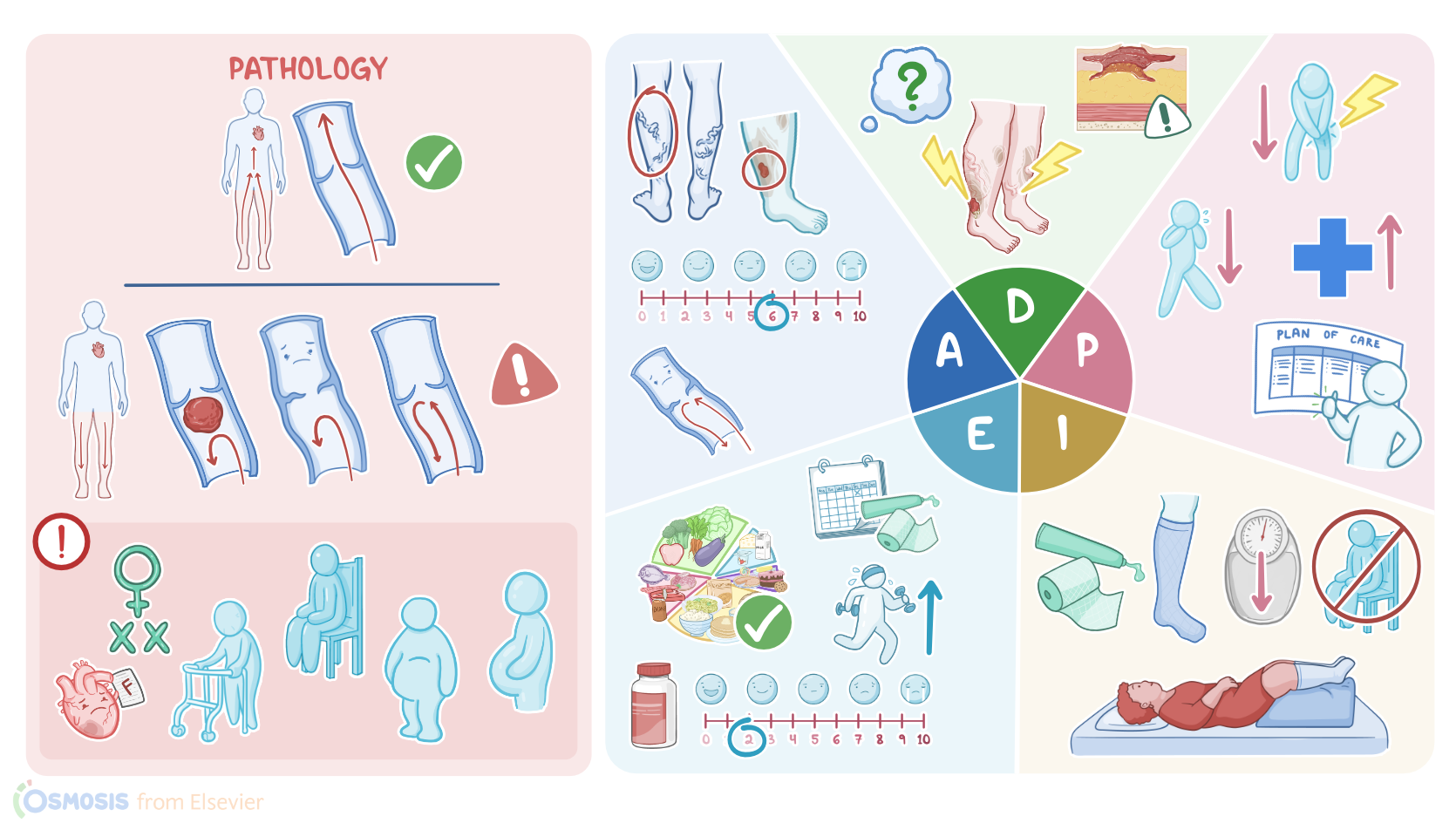
Peripheral venous disease or PVD for short, is characterized by an obstruction or defect of the veins, and most often affects the legs.
Normally, veins drain blood from peripheral organs and tissues towards the heart, and they have one-way valves to prevent backflow.
In PVD veins are either obstructed by a blood clot or embolus, are weak or dilated, or there's valvular insufficiency. So blood ends up leaking backward and pooling in the lower legs, leading to venous hypertension.
Risk factors for PVD include female sex, increasing age, sedentary lifestyle, obesity, and pregnancy. Other important risk factors for PVD include associated conditions like heart failure, varicose veins, and having a history of trauma or surgery.
Finally, another risk factor for PVD involves standing or sitting with the legs crossed for long periods of time. OK.
Now, clients with PVD often report pain in the legs, swelling, and a sensation of heaviness. Fluid and red blood cells can leak out of the small veins and capillaries and into the surrounding tissues, causing edema and inflammation in the lower extremities.
As the red blood cells break down in the tissue, they release hemosiderin, which eventually causes the skin to take on a brownish discoloration.
Moreover, as normal subcutaneous tissue is replaced by fibrous tissue, the skin becomes thick, leathery, and itchy. This will cause the skin to become more vulnerable to ulceration and painful sores, most often above the medial malleolus.
Clients with PVD may also develop some serious complications. First off, clients may develop chronic non-healing sores and ulcers, which pose a risk for infection and pain.
In addition, pooling of blood can increase the risk of blood clot formation within the veins, which can cause inflammation and thrombophlebitis.
Diagnosis of PVD relies largely on the client's history and physical examination. In addition, a venous ultrasound is usually performed to visualize venous blood flow and determine the presence of a blood clot.
Alternatively, a venography procedure can be performed by injecting a dye into the veins, and an X-ray is taken to identify any obstruction.
When DVT or pulmonary embolism are suspected, a blood test should be performed to measure the D-dimer, which is a breakdown product from blood clots.
Treatment options for PVD include increasing activity, elevating the legs above the heart, as well as application of compression stockings or tubular support bandages to help prevent backflow of blood, promoting venous return upward toward the heart.
Rarely, surgical treatment is required, such as a vein transplant, repair, or removal. You begin your assessment by asking how Mrs.
Assessment3:09–4:42
Diallo is feeling. She tells you the sore on her leg is painful, and that lately her legs have been more swollen and have felt heavy.
Her vital signs are heart rate 80 BPM and regular, respiratory rate 16 breaths per minute with clear breath sounds bilaterally, BP 122/80 millimeters of mercury, temperature, 97.9 °F or 36.6 °C, and pain 6 out of 10, located on her right leg.
As you assess her lower extremities, you note the following. Posterior tibial and petal pulses are 2+.
The skin on her lower extremities is dry, flaky, and leathery, with a brownish discoloration. Edema is 3+.
You notice bulging, rope-like veins bilaterally. There is an open ulcer with irregular borders located between the right lateral malleolus and calf muscle.
There is a moderate amount of thick exudate present on the wound. You review the results of her venous ultrasound, which shows vein dilation, valvular incompetence, and varicosities.
ABI results for right and left legs are 1.0 and 1.2 respectively. As you review her chart, you note her height is 5 ft 2 inches, and her weight is 200 lbs or 90.7 kg.
You document the size, location, and appearance of the venous ulcer before leaving the room. You assist Mrs.
Diallo into a comfortable position with legs elevated with pressure off the wound. Now that you've completed your nursing assessment, you establish your nursing diagnoses for Mrs.
Diagnosis4:42–4:59
Diallo. And they are impaired skin integrity related to venous hypertension, chronic pain related to tissue damage, and ineffective health management related to difficulty implementing measures to prevent venous ulcers.
Next, you collaborate with Mrs. Diallo and the healthcare team to develop goals for her plan of care.
Planning4:59–5:22
At her follow-up appointment in one week, Mrs. Diallo will remain free of new venous ulcers, edema will be decreased, and her existing ulcer will show signs of healing.
Her pain will be managed, and she will adhere to her prescribed care regimen. Now, you are ready to implement the plan of care.
Implementation5:22–6:47
First, you provide wound care and apply dressing to the wound. You let her know that the physician recommends an over the counter NSAID as needed for pain, and you reassure her that as her wound begins to heal, the pain will decrease.
Then, you teach Mrs. Diallo how to apply a new pair of compression stockings to both her extremities, and you stress the importance of leaving the compression stockings on during the day.
You explain how increasing her activity and avoiding sitting or standing for prolonged periods of time can help increase venous circulation.
And you advise her that she should avoid constrictive clothing or crossing her legs when seated. You remind Mrs.
Diallo that she should elevate her legs above the level of the heart when sitting to help decrease swelling. Next, you explain how losing some weight can help improve venous circulation, and how appropriate dietary choices can promote wound healing.
To assist her, you make an appointment for her with the registered dietitian, so that together they can design a dietary regimen that includes her personal preferences while meeting her nutritional needs.
You urge her to contact the physician right away if she notices increased redness, swelling, or drainage from the wound site, if the pain increases, or if she experiences fever or chills.
Finally, you make an appointment for her to return in one week for a dressing change. OK, after one week, Mrs.
Evaluation6:47–7:42
Mrs. Diallo tells you that she has been wearing her stockings each day and that they help her legs feel less heavy and that she has been able to be more active.
She has also been enjoying her new diet plan, and she goes on to tell you that the NSAID is controlling her pain at 2 out of 10, which is an acceptable level for her.
Together, you review her care regimen, and you make an appointment for her next dressing change the following week. You continue to evaluate the effectiveness of your interventions and adjust Mrs.
Diallo's plan of care as needed. All right, as a quick recap.
Summary7:42–8:29
Your client, Muriel Diallo, is a 45 year old female with a history of peripheral venous disease, which is characterized by venous hypertension, edema, skin changes, and the formation of ulcers.
Your assessments identified varicose veins and a painful venous ulcer on her right leg. Your nursing diagnoses included impaired skin integrity, chronic pain, and ineffective health maintenance.
The goals you planned were focused on wound care, pain management, improving venous circulation, and adherence to her treatment regimen.
Along with the healthcare team, you work to implement interventions to achieve the goals of the plan of care. As you care for Mrs.
Diallo, you will continue to evaluate and revise your plan of care as needed.
| PERIPHERAL VENOUS DISEASE (PVD) | ||
| KEY POINTS | NOTES | |
| PATIENT REPORT |
| |
| PATHOPHYSIOLOGY |
| |
| DIAGNOSIS AND TREATMENT |
| |
| ASSESSMENT |
| |
| NURSING DIAGNOSES |
| |
| PLANNING |
| |
| IMPLEMENTATION |
| |
| EVALUATION |
| |
- "Harrison’s Principles of Internal Medicine, 21st edition" McGraw Hill / Medical (2022)
- "Pathologic Disparities Between Peripheral Artery Disease and Coronary Artery Disease" Arterioscler Thromb Vasc Biol (2020)
- "Heart Disease and Stroke Statistics-2022 Update: A Report from the American Heart Association" Circulation (2022)
- "Clinically-indicated replacement versus routine replacement of peripheral venous catheters" Cochrane Database Syst Rev (2019)
- "Health Assessment for Nursing Practice, 7th edition" Elsevier (2021)
- "Critical Care Nursing: Diagnosis and Management, 9th edition" Elsevier (2021)
- "Symptoms in Dilating Venous Disease" Curr Cardiol Rev (2020)
No notes for this video yet
Try adding a note below