Physical assessment - Lymphatic system: Nursing
Assessment of the lymphatic system should be completed as part of a comprehensive assessment, like during a routine physical exam, or as part of a focused exam if a client is experiencing issues such as lymphadenopathy, or enlarged lymph nodes. The lymphatic system provides the nurse with information about the integrity of the immune system, as well as the body’s ability to regulate fluid and remove waste. Let’s review the process of completing a lymphatic system assessment.
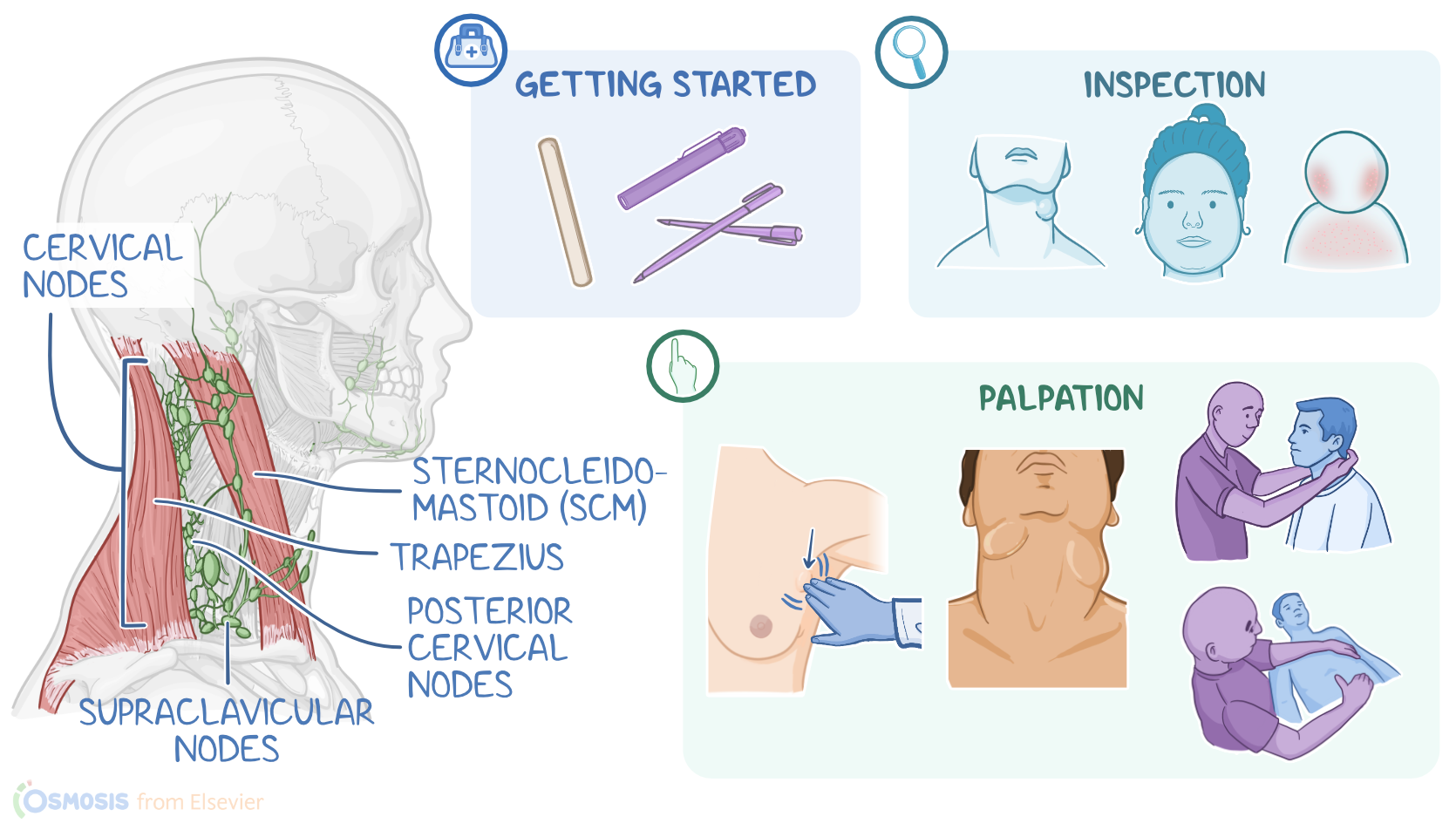
Okay, the supplies you’ll need to assess the lymphatic system include a tongue depressor, pen light, and washable marker or pen.
Then, prepare for the exam by ensuring your client is in a comfortable position, that your hands are warm, and that the temperature in the room is comfortable. Provide privacy by closing the door and curtains, properly draping your client, and only exposing areas of their body as needed to perform your examination.
Before getting started, explain the procedure to your client and be sure to answer any questions they have before obtaining verbal consent. Then, perform hand hygiene and collect your supplies.
Locating the anatomical landmarks of the lymphatic system will help guide the placement of your equipment and hands throughout your assessment. To find the palpable lymph nodes in the head and neck region, start at the base of the skull to locate the occipital nodes. Then, move over the mastoid process to find the postauricular nodes, and then to the front of the ear to find the preauricular nodes.
Next, the parotid and tonsillar nodes are accessible at the angles of the mandible; the submandibular nodes are halfway between the tip and angle of the mandible; and the submental nodes are just behind the tip of the mandible.
Moving down the neck, locate the cervical nodes around the sternocleidomastoid muscle; the posterior cervical nodes along the anterior border of the trapezius muscle; and then move to the supraclavicular areas, which are in the angles between the clavicles and the sternocleidomastoid muscle, to locate the supraclavicular nodes.
Next, move to the upper extremities in the pocket of both axillae to assess the axillary nodes as well as in the space between the triceps and biceps muscles to find the epitrochlear nodes.
Lastly, in the lower extremities, locate the superior superficial inguinal nodes and inferior superficial inguinal nodes bilaterally in each groin, and the popliteal nodes, which exist in the popliteal fossae.
Alright, assessment of the lymphatic system includes inspection and palpation.
Okay, begin your assessment with inspection. Typically, you are not able to visualize lymph nodes or the lymph system. However, visible abnormalities of the lymphatic system usually fall into one of three categories: lymphadenopathy, which is enlargement of lymph nodes, lymphangitis, which appears as reddened lines on the skin, or lymphedema, which is swelling from an accumulation of lymph fluid in the tissues.
Start with the head and neck and move downward, inspecting each area of the body for visible lymph nodes, swelling, and redness.
Next, using a tongue depressor and pen light, inspect the tonsils and adenoids inside the oropharynx, noting their size, color, and shape. Both structures should be pink and symmetrical with an irregular surface.
| PHYSICAL ASSESSMENT - LYMPHATIC SYSTEM | ||
| KEY POINTS | NOTES | |
| DEFINITION |
| |
| GETTING STARTED |
| |
| ANATOMICAL LANDMARKS |
| |
| METHODS OF ASSESSMENT |
| |
| INSPECTION |
| |
| PALPATION |
| |
| NURSING IMPLICATIONS |
| |
No notes for this video yet
Try adding a note below